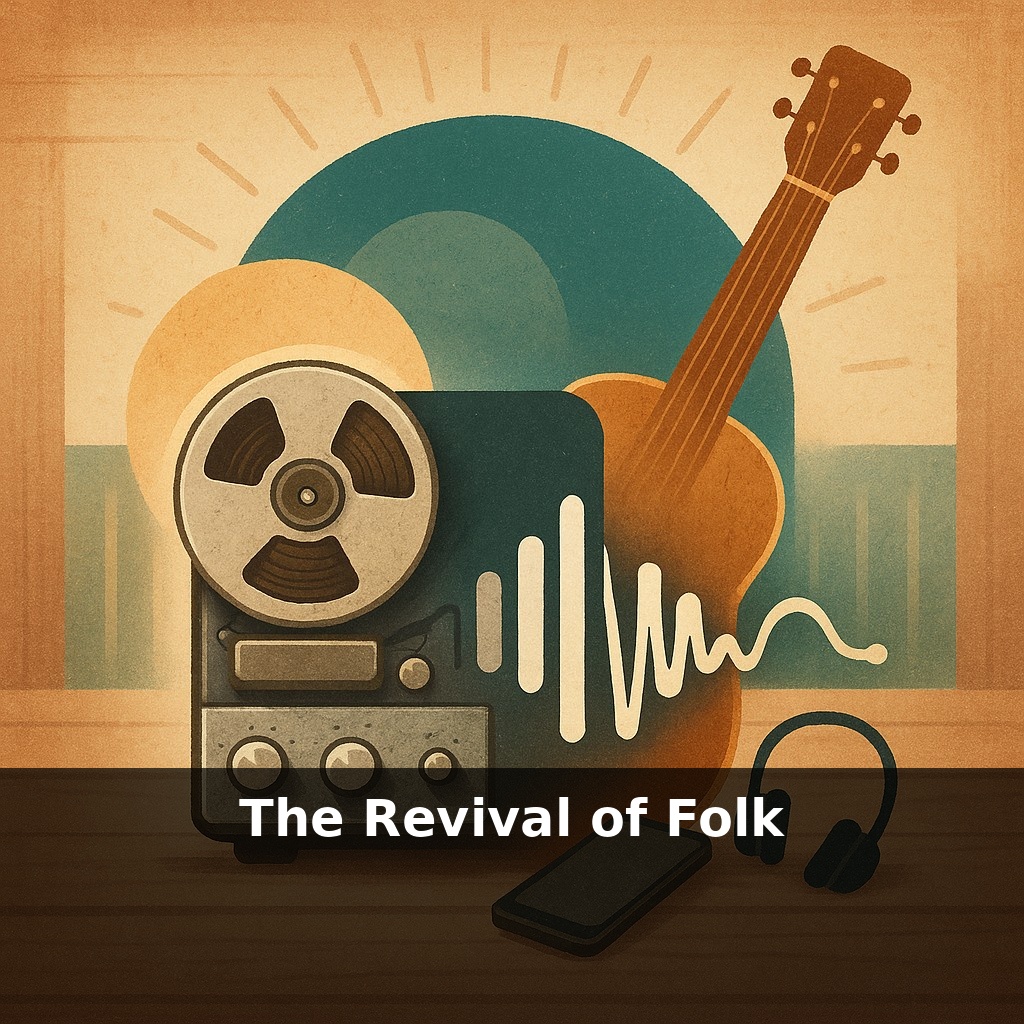
A century-old ballad recorded on a crackling tape suddenly goes viral on a teenager’s playlist. In one moment, a song sung on porches and picket lines is sharing space with glossy pop hits. How did handmade, low-fi storytelling sneak back into the global spotlight?
By 2022, “Americana/Folk” was reportedly Apple Music’s fastest‑growing editorial genre, and Smithsonian Folkways had quietly doubled its streaming numbers in just four years. This isn’t just nostalgia; it’s a shift in what listeners crave from music. Folk’s draw is less about vintage aesthetics and more about people wanting songs that sound like they were written by someone they could actually talk to.
Across continents, young artists are dusting off regional lullabies, protest songs, and work chants, then stitching them into tracks that sit comfortably next to bedroom pop and indie rap. A busker’s ballad might show up in a prestige TV soundtrack; a traditional lullaby might become the hook of a dance track. Instead of being sealed in archives, folk traditions are becoming living toolkits that artists reach for when they want their music to feel grounded, local, and unmistakably human.
In the background, the infrastructure quietly changed first. Streaming platforms stopped being just libraries and began acting like curators, slipping banjo‑laced tracks beside chart pop and algorithmically nudging listeners toward “songs with stories.” At the same time, social feeds filled with front‑facing camera videos of people singing in kitchens, stairwells, and backyards—performances as unstyled as a voice memo. Niche scenes formed around these moments: Celtic fiddle TikToks, indie songwriters reviving murder ballads, queer and Indigenous artists rewording standards for their own communities.
Part of folk’s revival is brutally practical: it’s one of the cheapest genres to start making. You don’t need a full band or a studio—just a half‑decent mic and a story you’re willing to say out loud. For younger artists crushed by rising gear costs and unstable incomes, that stripped‑down setup is a feature, not a bug. It means they can move fast, release often, and test songs in public without waiting for a label to sign off.
But the resurgence isn’t only about access; it’s about flexibility. Folk has always been less a fixed sound than a permission slip: “Use whatever tools you have to say what your people need said.” Today that translates into hybrid records where a Venezuelan cuatro meets 808 drums, or where an Irish ballad tune quietly structures a song about climate anxiety. The “rules” are informal: keep the lyrics front‑and‑center, keep the emotional stakes high, and don’t worry if the instrumentation wanders.
That looseness matters for communities whose histories were sidelined in earlier folk booms. Black string‑band players, Sámi joik singers, Roma brass groups, South Asian diasporic storytellers—many are now framing their music consciously as folk, not world or fusion. Tagging it that way on platforms, festival lineups, and grant applications isn’t just semantics; it plugs them into networks like Folk Alliance International, which has grown steadily as organizers realize the word “folk” can—and should—hold multitudes.
The political edge is sharpening again, too. Where a previous generation might have written generalized “we are the world” anthems, contemporary folk writers are naming specific pipelines, court cases, and politicians in their verses. A song can debut at a rally in the morning, hit a live stream by evening, and circulate as a chant at protests a week later. The feedback loop is tight: organizers commission songs, songs amplify movements, movements give artists new language and audiences.
Unexpected collaborators are fueling the cycle. EDM producers sampling field recordings, rappers inviting choirs that specialize in spirituals, video‑game composers borrowing modal riffs from archival collections—each collaboration quietly updates what counts as folk. It’s less about acoustic purity than about continuity: does this song carry a thread from older voices into a present tense that feels urgent? If the answer is yes, listeners are proving they’re willing to follow that thread almost anywhere.
A concrete way to see this revival is to follow a single song across borders. A songwriter in Seoul might start with a grandparents’ harvest melody, slow it down, and layer it under lyrics about burnout and housing costs. Months later, a DJ in Lisbon chops that same topline into a late‑night remix; a year after that, a community choir in Toronto learns the stripped‑back original from a fan‑made chord sheet and performs it at a neighborhood fundraiser. The “folkness” isn’t in any one version, but in how easily the song slips into new mouths and settings.
Revival also shows up in how people use place. A Berlin producer records friends singing in a subway tunnel, then builds a track around the reverb of the tiles. A Kenyan collective runs “song circles” under a city overpass, treating traffic noise like another instrument. Reviving folk traditions is like sketching with charcoal in a city of neon signs: the tool is ancient, the backdrop unmistakably now, and the contrast makes every line feel more deliberate—and more alive.
Folk’s next chapter may lean less on nostalgia and more on design. City planners are already testing song circles in public parks the way they once added basketball courts—spaces for shared rhythm instead of shared scores. Educators are slipping local ballads into history units as living footnotes. As archives go online, young creators can “crate-dig” with a search bar, sampling forgotten voices the way chefs revive ancient grains on modern menus. The quiet risk: who gets to profit from these rediscovered stories?
Folk’s revival might hinge on whether listeners treat songs less like disposable paper cups and more like handwritten letters—meant to be answered, not just consumed. Your challenge this week: seek out one folk track rooted in a culture not your own, learn its backstory, and share it like a borrowed book you’re responsible for returning well‑kept.