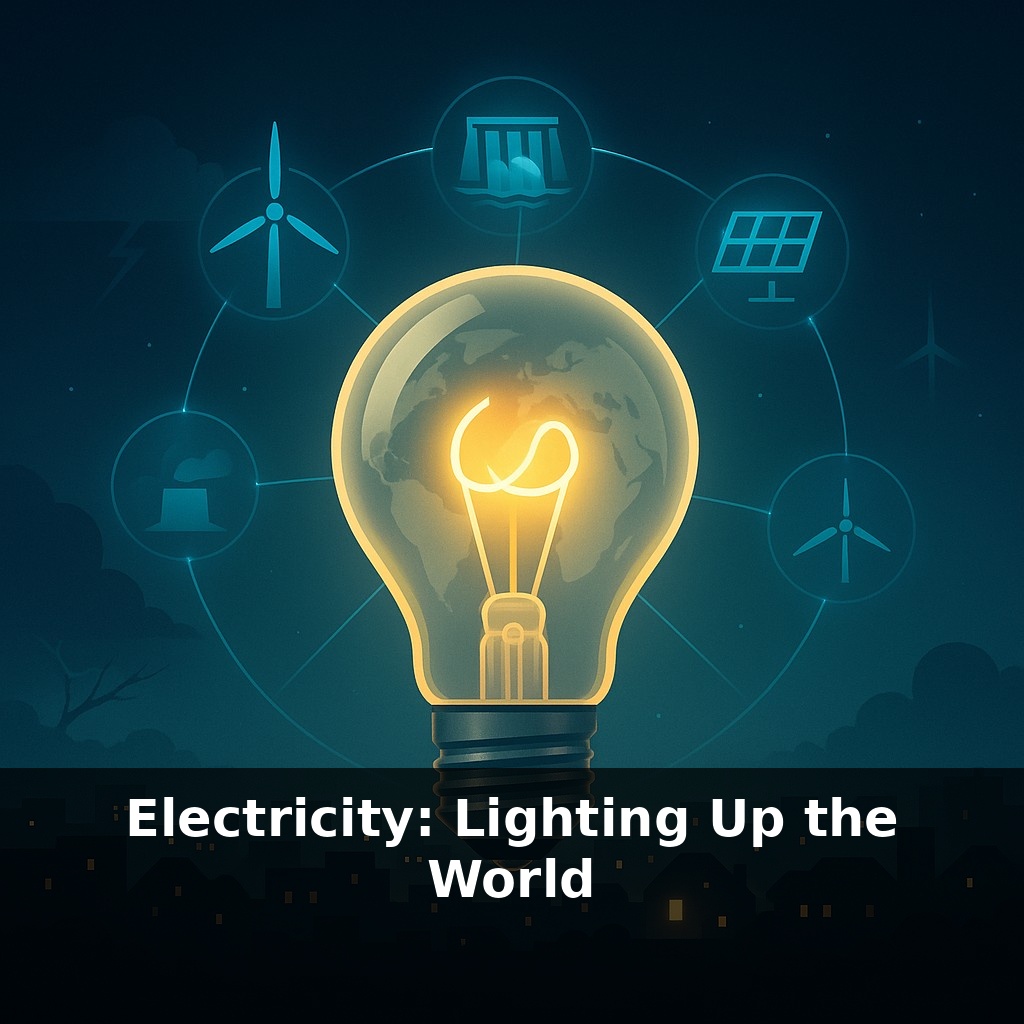
Electricity: Lighting Up the World
📝 Transcript
Right now, as you listen, thousands of kilometers away a storm could knock down a tree—and your lights won’t even flicker. That’s the strange promise of electricity: invisible, fragile in theory, yet so reliable that most of us only notice it for a few minutes a year.
Yet that quiet reliability hides a messy, global choreography. Somewhere, coal is burning, rivers are turning turbines, sunlight is striking silicon, and wind is wrestling with spinning blades—each source feeding a vast, constantly shifting marketplace of electrons. Flip a switch in your bedroom and, in a sense, you’re casting a vote: for a particular power plant, a certain fuel, a specific technology mix. Streetlights, server farms, subway systems—all of them are participants in this live auction of demand and supply. And the grid must respond in real time: every second, everywhere, total generation has to match total consumption almost perfectly. Too little, and systems crash; too much, and equipment can fail. In the background, algorithms predict our habits, operators juggle resources, and new devices quietly negotiate when and how they draw power.
Now zoom in from that vast system to the tiny decisions happening in your own walls. A phone charger left plugged in, a fridge cycling on at 3 a.m., an elevator starting as dozens of kettles boil in nearby kitchens—each is a small “request” that ripples outward. In many cities, these ripples stack into sharp spikes: morning routines, lunch rushes, evening streaming marathons. To keep those spikes from becoming cracks, we’ve layered on new tools: rooftop solar, home batteries, responsive appliances, even electric cars that might one day feed energy back instead of only taking it.
Stand in a city at night and look up: behind every lit window is a different story of how electricity is being used, but they all share the same three basic moves—generation, transmission, and distribution.
Generation is where motion becomes electrical energy. A spinning shaft in a turbine—driven by steam, falling water, or wind—turns a generator so that magnetic fields and coils of wire continually trade energy back and forth. Faraday showed that changing magnetic fields can push charges along a wire; modern power stations simply industrialize that insight on a huge scale. Even solar panels, which have no spinning parts, are doing a similar kind of conversion: incoming light kicks electrons into motion inside a semiconductor so they can join the larger flow.
Once created, that energy has to travel. Transmission lines carry bulk power across long distances at very high voltages, stepping it up and down through transformers like a series of language interpreters passing a message across a continent. Those metal towers marching across rural landscapes aren’t just structural supports; they’re precisely engineered compromises between safety, efficiency, and cost, spaced and shaped to manage electric fields, storms, and even the wingspans of birds.
Closer to where you live, the system branches and narrows. Substations break the bulk flows into smaller streams, routing them through underground cables or neighborhood poles. Protection devices sit everywhere—circuit breakers, relays, fuses—constantly watching for faults: a tree brushing a line, a car hitting a pole, salt spray on an insulator. When something goes wrong, they must decide in fractions of a second which tiny piece of the network to sacrifice so that the rest can keep running.
Inside buildings, yet another layer of translation happens. Voltage is lowered again, divided into circuits, and finally presented at outlets and light fixtures where it meets an extraordinary diversity of loads: motors in elevators and fans, heating elements in stoves, sensitive electronics in laptops and LED drivers. Each device “asks” for power in its own way—steady, pulsating, or in sharp bursts—and the wider system quietly absorbs those quirks, reshaping countless individual demands into a smooth, continuous flow, the way an orchestra turns many distinct instruments into one piece of music.
Stand in front of a single light switch and you’re touching the end of a story that might start in a desert, on an offshore platform, or on a windswept ridge. One flip, and your choice of bulb suddenly matters: an old incandescent quietly turns most of that energy into heat; a compact fluorescent stretches each watt further; an LED squeezes out even more light, staying cool and lasting for years. Multiply that by every hallway, shop sign, and stadium, and efficiency stops being a minor detail and becomes a kind of hidden power plant.
Cities are learning to treat this “invisible plant” seriously. Streetlights that once burned at fixed levels all night now dim when roads are empty and brighten when pedestrians approach. Data centers shift some tasks to cooler hours to avoid adding strain during local peaks. Even households join in: smart plugs delay a dishwasher cycle, heat pumps pre‑warm a home before demand surges, and EV chargers slow down briefly when neighborhoods run hot.
Your challenge this week: notice three moments when something could have run later, slower, or smarter—and didn’t.
The next frontier isn’t just cleaner electrons, but giving them better “jobs.” As heating, transport, and industry plug in, demand patterns will reshape cities: quiet streets hiding dense EV charging, warehouses roofed with panels, office towers acting as giant thermal batteries. Policy, not physics, will decide who benefits: will remote villages leapfrog straight to solar microgrids, or be left in the dark while data centers sip flawless power like VIP guests at an endless reception?
In the end, every outlet becomes less a passive socket and more a vote for the world you want lit. As homes, cars, and factories plug into cleaner sources, the story shifts from “Can we keep the lights on?” to “What kind of light do we choose?” The next switch you flip is a tiny steering wheel, nudging billions of future nights a shade brighter or fairer.
Start with this tiny habit: When you flip a light switch on at home tonight, pause and say out loud which energy source is probably powering it (like “coal,” “natural gas,” “solar,” or “wind”). Then, once a day when you plug in your phone, glance at the wattage label on the charger and just note the number in your head—no lists, no apps, just a 2-second mental check. This tiny pause will quietly train your brain to connect everyday electricity use to where it actually comes from and how much power it needs.
From this course
Modern Paradigm Shifts: Innovations and Ideas
6 episodesUnlock all episodes
Full access to 6 episodes and everything on OwlUp.
Subscribe — $1.99/monthLess than a coffee ☕ · Cancel anytime