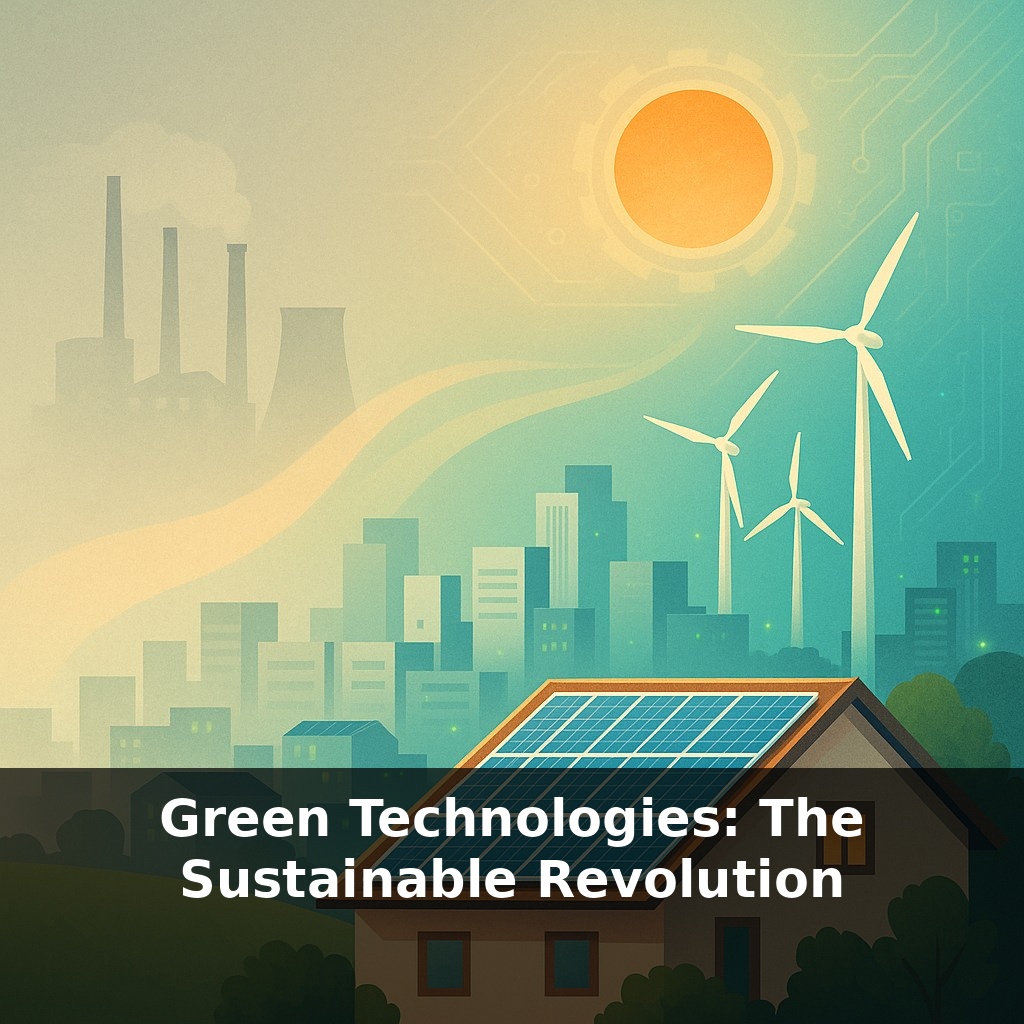
Right now, more new power plants run on sun and wind than on coal or gas. A few decades ago that sounded utopian. In this episode, we’ll step into factories, cities, and even your home to trace how green tech quietly became a serious economic powerhouse.
A decade ago, installing rooftop solar was like splurging on a luxury sports car; today it’s edging toward family-sedan territory—and still getting cheaper. That same cost freefall is reshaping factories, data centers, and even the materials in your shoes and smartphones. Behind the headlines about climate targets, a quieter shift is underway: entire supply chains are being rewired to squeeze more value from every joule of energy and every kilogram of raw material. Cities test buildings that generate more power than they use; manufacturers lease products, then take them back to harvest the materials; farmers deploy sensors to cut fertilizer and water use. This isn’t just about “being green.” It’s about a new industrial logic where wasting energy or resources starts to look as outdated as dial‑up internet.
In this episode, we’ll zoom out from individual gadgets and projects to see how entire systems are being redesigned around efficiency and reuse. Think of city planners quietly redrawing maps so electricity, heat, transport, and waste streams interlock like a carefully tuned orchestra instead of a noisy jam session. Policies, too, are shifting from one‑off subsidies to long‑term rules that reward low‑carbon choices by default—shaping what factories build and what stores stock. Meanwhile, investors are treating emissions like financial risk, nudging capital away from assets that could soon be stranded.
In boardrooms and city halls, the new question isn’t “Is green tech real?” but “How fast can we retool without breaking things?” That tension shows up most clearly in three arenas: infrastructure, materials, and rules.
Start with infrastructure. As more variable power floods into networks, grid operators are turning into air‑traffic controllers for electrons. They juggle giant battery parks in California that can power hundreds of thousands of homes for hours, neighborhood‑scale batteries in Germany, and fleets of electric buses in China whose charging times are shifted minute‑by‑minute to stabilize local voltage. Data and software become as important as steel towers, making “virtual power plants” out of thousands of small devices that collectively act like a single, flexible generator.
Then there’s the materials revolution. Only a sliver of plastics and metals ever come back into circulation today, so a new class of companies treats waste as a high‑grade ore. Swedish firms experiment with fossil‑free steel made using hydrogen; start‑ups in India turn crop residues into packaging that can compost instead of clogging rivers; Japanese manufacturers design electronics so key components slide out like drawers for quick harvesting. The goal is not just recycling more, but redesigning products so recycling becomes the easy, profitable default.
Rules and money quietly steer all of this. Carbon prices in Europe, tax credits in the United States, and clean‑energy mandates in places like Chile and South Korea flip investment decisions: suddenly it’s riskier to bet on a coal plant that could be regulated out of existence than on a wind farm whose fuel is free. Central banks warn that climate‑exposed assets threaten financial stability, so insurers and pension funds start asking awkward questions about 30‑year fossil projects.
The twist is that adoption rarely follows a smooth line. It crawls, then sprints. Once electric buses prove cheaper over their lifetime in one city, others copy the playbook; once one big retailer demands low‑carbon cement, suppliers scramble to offer it everywhere. The transition is uneven and contested—but economies, piece by piece, are being rewired to reward using less and reusing more.
Walk through a modern sneaker store and you’re seeing the new paradigm in miniature. One brand weaves uppers from recycled ocean plastic; another offers a “return to remake” label that turns worn pairs into playground flooring. In fashion, rental and resale platforms scale this logic, treating closets as circulating libraries rather than landfills-in-waiting. Buildings follow suit: a Dutch office block is catalogued down to each beam and panel so, when renovated, it can be disassembled like a carefully kept Lego set and rebuilt elsewhere. In industry, breweries sell spent grain to mushroom farms, which then supply restaurants across the street—a tight little loop of calories and cash. Data centers in Scandinavia pipe their waste heat into nearby homes, effectively turning Netflix binges into neighborhood heating systems. The logic spreads: designers specify screws instead of glue so products can be opened; cities publish “materials passports” so nothing valuable leaves as anonymous trash. Step by step, waste becomes a design flaw, not an inevitability.
Cities become the quiet test labs. Parking lots turn into shaded micro‑grids; school roofs host student‑run energy clubs; old landfills sprout solar and bike parks instead of methane. Streetlights dim when no one’s around, cutting bills and revealing just how much excess we normalized. As green tech spreads, zoning codes, building permits, and even mortgage rules start rewarding designs that leave neighborhoods cleaner, cooler, and cheaper to run each decade, not just at move‑in day.
The next frontier is less about inventing gadgets and more about redesigning habits, contracts, and city rhythms around them. Think of transit passes that bundle bike‑share, buses, and car‑share like a streaming subscription, or neighborhoods timing heavy power use to local sun and wind. As these experiments stack, “sustainable” shifts from niche label to boring default.
Before next week, ask yourself: Which single green technology from the episode—like rooftop solar, home battery storage, or smart thermostats—could realistically fit into my home or workplace this year, and what’s the very first step I can take today to explore it (getting a quote, checking local incentives, or comparing products)? If I had to cut my personal carbon footprint by 10% using ideas from the episode (renewable energy, efficient appliances, electric transport, or community solar), which two changes would give me the biggest impact for the least disruption to my current lifestyle? Who in my circle (a neighbor with panels, a coworker with an EV, or a local sustainability group) could I reach out to this week to learn from their real-world experience with one of these technologies, and what exactly will I ask them?