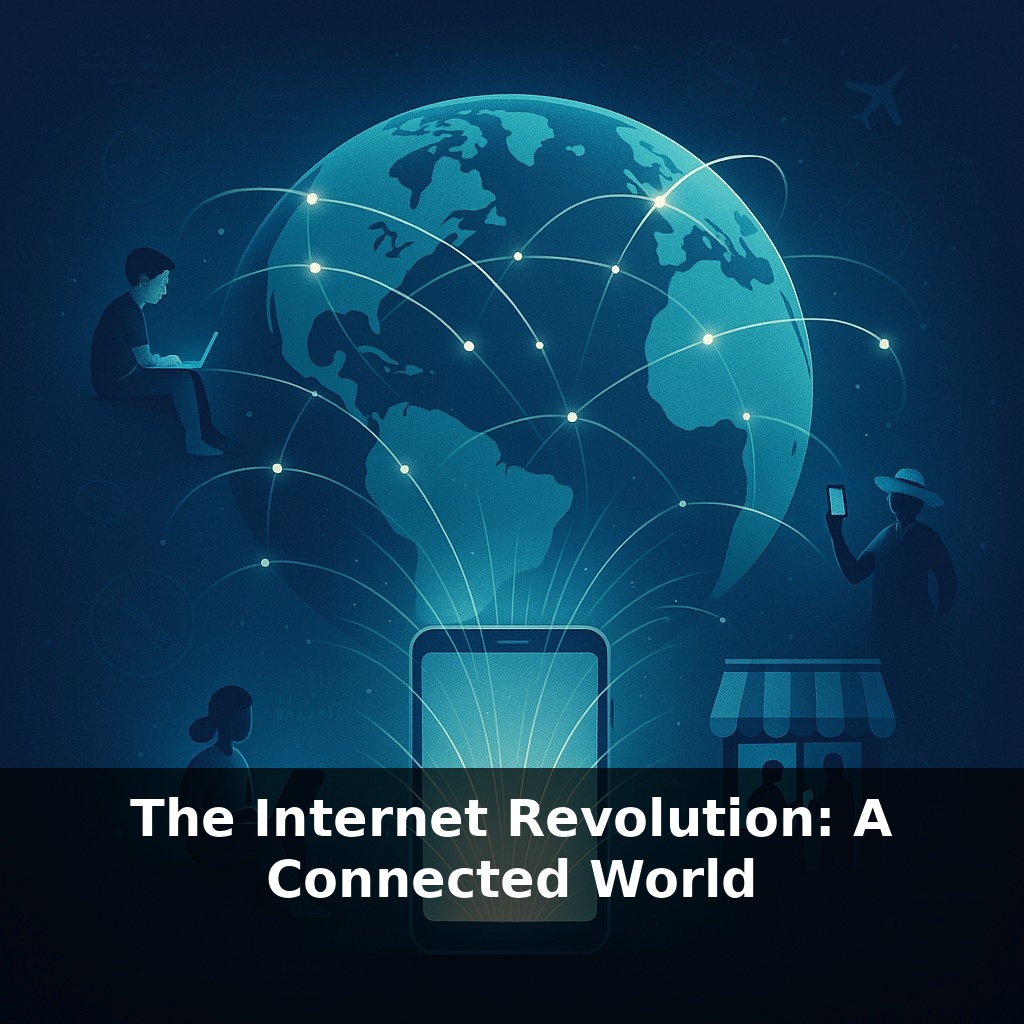
Half of humanity wakes up each day, reaches for a screen, and quietly plugs into the same invisible system. No passport, no ticket, no central switchboard—yet it almost never fails. In this episode, we’ll trace how a glitchy research experiment became that silent daily ritual.
We don’t just *use* this network—we rearrange our lives around it. A teenager in Lagos learns to code from a tutor in London. A farmer in India checks tomorrow’s prices in Dubai before deciding what to plant. A small shop in Bogotá sells to customers it will never meet, in currencies it will never hold. The Internet quietly turns local decisions into global ones.
Yet this transformation didn’t come from a master plan. It emerged from a set of simple, shared rules that let anyone plug in, experiment, and, sometimes, accidentally change the world. When Tim Berners-Lee released the Web’s source code for free, he wasn’t launching a trillion-dollar industry; he was sharing a tool.
In this episode, we’ll follow how those tools, rules, and countless personal choices converged—shifting power, opportunity, and even the boundaries of community itself.
Those shared rules did something subtle to our sense of place and time. Messages stopped “traveling” and began arriving almost instantly, shrinking delays that once shaped business, news, and even friendships. A breaking story in one city could ripple worldwide before local radio finished its hourly bulletin. As smartphones spread, access moved from desks to pockets, and being “online” stopped feeling like a separate activity. You could negotiate a contract, join a protest, or fall in love while standing in a grocery line—each tap quietly stitching new threads into a constantly shifting, collective story.
The story begins in 1969 with a failure. Engineers tried to send the word “LOGIN” from one computer at UCLA to another at Stanford. The system crashed after the first two letters—“LO.” That stuttered start hinted at what was coming: a world where machines could talk across distance, even if they had to learn the hard way.
Through the 1970s and 80s, researchers like Vint Cerf and Bob Kahn worked on something deceptively simple: a common way for different kinds of machines and networks to pass tiny chunks of data back and forth. Instead of one giant, centralized system, they imagined many independent networks agreeing on shared “grammar” so their messages could interoperate. That idea solidified into TCP/IP, and with it, a radical principle: the network itself would do as little as possible. Intelligence would live at the edges, in the devices and applications people built.
That “end-to-end” design quietly redistributed power. You no longer needed permission from a telecom monopoly to try something new. If your machine could speak the protocol correctly, you could experiment—build email, file sharing, or eventually social media—without asking anyone in the middle.
Then, in the early 1990s, Tim Berners-Lee added another layer: a way to link documents with clickable references and a standard language for describing pages. Crucially, he didn’t patent it or charge licensing fees. By releasing the code, he turned a lab convenience into a canvas that anyone with a dial‑up modem could paint on.
As more people joined, a physical infrastructure grew almost out of sight. Phone lines gave way to fiber-optic strands thinner than a human hair, carrying pulses of light across continents and under oceans. Today, thousands of these cables crisscross the seabed, connecting data centers that hum quietly on the outskirts of cities. Signals dive underwater, jump across countries, and surface in your pocket so fast that the path feels irrelevant.
Yet behind every tap is a choreography of routers choosing paths, servers responding to requests, and packets taking different routes before reuniting at their destination—like individual brushstrokes that only reveal the full picture when you step back.
A single post from a teenager can spark a street protest, shift a company’s stock price, or launch a fashion trend by the weekend. A coder in São Paulo publishes an open‑source library; days later, it quietly lives inside banking apps, climate models, and indie games built continents away. This isn’t just communication—it’s compounding collaboration.
Consider Wikipedia: millions of volunteers, no central newsroom, yet an encyclopedia that updates faster than most textbooks can be printed. Or Shopify: tools built by a small Canadian team now underpin storefronts for artisans in Hanoi, vintage dealers in Berlin, and family bakeries in Nairobi. A musician uploads a track from a bedroom studio, and an algorithm slips it into playlists heard on commuter trains in Tokyo and cafés in Buenos Aires.
Think of this whole system less as a machine and more as a coral reef: billions of tiny contributions, each small on its own, layering over time into something vast, intricate, and alive—shaped not by a single architect, but by countless, overlapping intentions.
Soon, streets, farms, factories—even our bodies—will quietly stream data, like cities lit at night, revealing hidden patterns of motion, stress, and need. Hospitals may spot outbreaks days earlier; buses could reroute themselves in storms; irrigation might adjust leaf by leaf. But who owns the glow of that data, and who stays in the dark? The coming struggle isn’t just faster connections—it’s over whose realities get measured, optimized, and remembered.
Soon, even small choices—liking a song, scanning a receipt, pausing a video—will leave trails, like footprints in fresh snow. Those traces can guide better maps for health, learning, and cities, or harden into walls of profiling and exclusion. As more of life reflects through screens, the open question is: how much of that mirror do we get to shape?
Here’s your challenge this week: Pick one online community you’re already part of (Discord server, subreddit, Slack group, or niche forum) and move from “lurker” to “contributor” by posting *one* genuinely helpful comment or resource each day for the next 5 days. Use at least one internet-native tool mentioned in the episode—like a shared doc, collaborative whiteboard, or open-source repo—to co-create or improve something with others (for example, adding a suggestion, fixing a typo, or sharing a template). By the end of the week, message one person from that community to start a 15-minute video or voice chat about a shared interest, turning a weak online tie into a real connection.