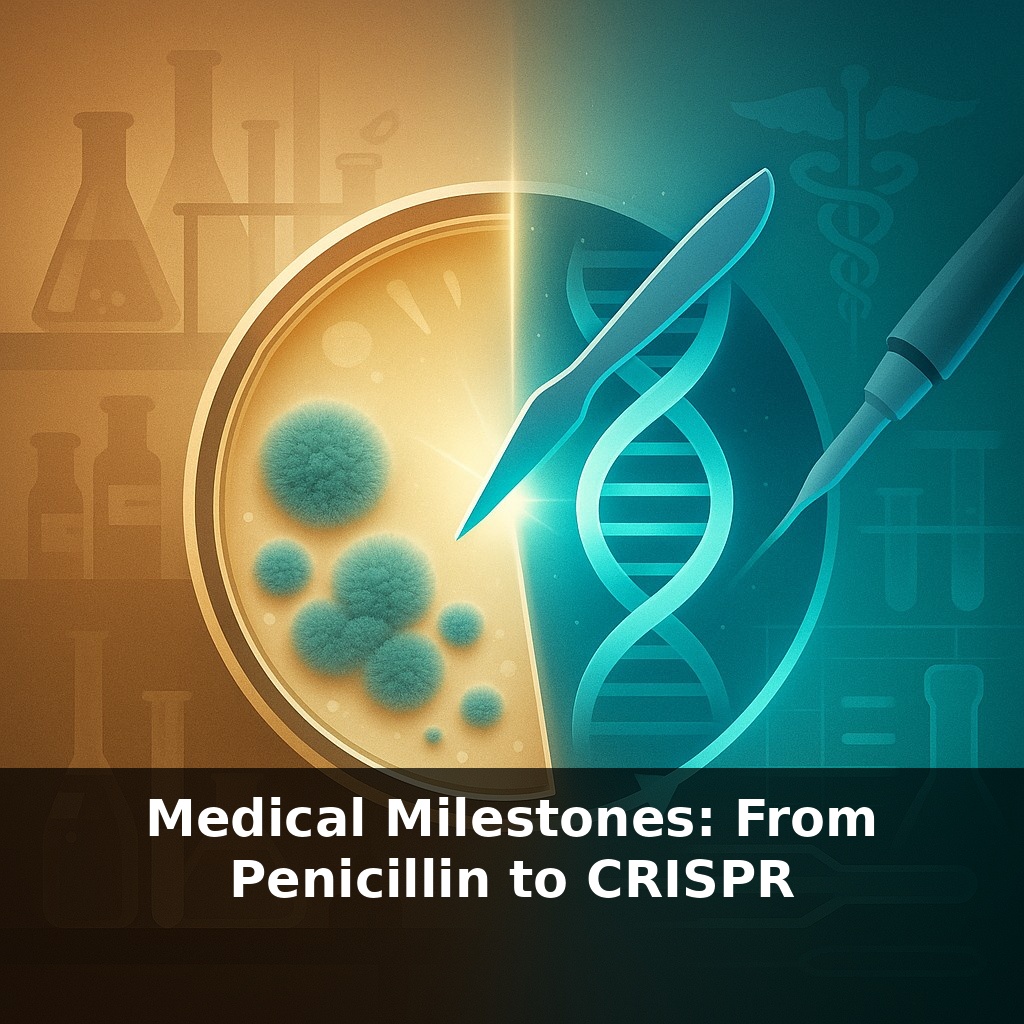
In one human lifetime, we went from soldiers dying of a scraped knee to scientists editing genes for sickle‑cell disease. In this episode, we’ll step into two laboratories, decades apart, to see how a messy mold and a molecular scalpel rewired modern medicine.
Penicillin and CRISPR didn’t just change treatments; they changed what we dare to attempt. Once infections could be tamed, surgeons pushed into longer, riskier operations—organ transplants, open‑heart surgery, joint replacements. Hospitals, once cautious workshops of last resort, began to feel more like engineering bays where damaged parts could actually be repaired, not just endured.
Today, CRISPR is nudging us toward a similar turning point. It’s not only about rare diseases in distant clinical trials; it’s reshaping how we think about everything from food allergies to cancer screening. Research teams are testing CRISPR‑based diagnostics that can detect viruses almost as quickly as a home pregnancy test, and crops are being tuned to survive heat and drought. As these tools scale, they start to feel less like miracles and more like infrastructure—quietly rewiring what’s “normal” in health and daily life.
By the time antibiotics were widely available, they didn’t just save lives in the operating room—they reshaped everyday confidence. Parents were less terrified of a child’s fever, soldiers survived wounds that once meant certain death, and routine dental work no longer carried the same mortal risk. We’re at a quieter, early version of that shift with today’s genetic tools. Instead of waiting passively for illness, researchers are mapping where our DNA makes us fragile, the way urban planners mark flood zones, then testing whether targeted edits could move those danger lines.
Antibiotics didn’t spread because Fleming had a eureka moment; they spread because, during World War II, governments treated drug manufacturing like building ships or planes. Industrial chemists figured out how to grow Penicillium in giant tanks using corn steep liquor, a cheap by‑product of corn processing. Yields jumped by orders of magnitude. By 1944, a single American factory could produce more penicillin in a day than the entire world had in 1941.
That industrial story matters, because it’s the difference between a clever lab trick and a societal turning point. The same pattern is quietly repeating with today’s gene‑focused tools. Early experiments were slow, bespoke, almost artisanal. Now, cloud labs, DNA synthesis companies, and automated sequencing pipelines are doing for genetic work what fermenters and factory chemistry did for early anti‑infective drugs: making them fast, predictable, and, crucially, boring enough to rely on.
Once antibiotics became reliable, entire medical specialties reconfigured themselves around them. Orthopedic surgeons embraced metal implants knowing infections were less likely to turn a broken bone into a death sentence. Public health agencies rolled out mass treatment campaigns for diseases like syphilis and rheumatic fever. The drug was just one piece; new guidelines, training programs, and supply chains completed the transformation.
Something similar is starting around programmable DNA tools. Cancer centers are building “molecular tumor boards” that routinely examine a patient’s mutations and match them with tailored trials. Agricultural institutes are planning breeding programs on laptops first, fields second. Even conservation biologists are debating whether genetic interventions should sit alongside protected habitats and captive breeding.
But there’s a shadow side to scalability. Overuse of broad‑spectrum drugs has driven resistant “superbugs” that now haunt intensive care units. That history is shaping today’s guardrails: ethics review boards, moratoria on editing human embryos in many countries, and debates about whether some edits should remain off‑limits no matter how easy the technology becomes.
In the 1940s, one British hospital tracked deaths from routine hip‑fracture surgery before and after widespread drug access. Mortality plunged so sharply that administrators rewrote discharge plans: patients were suddenly expected to go home, not to hospice. That quiet paperwork change signaled a deeper shift—medicine moving from “crisis management” to “recovery planning.”
Today’s genome‑focused tools are nudging similar rewrites in very different places. In Nigeria, researchers are testing whether tweaking local mosquito populations could cut malaria transmission without massive pesticide spraying. Cancer centers in the US and Europe are piloting blood tests that look for genetic traces of tumors long before symptoms, reshaping the idea of an annual checkup.
Think of a coastline artist who once only painted after storms; now, with satellite data, they can sketch where the waves will hit years in advance and help redesign the seawalls themselves. The work stops being solely about treating damage and starts to include reshaping the landscape that makes damage likely.
Hospitals and labs may soon face choices that feel less like picking a drug and more like urban planning: which genetic “roads” to widen, which to close, and who gets to move freely. Insurance models, patent rules, even medical training will need rewiring as therapies target ever‑smaller patient groups. Low‑resource regions could leapfrog if open protocols spread, or be locked out if tools stay gated—turning biology’s new toolbox into either a global equalizer or a fresh fault line.
As new therapies move from rare labs to routine clinics, each approval is less a finish line than a trail marker. Some paths will dead‑end; others will fork into uses we didn’t intend—like off‑label apps for the genome. Your challenge this week: notice where today’s “last‑resort” treatments already hint at becoming tomorrow’s standard tools.