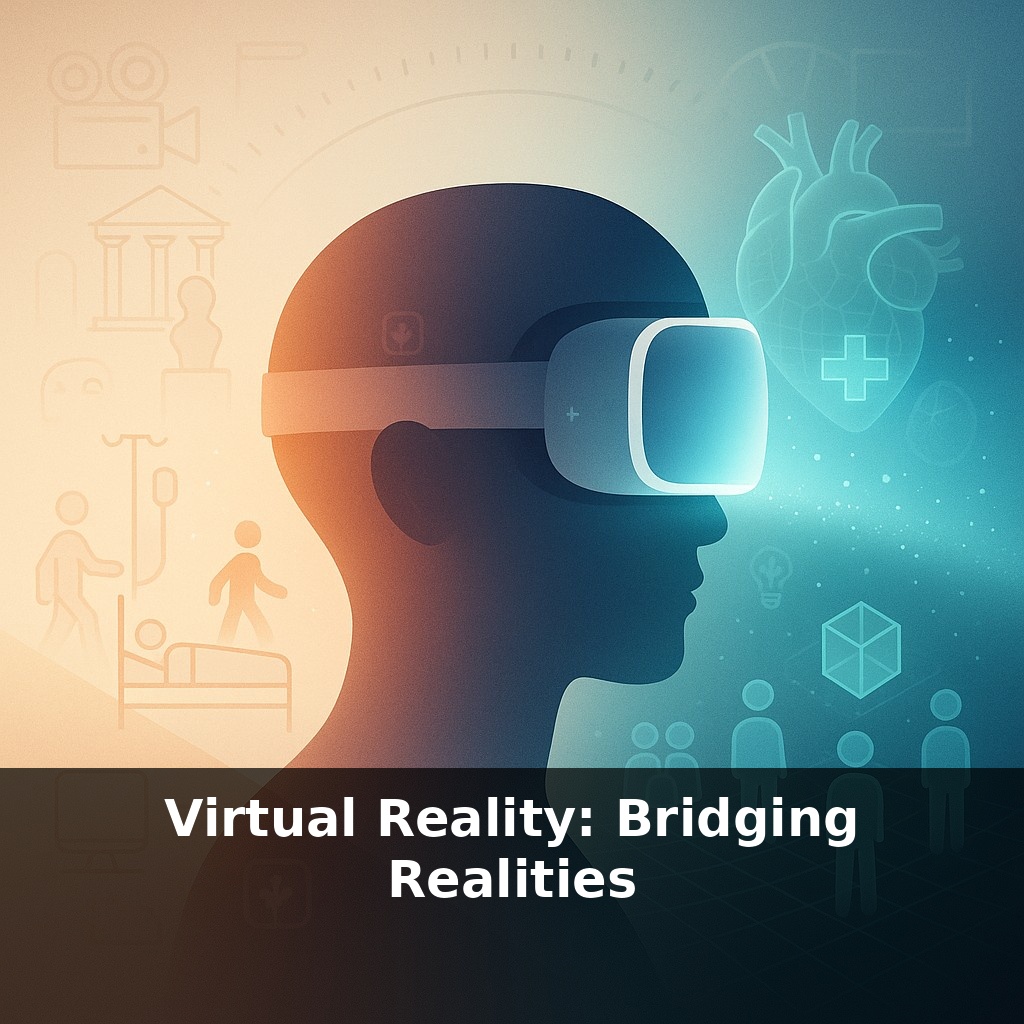
Right now, somewhere in a hospital, a patient is walking again for the first time—without leaving their bed. In another room, a new hire is defusing a virtual crisis that never really happens. One technology quietly sits over their eyes, yet rewires how they learn and heal.
A 3-minute museum visit that never happened. A surgical rehearsal on a heart that doesn’t exist. A meeting where no one booked a flight, yet everyone “stood” around the same prototype. VR is slipping into these in‑between spaces of daily life—not as a spectacle, but as quiet infrastructure.
Instead of asking “is this real?”, a better question is “what counts as real experience?” When your memory file for “first time presenting to a hostile audience” comes from a headset session, your brain doesn’t label it “fake”; it just stores stress, tactics, outcomes.
We’re entering a phase where entire careers, friendships, even phobias will be shaped by events that played out in digital rooms. That shift isn’t just technical; it’s social, economic, and ethical. Who designs those rooms? Who owns the data from what you do inside them? And how do we calibrate a life lived across overlapping realities?
In the past, new media mostly rearranged how we consumed things: radio compressed distance, TV compressed time, smartphones compressed attention. VR quietly compresses *presence*. It lets a nursing student, a forklift operator, and an architect all rehearse high‑stakes decisions without high‑stakes consequences. The constraints are shifting too: headsets are getting lighter, content is moving to the cloud, and standards like OpenXR promise that today’s virtual classroom or factory won’t be stranded in yesterday’s hardware.
Walk through three current VR frontiers and you start to see where this “quiet infrastructure” is actually being laid.
First: **skills that are too risky, rare, or expensive to practice for real.** A refinery explosion, a neonatal emergency, a Black Friday retail crush—these are events you can’t stage safely or repeatedly. Yet companies like Walmart, airlines, and hospitals now run people through these edge cases dozens of times in headsets. The value isn’t spectacle; it’s the ability to pause, rewind, and branch. What if the trainee misreads a gauge? What if a customer panics instead of complies? Traditional training shows the “happy path.” VR lets you inhabit the messy tree of what‑ifs.
Second: **therapy that leans into fear instead of skirting it.** Phobia treatment used to mean hunting for spiders or booking actual flights. Now clinicians dial up controlled exposures: a high balcony, turbulence, a crowded party. Heart rate spikes, palms sweat, yet a single tap can freeze the scene or reduce intensity. For PTSD or chronic pain, environments can be tuned to distract, soothe, or gradually confront triggers. The controversial question here isn’t whether it “feels real enough”—it’s who decides the dose, and what happens when insurers start preferring virtual exposure because it’s cheaper to bill.
Third: **work that treats location as optional but embodiment as non‑negotiable.** A dispersed engineering team can stand around a shared engine model, peel off layers, annotate components, and test ergonomics in ways that flat video calls can’t match. In construction, crews rehearse site walkthroughs before ground is broken, spotting line‑of‑sight issues or safety hazards early. For some firms, “first day on the job” already starts in a headset: navigate the warehouse, meet a virtual supervisor, practice lock‑out procedures.
Threaded through all this is the emerging **stack**: lighter optics, eye‑tracking that reshapes what gets rendered, cloud servers pushing scenes to slim clients, open standards promising that a lesson designed today still runs on tomorrow’s hardware. The more seamless that stack becomes, the less you notice the headset—and the more debates shift from “does this work?” to “who benefits, who is excluded, and what counts as enough consent when your gaze, gestures, and micro‑hesitations are all being logged?”
A firefighter in training now “walks” through ten burning buildings before seeing one in person, learning how smoke curls around stairwells and how fast visibility collapses when a door opens the wrong way. A logistics planner steps into a full‑scale cargo hold, rearranging pallets until loading time and fuel use drop measurably. A language learner practices in a bustling virtual market, haggling and mispronouncing in front of AI shopkeepers who never lose patience or switch to English to “help.”
Urban planners test different street layouts by standing at kid‑height on a virtual crosswalk, watching whether simulated drivers really slow down. Artists sketch sculpture in mid‑air, then 3‑D print the version that still feels right after they’ve walked around it from every angle. Think of it less as an escape hatch and more as building a second trail system in the same forest: another set of paths you can take to reach skills, empathy, and decisions—often faster, sometimes more safely, but never entirely without consequence.
As headsets shrink and networks speed up, “going in” could feel as casual as opening a browser tab. Instead of rare field trips, students might swap classrooms like streaming playlists, while neighborhoods hold meetings in shared models of their own streets. Artists could ship worlds instead of canvases, and small towns might host global festivals without a single tourist flight. The tension: when reality becomes layered, who gets to decide which layer is the default, and which voices shape its rules?
VR’s next frontier may be less about headsets and more about habits: tiny rituals, like a five‑minute “walk” before a hard call or a shared prototype review at lunch. As these moments stack up, our calendars start to look like layered maps—overlapping routes through tasks, relationships, and places we’ve never physically stood, yet still helped shape.
Here’s your challenge this week: Spend 20 minutes in a social VR app like VRChat or Horizon Worlds and have one real-time conversation with a stranger about something you both care about (games, art, music—your pick). Before you log in, choose one specific intention—either to practice empathy (by mostly asking questions) or to practice presence (by focusing on body language, tone, and environment). Right after you log out, rate the interaction from 1–10 on how “real” it felt and decide one concrete tweak you’ll make for your next VR session to deepen that sense of connection.