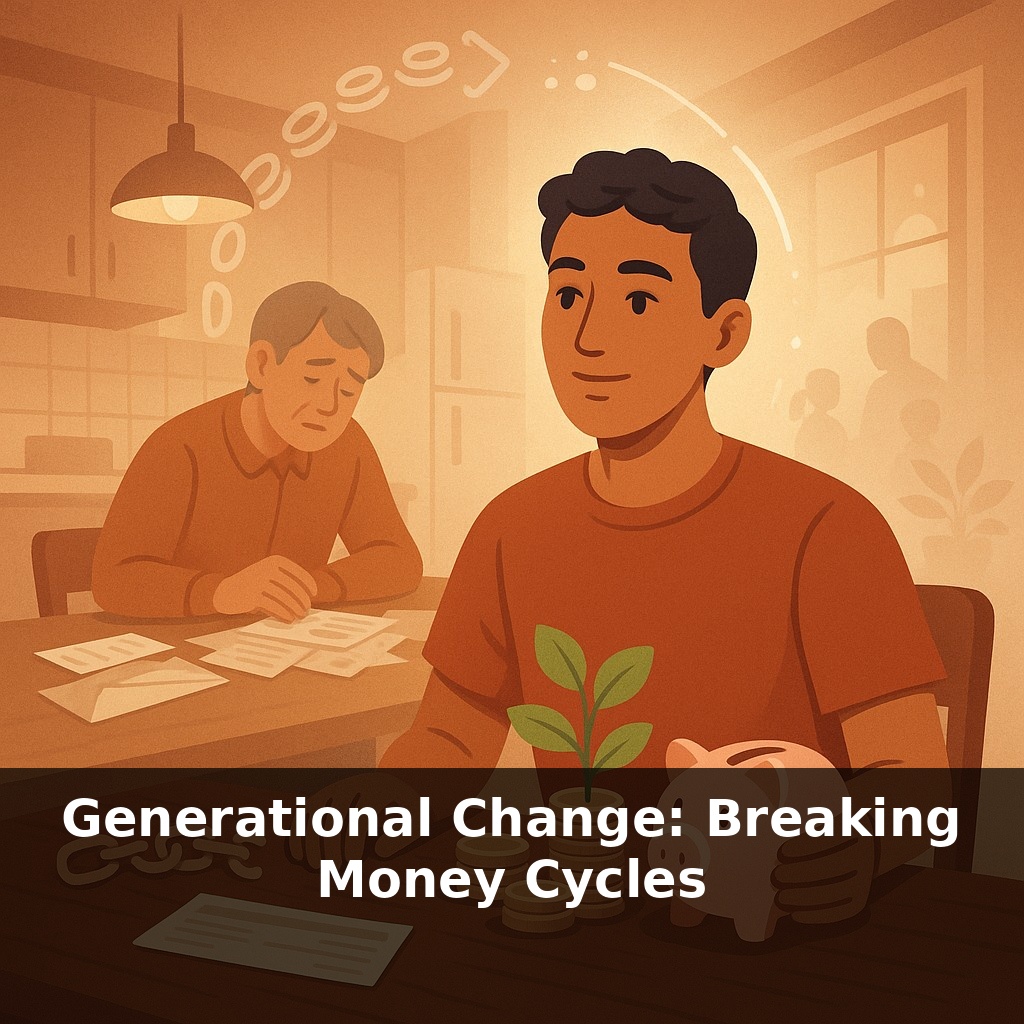
About half of your money habits were already shaped before you earned your first paycheck. A stressed parent at the kitchen table, a quiet conversation about rent, an offhand comment about “people like us” and money—each moment quietly scripting how you save, spend, and dream today.
Seventy percent of wealthy families lose their money by the second generation, and ninety percent by the third. At first, that sounds like proof that “keeping money” is just as hard as “getting money.” But it’s really evidence of something deeper: every family is running a quiet money script in the background—assumptions about risk, security, generosity, and what’s “normal” for people like us.
Those scripts don’t just shape what we do with each paycheck; they shape what we expect from ourselves and from the world. One family treats a bonus like a fragile snowflake—beautiful, temporary, meant to be enjoyed before it melts. Another treats it like a brick—one more piece in a wall they’re determined to build.
The research is clear: these patterns are powerful but not permanent. They can be edited, upgraded, and—over time—replaced with a new default for your kids and theirs.
Some of those inherited scripts are loud—“debt is evil,” “rich people are greedy.” Others are quiet, buried inside everyday choices. Do you round up when tipping, or calculate to the cent? Do you treat a tax refund like a sale at your favorite store or like a chance to clear a lane on a crowded highway? None of these choices are random. They’re shaped by what you saw modeled, and by the options your family actually had. The key shift now isn’t blame; it’s curiosity. Instead of “why am I like this with money?” try “who did I learn this from—and does it still serve me and my people?”
Most people think “breaking cycles” means earning way more than their parents. Income helps, but the data say something quieter is doing heavy lifting: what you *do* with whatever comes in, and what tools you can actually reach.
Researchers estimate roughly half of your wealth position can be predicted by your parents’ wealth. That sounds discouraging until you notice the flip side: the other half is still in play. That “in play” space is where mindset, access, and systems collide.
Start with access. Two families earn the same $55,000. One job offers a 401(k) with automatic enrollment and a match; the other offers nothing. In the first, money slips into an investment account before it ever hits checking. Over ten or twenty years, that quiet autopilot builds a cushion, then options: a down payment, a business idea, a semester of college covered in cash. In the second, every dollar has to fight for survival against rent, groceries, and emergencies. One household gets compounds returns; the other gets compound stress.
Then look at small structural boosts. A child with a basic savings account in their name is more likely to attend college—not because the balance pays full tuition, but because the presence of an asset changes expectations and decisions all the way through school. College becomes default, not fantasy. That expectation nudges course choices, friendships, and risk-taking in ways that don’t show up in a monthly budget, but absolutely show up in a lifetime balance sheet.
Programs that combine new beliefs with these kinds of tools move the needle fastest. When someone learns how credit actually works *and* gets help disputing errors and setting up automatic payments, their score climbs. A higher score lowers borrowing costs, which frees up cash to save or invest, which makes the next emergency slightly less catastrophic. The cycle that once spun downward slowly tilts upward.
The key theme across successful families and successful interventions is this: they don’t rely on willpower alone. They install rails. Defaults that quietly protect the next version of you—and eventually, the next generation—from your current fears and limitations.
Consider three quiet “cycle-breakers” that show up in real families, not theory.
First, the aunt who opens a $25 custodial investment account for every niece and nephew, then screenshares once a year to show how it grew. She isn’t just gifting money; she’s normalizing ownership, questions, and long-term thinking.
Second, the rideshare driver who routes every third payout straight into an online savings pot labeled “Next Move.” No drama, no manifesto—just a repeated choice that slowly changes what “emergencies” feel like, and what options exist when a landlord raises the rent.
Third, the couple who decide that every tax refund funds one “today upgrade” and one “tomorrow upgrade”—maybe a weekend trip *and* paying down a high-interest card. Over time, that rhythm teaches their kids that enjoyment and prudence can share the same paycheck.
Each of these is small, specific, and boring on purpose. But boring, repeated actions are what make new defaults feel natural instead of heroic.
A generation from now, “broke but trying” could be as temporary as a career phase, not a family identity. As baby bonds, kid-friendly finance apps, and community investing mature, your individual choices plug into bigger currents—like a backyard solar panel feeding a wider grid. When more households quietly accumulate small assets instead of chronic shortages, neighborhoods gain stability, kids see options earlier, and political pressure grows for systems that reward steady builders, not just lucky starters.
Think of this as shifting from solo practice to a small band: your choices on savings, credit, and income are one instrument, but you can recruit others—community programs, fair‑finance tools, trusted friends—to round out the sound. Over time, that shared rhythm can make “we don’t do wealth” feel as outdated as cassette tapes.
Before next week, ask yourself: 1) “What is one specific money belief I absorbed from my parents (like ‘we don’t talk about money’ or ‘debt is normal’) that I’m still acting out today, and how is it showing up in my checking account or credit card right now?” 2) “If I imagined the next generation watching me manage money, what is one concrete behavior this week—like having a transparent money talk with a partner/sibling, or redirecting $20 from impulse spending into savings—that would model a healthier cycle?” 3) “When I feel guilt or fear around spending or saving (for example, saying no to a family request for money or setting a boundary about lending), what story from my family’s past is getting triggered, and what new story do I want to start telling instead?”