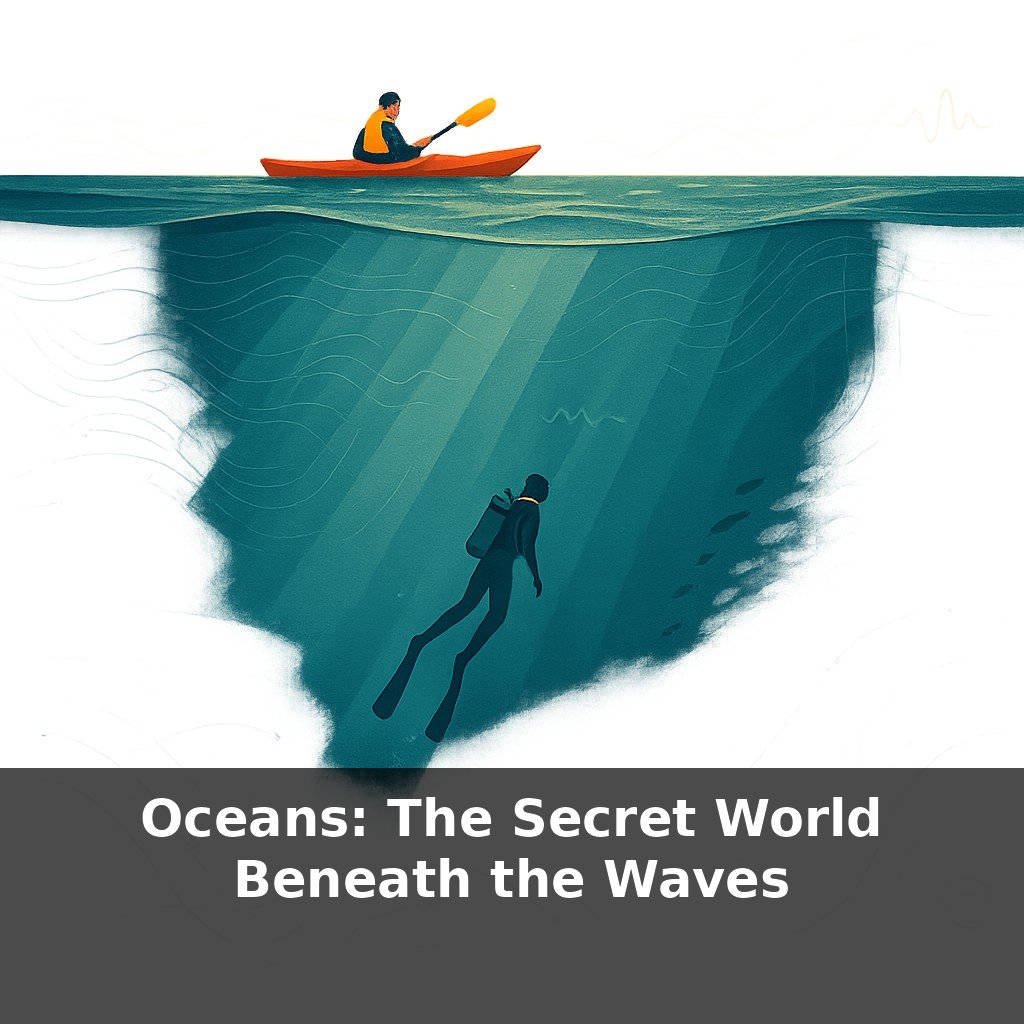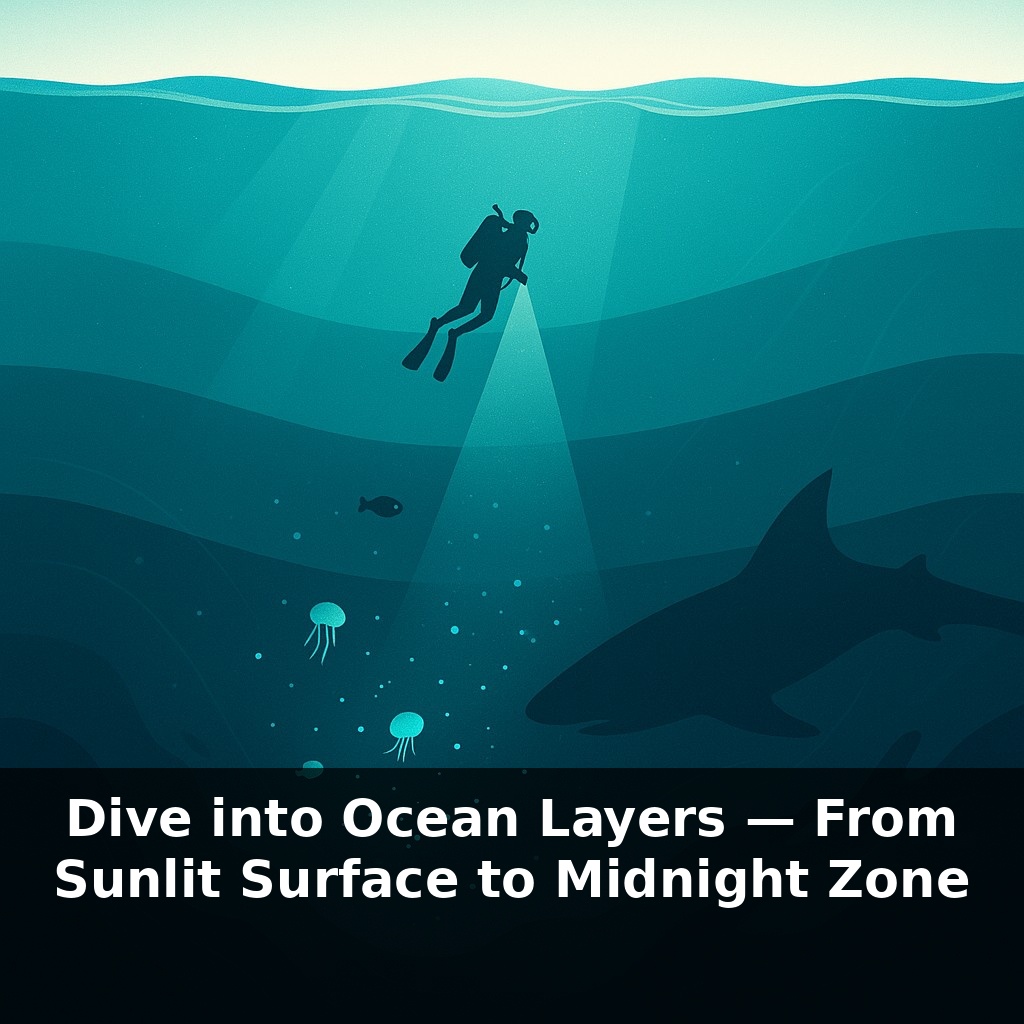
A diver’s torch fades to a tiny halo, yet life below starts *glowing* brighter. Fish with glassy heads, sharks that light their bellies, whales singing across oceans—our story today begins where sunlight dies, but the sea’s strangest secrets switch on.
Ninety percent of the ocean’s volume exists in permanent darkness, yet what happens there quietly steers Earth’s climate, weather, and even our food supply. In Episode 1, we stayed mostly at the surface; today, we’re descending through the ocean’s five main layers, following the trail of fading light, dropping temperature, and crushing pressure.
Think of this vertical journey less like a plunge and more like hiking down a mountain flipped upside down: every “step” deeper brings a new community, new rules for survival, and new ways energy flows. Some layers act like conveyor belts, shuttling carbon into the deep; others form invisible “acoustic highways” where sound—and whale songs—can travel extraordinary distances.
As we move from the bright skin of the sea to its deepest trenches, we’ll see how each layer shapes not just ocean life, but the stability of life on land.
As we descend, pay attention to how quickly the rules change. Light drops off within a couple of hundred meters, but heat, salt, and even sound keep shifting far deeper, like ingredients layered through a complex stew. Currents can trap warm, salty water above colder layers, creating invisible “ceilings” that many creatures rarely cross. These stacked layers don’t just sit still; they slide, tilt, and sometimes break apart in storms, heatwaves, or El Niño events. When that happens, nutrients can surge upward—or stay locked away—reshaping fisheries, weather patterns, and even coastal economies.
Just below the choppy surface, the epipelagic zone is where physics, chemistry, and biology collide most violently. Waves stir gases into the water, winds drag the surface into currents, and microscopic drifters harvest energy faster than any rainforest. But the real drama begins as we leave this familiar layer and cross an invisible boundary known as the thermocline—a sharp plunge in temperature that also marks a shift in strategy for almost everything alive.
In the mesopelagic, the “twilight zone,” organisms stop relying on surface conditions and start relying on motion. Billions of fish, shrimp, and squid commute up and down hundreds of meters every day, tracking shifting safety and food. This daily vertical migration is now considered the largest synchronized movement of animals on Earth, redistributing carbon and nutrients like an elevator that never shuts down. It also frustrates fisheries: sonar sees dense layers of life, but those layers slide up and down, defying simple harvesting.
Deeper still, in the bathypelagic and abyssopelagic, the water column becomes more stable, but “stable” does not mean “empty.” These layers are fueled by a slow rain of organic particles from above, punctuated by dramatic events: the fall of a dead whale, a bloom of material from a distant plankton surge, or a pulse of oxygen-rich water formed near polar seas decades earlier. For climate scientists, these depths are a time capsule, storing signals of past storms, heatwaves, and even volcanic eruptions.
Drop into the hadalpelagic trenches and conditions become intensely local. Each trench is like a separate country with its own rules—different sediments, earthquakes, and chemical gradients. Some trap organic matter; others flush it quickly. Because only specialized submersibles and landers can reach them, data are sparse, and basic questions—How connected are trenches? How much carbon do they lock away?—are still unanswered.
Across all five layers, one theme repeats: vertical structure controls who eats, who survives, and how long carbon stays out of the atmosphere. Companies planning deep-sea mining, nations negotiating climate targets, and conservationists designing marine protected areas all grapple with these stacked, shifting worlds. We’ve named the floors, but we’re only beginning to understand how the whole building holds the planet’s climate steady.
In the upper layer, coastal upwelling zones act like a chef’s ladle, dipping into deeper, nutrient‑rich water and pouring it onto the “surface table.” That surge feeds plankton blooms so intense they can be seen from satellites, and it’s why fisheries off Peru or California boom when upwelling is strong and crash when it weakens. Deeper down, midwater oxygen minimum zones form thin, inhospitable “belts” that many animals skirt around, reshaping migration routes and sometimes forcing predators and prey into unusual confrontations near their edges. In the abyss, slow, cold currents shuffle water masses between ocean basins on journeys lasting centuries, quietly redistributing dissolved metals, pollutants, and even traces of nuclear tests. Trenches then tweak this grand pattern: some act as sticky traps where fine sediments and microplastics accumulate, while others behave more like slide chutes, channeling material into the mantle during subduction and blurring the line between ocean and solid Earth.
Less than a quarter of the seafloor is mapped in detail, yet decisions about mining, cables, and protected areas are racing ahead. As we probe deeper layers, we’re finding “hotspots” of change where warming, deoxygenation, and shifting species stack up like storm fronts. Those same zones may hide molecules for new medicines or enzymes for cleaner industry. Your challenge this week: follow one ocean news story and ask, “Which layer is this really about?”
Each descent adds another unanswered question: How do storms on the surface stir microbes kilometers below? Where do drifting plastics finally settle? As new robots, DNA samplers, and undersea observatories come online, we’re not just mapping depth—we’re tracing hidden routes of carbon, pollutants, and even genes that tie all five layers together.
Before next week, ask yourself: 1) “If I treated my day like the ocean, what’s my ‘sunlit zone’—the time when my energy and clarity are brightest—and how could I deliberately reserve that window for my most mentally demanding task?” 2) “What’s one ‘twilight zone’ habit (like endless scrolling or half-focused multitasking) that quietly drains my focus, and how could I put a simple boundary around it for just the next three days?” 3) “What’s one ‘midnight zone’ curiosity—something deep and unexplored in my life or work—that I’m a little scared to dive into, and what’s a 10-minute, low-risk way I can start exploring it this week, the way a submersible would slowly descend into the dark?”