Some of the fastest hunters in the sea can *heat their own brains* just to see better in cold, dark water. Out in the open ocean, with no rocks or reefs to hide behind, survival turns into a high‑speed game of glow, camouflage, and movement in three dimensions.
Out here, there are no reef corners to duck behind, no seafloor forests to thread through—just blue stretching hundreds of meters in every direction. Yet this “empty” space is crowded with specialists. Tiny plankton rise and sink each day in a commute so massive it outweighs all the world’s cows. Lanternfish—small, unremarkable at first glance—quietly dominate the deep, making up most of its fish biomass and feeding armies of predators. Nearby, translucent siphonophores stretch longer than whales, functioning like living conveyor belts for prey. Above them, sleek hunters like bluefin tuna slice through water with the efficiency of racing yachts, reading faint temperature lines and pressure cues the way we read road signs. In this episode, we’ll follow these pelagic tacticians and unpack how you survive when there’s nowhere to hide but the water itself.
Far from coasts and seafloors, life has to treat the water column itself like multi‑story real estate. Different depths offer shifting bargains: more light but more predators near the top, safety in darkness but scarce food below. Many residents don’t just pick a “floor”—they commute, timing daily journeys to match changing light like shoppers following store hours. Others turn their bodies into tools: built‑in headlights to signal or lure, mirrored flanks that bounce surrounding colors, fins tuned like airplane wings. Even their senses stretch into this space, detecting tiny pressure ripples as if “feeling” distant movement.
In this kind of open water, one of the most powerful tricks is to vanish in plain sight. Many fishes wear counter‑shading: dark backs, pale bellies. From above, that dark top blends with deeper water; from below, the pale underside merges with the brighter surface. Some species refine this further with silvery, mirror‑like sides that reflect whatever color surrounds them, erasing their outline from most viewing angles. It’s less like a fixed “color” and more like adaptive window glass.
Others go the opposite way and become moving signals. Bioluminescent organs—light‑producing photophores—are arranged in precise patterns that act almost like license plates. Certain squids and deep‑sea fishes use these patterns to recognize mates of their own species in the dark, reducing wasted effort on the wrong partners or even on predators that mimic prey. Some can modulate brightness, brightening or dimming in milliseconds as clouds pass overhead or as they shift depth.
A huge fraction of midwater life participates in the diel vertical migration, but not all players move the same distance. Small crustaceans may travel tens of meters; larger fishes and squids can commute hundreds. The timing and extent of these journeys are tuned to local conditions—moon phase, water clarity, even how many predators are currently patrolling. It’s more like a fleet of elevators on different schedules than a single, synchronized stampede.
Movement strategies don’t just run up and down, but side to side. Many animals form schools—tightly coordinated groups whose constant shape‑shifting makes it hard for a hunter to isolate one target. High‑speed video shows that when an attacking predator breaks into a school, information ripples through the group in waves, each fish adjusting its position based on just a few neighbors. The end result looks complex, but the rules are simple: maintain distance, match speed, turn when your neighbors turn.
All of this only works if you can sense what’s coming. Many open‑ocean species have oversized eyes tuned to tiny contrasts or faint flashes. Lateral lines—pressure‑sensing canals along the body—pick up distant movements, like feeling the wake of an approaching animal before you see it. Some sharks add electroreception, detecting weak bioelectric fields to find hidden prey. Combined, these senses stitch together a 3D mental map of moving threats and opportunities in a place with no walls, no floor, and almost no landmarks.
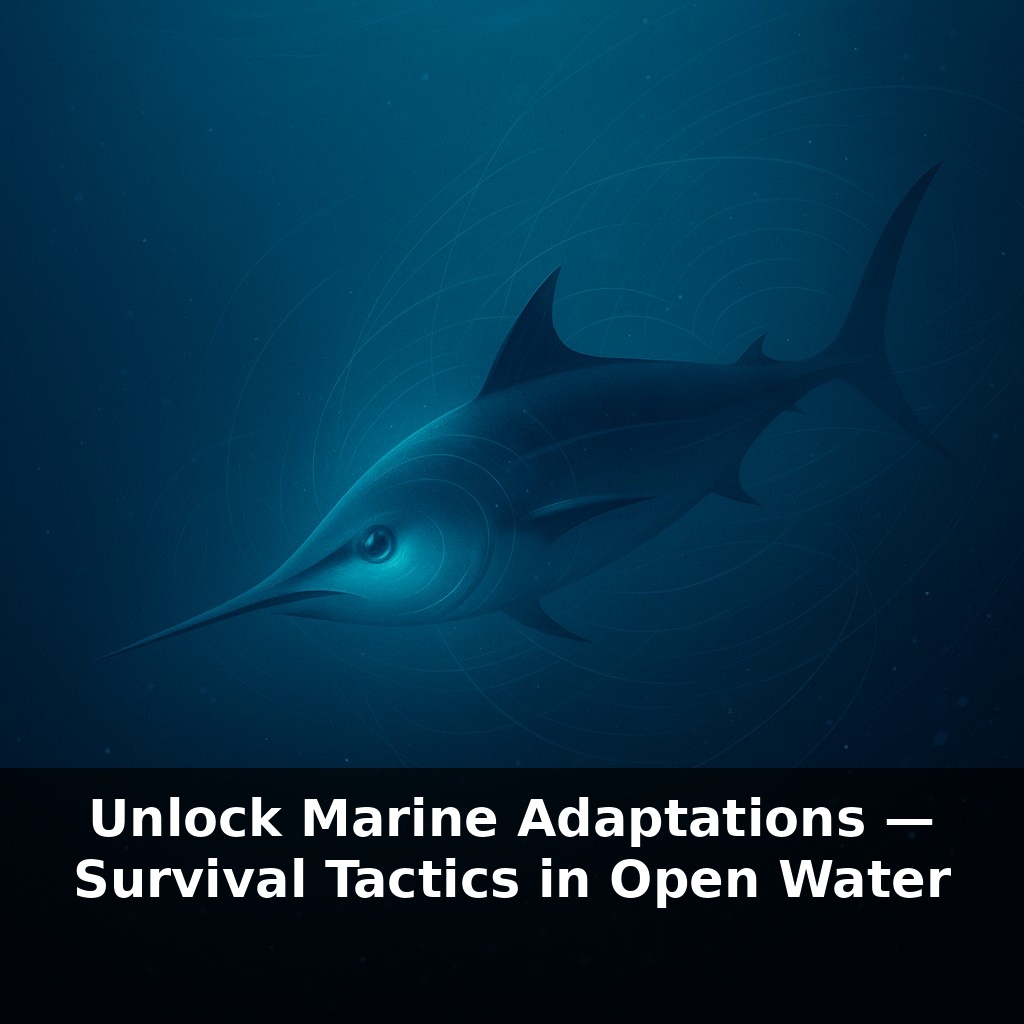
A shoal of small, silver fish doesn’t just *look* coordinated; it behaves like a living algorithm. Each body is running the same simple rule set, yet the group can split around an obstacle and rejoin within seconds. Predator evasion emerges from local decisions, not a leader’s command. Bioluminescent patterns work on similar principles of code and response. Some deep‑water shrimp alter their flash timing in different “dialects,” shortening pulses when predators are common, lengthening them when signaling to mates. Open‑ocean hunters lean on equally specialized sensory shortcuts. Swordfish, for example, often slash through dense aggregations of prey with rapid head sweeps, not precise single‑target strikes; their lateral line and vision only need to be good enough that *some* hits land. Even jelly‑like salps, drifting in chains, process the water they pump for both food and clues—tiny shifts in particle size or chemistry can trigger the whole chain to change depth or direction, a collective decision without a brain.
Designers now mine these mid‑ocean tricks like engineers studying a Formula 1 car. Schooling rules inspire collision‑avoiding drone swarms; streamlined hunters shape quieter subs; bioluminescent proteins already light up cancers in lab mice. But as mining plans target mid‑water metals and warming shifts oxygen “comfort zones,” we’re altering the very stage that forged these tools. Protecting it isn’t just ethics—it’s safeguarding a library of blueprints we’ve barely started to read.
Out here, even “mistakes” become experiments. A slight twist of a fin, a new flash pattern, a bolder climb toward the surface—evolution keeps testing combinations like a chef adjusting spice levels. Some trials vanish; others rewrite who hunts whom, and where. As we change the oceans, we’re also changing which recipes get saved for the next course.
Try this experiment: Fill your sink or a large bowl with cold water, drop in a few ice cubes, then submerge one hand and time how long you can comfortably keep it there while calmly breathing. As you do this, imagine you’re a marine mammal triggering the “diving reflex”: slow your breathing, relax your shoulders, and notice how your heart rate and urge to pull your hand out change over 1–2 minutes. Then repeat once more, but this time tense your body and breathe fast like a stressed fish fleeing a predator, and compare how much harder it is to stay in. You’re basically running a tiny, safe version of open‑water survival tactics on land—testing how calm vs. panic changes your body’s performance in a cold “ocean.”