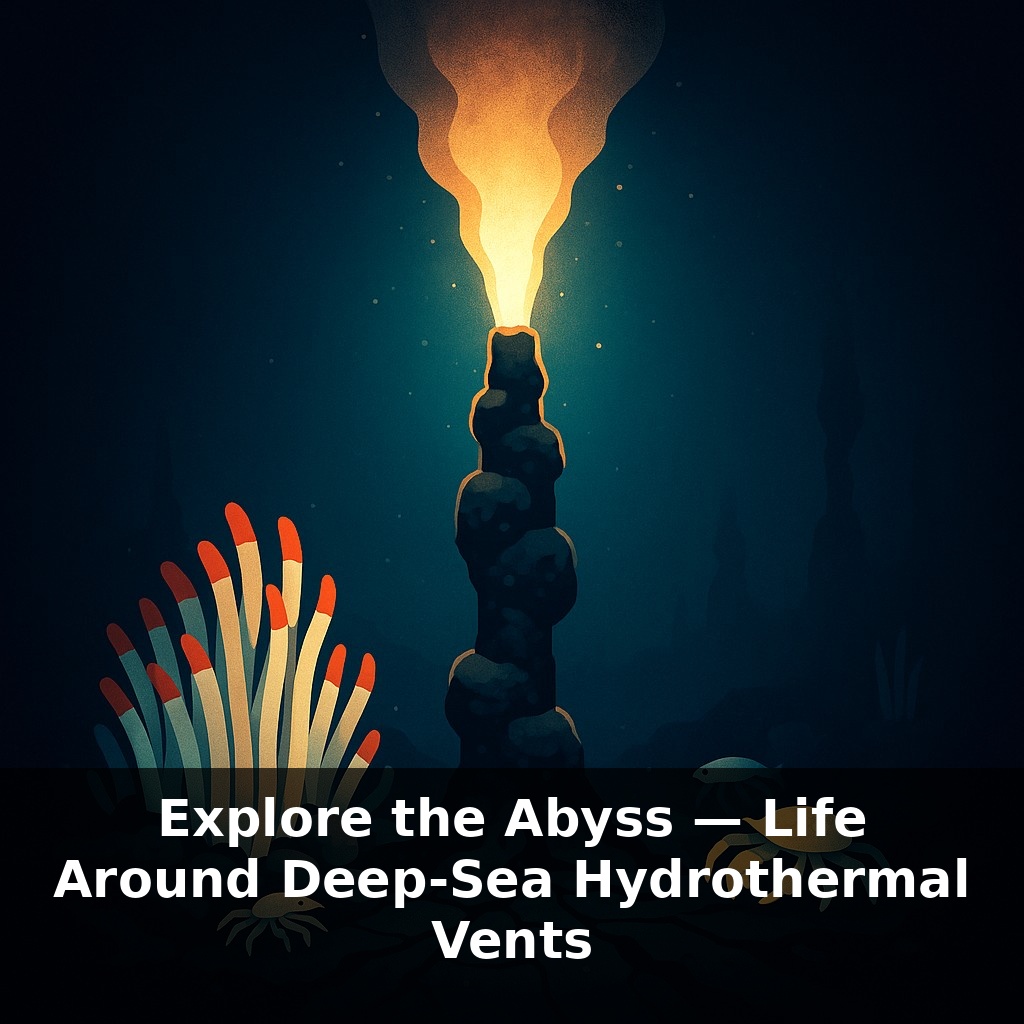
Water hot enough to melt lead gushes from cracks in the freezing deep ocean—and instead of killing life, it feeds it. In this episode, we drop into that darkness mid‑eruption and follow the first strange creatures that rush toward the scalding, toxic plumes to build a world.
At these depths, light never arrives—but eruptions do. While coral reefs and mangroves we’ve visited before rely on steady sunlight, vent fields flicker in and out of existence on geological short notice. A new crack opens, fluid starts roaring out, and within months the bare rock is crowded with life that didn’t exist there the year before. Scientists track these newborn communities the way wildfire ecologists watch regrowing forests, noting who shows up first, who dominates, and who gets pushed to the edges as conditions change. Some pioneers are tiny, free‑swimming larvae drifting in the deep until a faint chemical clue says “settle here.” Others hitchhike on crustaceans or fish, spreading from one distant vent to another. In this episode, we’ll explore how entire food webs assemble, collapse, and leapfrog across the dark seafloor, connecting isolated oases into a hidden, shifting network.
As we move closer, the seafloor stops looking empty and starts to resemble a construction site frozen in midnight. Mineral‑rich fluids harden into craggy chimneys, layer by layer, like dark lava cakes rising in slow motion. Each new ledge, crack, and hollow adds real estate for life: snug crevices for baby snails, exposed ridges for heat‑loving microbes, overhangs where crabs can lurk out of the flow. Even the temperature shifts over just a few centimeters, from scalding to near‑freezing, carve the landscape into invisible “neighborhoods” that different species claim as their preferred address.
Closest to the flow, life starts at the microscopic scale. Chemosynthetic bacteria and archaea tap into hydrogen sulfide, methane, and iron in the vent fluids, using them as fuel to build organic matter. Some cling directly to rock and chimney walls; others form shimmering mats that look almost like spilled metallic paint under the submersible’s lights. Different strains specialize in slightly different conditions—more sulfide, less oxygen, warmer, cooler—so even what looks like a uniform slime is actually a patchwork of invisible niches.
Larger animals plug into this chemical power grid in surprising ways. Giant tubeworms famously have no mouth or gut at all. Instead, they’re packed with symbiotic bacteria that perform chemosynthesis inside their bodies, while the worms provide a steady supply of sulfide and oxygen via their blood. Many vent mussels and clams do something similar: they still have digestive tracts, but much of their nutrition comes from bacterial partners living in their gills. In a sense, they are part animal, part chemical reactor.
Other species graze or hunt more conventionally, but their targets are vent‑tuned. Limpets scrape microbial films; some shrimp browse on bacterial gardens growing on their own shells; crabs pick off weakened mussels or snails. With so much energy entering at the microbial level, biomass can build up fast. In some fields on the East Pacific Rise, densities of tubeworms and mussels rival the crowded fish and corals we saw in shallow coastal habitats, even though sunlight never reaches here.
This bonanza is precarious. Chemistry can shift within hours if flow pathways clog or reopen. A fresh pulse of hotter, sulfide‑rich fluid might suddenly favor one group of microbes over another, rewriting the menu for grazers and predators above. Over months to years, whole communities undergo succession: fast‑growing pioneers dominate, then are shaded or smothered as late‑arriving species build thicker shells, taller clusters, and denser canopies.
Individual vent sites are temporary, often active for decades to centuries at most. To persist, vent life must be mobile at least once in its lifetime. Many species release larvae that can drift for months in deep currents, guided only by faint chemical signatures leaking from distant fields. Genetic studies show that populations thousands of kilometers apart can still be closely related, implying that even in the abyss, there are hidden highways connecting these isolated oases.
Your challenge this week: whenever you see headlines about volcanoes, earthquakes, or seafloor mapping, pause and ask, “What might this mean for life in the dark?” Then dig one layer deeper—check whether scientists have found vents or vent‑like habitats in that region, and note how often the story shifts from rocks to ecosystems once you look beyond the first article.
Some vents pulse like geysers, switching from gush to trickle over minutes. In those lulls, submersibles sometimes catch “snowfalls” of dead microbes drifting down, briefly feeding scavengers that lurk just beyond the active zone. Elsewhere, chimneys abruptly topple, shattering into rubble that octopus and squat lobsters quickly comb through, the way shorebirds work a freshly exposed tideflat. In the Indian Ocean, researchers have filmed pale eelpout fish hovering motionless in the shimmering mix of hot and cold water, snapping up stunned shrimp flushed from their hiding spots.
Chemically, not all vent kitchens serve the same menu. Some fields, rich in methane instead of sulfide, host communities that look similar from a distance but are built on different metabolic tricks. And vents don’t just matter where they roar. Plumes can drift hundreds of kilometers, sprinkling iron and other trace metals into nutrient‑poor surface waters above. Satellite data suggest that, in some regions, this invisible seasoning may boost phytoplankton growth, tying life in eternal night to blooms in sunlit seas.
Deep‑sea vents now sit at a crossroads. Mining plans target nearby metal‑rich crusts, raising questions: protect these sites like underwater World Heritage parks, or treat them as ore depots? Meanwhile, engineers eye vent enzymes as ultra‑tough catalysts, like tiny pressure‑proof sous‑chefs for cleaner industry. Astrobiologists test how such systems might glow in telescope data from ocean worlds, while swarms of seafloor robots begin listening for how these hot spots whisper into the climate system.
So as we leave the vents behind, treat them like distant city lights glimpsed from a night flight—brief, bright hints of activity in a vast dark. Each new survey line, sensor drop, or probe descent is like lifting another floorboard in an old house, exposing wiring we never knew existed—and maybe, in some far ocean, a neighbor we’ve never met.
Try this experiment: Build a mini “hydrothermal vent” in a clear glass or jar. Fill it with cold, salty water (stir in a spoonful of table salt, then chill it with ice until it’s very cold), then slowly pour in a small amount of nearly boiling, dark-colored water (use food coloring or strong coffee/tea) down the side or through a straw aimed at the bottom. Watch how the hot fluid rises and curls like a black smoker plume, then gradually mixes and spreads, just like vent fluids meeting the icy deep ocean. As you observe, tweak one variable at a time—saltier vs. less salty, hotter vs. less hot, colored vs. uncolored—and note how the “plume” behavior changes, mirroring how different vents create different habitats for tube worms, microbes, and other deep-sea life.