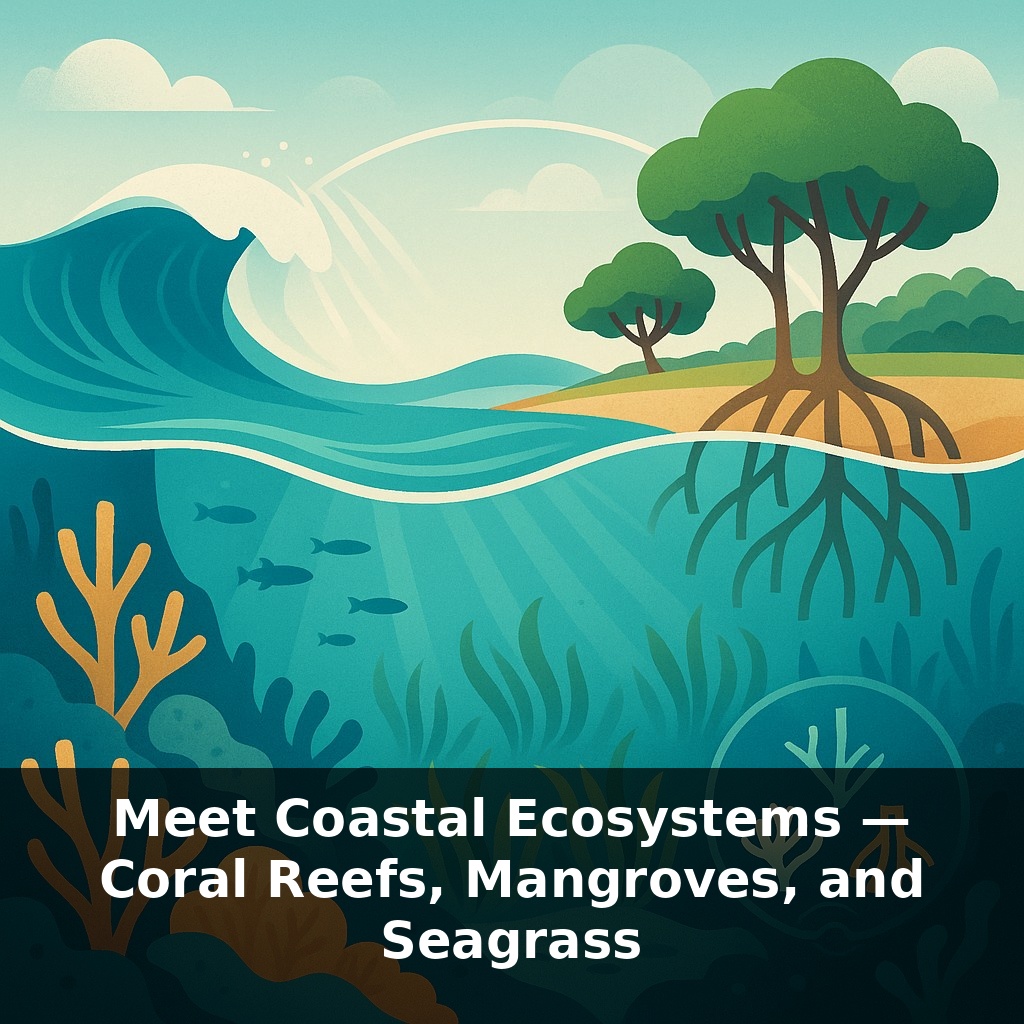
Right now, just off some tropical beaches, three quiet powerhouses are doing more climate work per square metre than a rainforest. Waves slam into a jagged wall, slow to a gentle roll, then slide over seagrass and into tangled roots that keep an entire coastline from unraveling.
Coral reefs, mangroves, and seagrass don’t just share space along the shore—they trade services, like three specialists in a tightly run clinic. Corals build the rigid framework that slows waves; mangroves rise just behind, catching sediment and nutrients; seagrass threads through the shallows, polishing the water and locking carbon into the seabed. Together they nurture about a quarter of all marine species while quietly buffering storms and storing carbon far faster, per square metre, than most forests on land.
Yet this coastal triad is under pressure from every direction. Warmer water pushes corals past their thermal limits, turning vibrant reefs ghost‑white. Mangrove belts are cleared for shrimp ponds, ports, and tourist developments. Clouded water and anchors scar the meadows offshore. In this episode, we’ll zoom in on how these three ecosystems depend on one another—and what unravels when even one link fails.
Seen from above, these coastal shallows look like color‑blocked stripes on a postcard—turquoise over reefs, olive where roots knot the shore, hazy jade where leaves sway underwater. From below, they function more like a busy transit system: larvae drifting from offshore spawning grounds “dock” on reefs, then move landward as they grow, slipping into seagrass shelter and mangrove shadows before returning to deeper water as adults. Fisheries, tourism, and coastal cities all tap into this flow, whether through a day’s catch, a dive site, or a storm that quietly does less damage than it could.
Seen up close, each member of this coastal triad runs its own “department” with a different specialty—and together they keep the whole shoreline economy afloat.
Start offshore, where reef structures add crucial three‑dimensional real estate. Nooks and ledges host everything from inch‑long gobies to patrolling reef sharks, but they also create gradients of light, flow, and shelter that larvae can sort themselves into. Many species time their spawning with lunar cycles and currents so their eggs drift toward this labyrinth instead of being swept into the open ocean. When we talk about “a quarter of marine species” using reefs, we’re really talking about a vast web of life stages that only overlap here for brief, critical windows.
Shift landward and you find a different strategy. Mangrove roots leak organic carbon and nutrients into surrounding water, feeding dense microbial communities. Those microbes, in turn, process nitrogen and other pollutants flowing off the land, often before they ever reach the reef. Fisheries biologists can sometimes track the chemistry of a fish’s otolith—the tiny ear bone—back to these sheltered nurseries, like reading tree rings that record a childhood spent in brackish shade.
Closer to the beach, seagrass blades slow water just enough for fine particles to settle. That creates a stable seafloor where clams, worms, and burrowing crustaceans can thrive. Their constant digging and filtering keeps oxygen circulating through sediments that might otherwise go anoxic. It’s a quiet feedback loop: animals maintain the meadow, and the meadow feeds and shelters them.
The physical links are just as important as the biological ones. Break wave energy on the reef, and storm surge arriving at mangroves is lower and slower, allowing root mats to hold. Let those roots be cleared, and huge pulses of sediment and nutrients suddenly rush outward, overwhelming the filtering capacity of seagrass beds and clouding reef waters during the very heatwaves that stress corals most.
Restoration projects are starting to respect these connections. In parts of the Philippines and Indonesia, teams now replant mangroves, transplant coral fragments, and seed seagrass within the same bay. Results suggest that recovery is faster when all three are rebuilt together, rather than as isolated patches, much like treating not just a single symptom but the whole patient in medicine.
Think of a coastal bay as a test kitchen where chefs share ingredients. When one “station” runs low, another can compensate—up to a point. After hurricanes in Belize, scientists found some fish populations rebounded faster where nearby habitats remained intact, suggesting mobile species simply shifted their feeding routes until damaged areas recovered. In Florida, tagging studies show juvenile snappers commuting daily between shaded roots and offshore structures, like regulars rotating between favorite cafés.
These connections matter for people, too. In Vietnam’s Mekong Delta, villages shielded by intact habitat mosaics reported lower repair costs after major storms than nearby communities with cleared shorelines. Insurance companies have started to notice: pilot projects in Mexico now treat reef crests and adjacent shallows as “insurable assets,” where payouts fund rapid, post-storm repairs. Researchers are also testing assisted adaptation—breeding heat‑tolerant coral strains, experimenting with floating breakwaters that reduce wave stress, and restoring habitat in zones projected to remain cooler “refugia” as oceans warm.
AI tools may soon monitor these habitats like fitness trackers for coasts, flagging stress before collapse. That opens doors to reef “insurance,” blue‑carbon credits, even dynamic fishing rules that shift as conditions change. But without strong community leadership, such tools risk becoming another glossy dashboard. The real test is whether coastal residents gain power—like chefs controlling their own recipes—instead of watching distant markets decide how their shorelines should look.
So the “secret world” near shore is less a wild jungle and more a carefully tuned orchestra, where missing players change the whole sound. Future choices—zoning laws, seafood we buy, how we travel—are like tweaks to the score. Your challenge this week: trace one decision you make back to the water’s edge, and ask who in this coastal ensemble it quietly conducts.