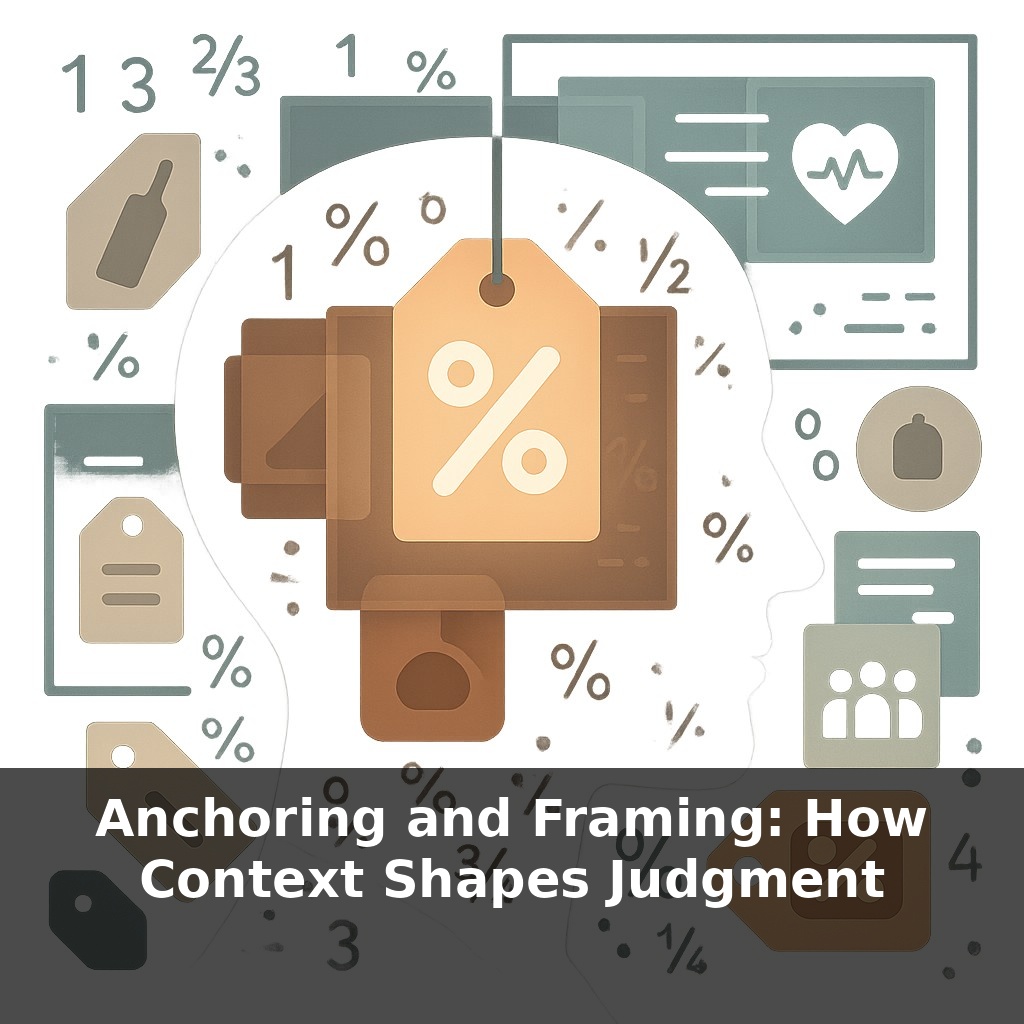
You’re about to hear the price of a bottle of wine: “this one’s 90 dollars.” Now here’s the twist—before I tell you that price, I could mention a luxury bottle that costs several hundred… or a bargain one under 10. That tiny change can quietly rewrite what feels “reasonable.”
Now widen the lens beyond prices. The same mental “first number wins” habit shows up when we judge risks, fairness, even our own abilities. Consider health decisions: if a treatment is introduced as helping “90 out of 100 people,” it feels reassuring. Describe the very same outcome as “10 out of 100 people still die,” and many of us suddenly hesitate—despite the statistics being identical. Or think about performance reviews: hearing that “most people struggle with this target” before you see your score nudges you to feel relieved by an average result, while “top performers usually hit this” can make the same score feel disappointing. We aren’t just reacting to facts; we’re reacting to how those facts are wrapped, sequenced, and compared. That’s the quieter twin of anchoring: framing—shaping judgment by shifting the context around a choice.
Marketers, negotiators, and even public institutions quietly lean on these patterns all the time. A charity suggests “most people give $50,” and suddenly $20 feels small. A hiring manager floats a “ballpark salary” before asking your expectations. A government report highlights “jobs created” instead of “jobs lost” when presenting the same data. None of this is random—it’s guided by decades of research showing how our judgments orbit around early hints and subtle wording shifts. The unsettling part: even experts—doctors, judges, investors—are moved by these cues, often while insisting they’re being purely objective.
Think about how quickly your mind grabs onto the *first* thing it can when numbers or options appear. That “first thing” doesn’t just nudge your reaction—it quietly builds the mental scale you’ll use for everything that follows.
In Kahneman and Tversky’s classic 1974 experiment, people spun a wheel that was secretly fixed to land on 10 or 65. Afterward, they estimated the percentage of UN countries in Africa. The wheel was obviously irrelevant, yet it bent people’s answers: those who saw 10 gave a median estimate of about 25; those who saw 65 went up to about 45. A nonsense number—clearly random, clearly uninformative—still tugged on serious judgment.
This isn’t a fragile lab curiosity. A 2011 meta-analysis of 34 studies found a fairly hefty average effect (around r = 0.41). That means these shifts are big enough to matter in real life: in salary talks, investment decisions, sentencing recommendations, or damage awards. And they’re stubborn. Even when people *know* someone is trying to sway them, they rarely correct fully.
You might assume training or expertise would shield professionals. Real-estate agents, for instance, explicitly learn to ignore listing prices and focus on fundamentals. Yet in Northcraft and Neale’s study, even seasoned agents’ appraisals moved with the list price, drifting only about 5% away from it. On a $500,000 property, that’s a $25,000 swing—purely from where the number was set.
Frames add another layer. When public-health teams tested different messages about flu shots in a large JAMA-published field trial, just describing the same outcome as “keeps you healthy” instead of emphasizing illness raised intentions by roughly 20%. The underlying risk didn’t change; the storyline did. Multiply that effect across a city or country, and a small wording tweak could mean thousands more people protected—or exposed.
A subtle twist: anchors don’t have to be numerical, and frames don’t have to mention probabilities. A product labeled “entry-level” versus “premium,” a lawsuit described as “egregious harm” versus “regrettable incident,” or a job called a “stretch role” versus a “safe fit” can all pull your expectations and choices in different directions before any hard facts appear.
Crucially, these influences don’t only operate when someone is trying to manipulate you. We anchor on *our own* first drafts: the initial salary you think you “deserve,” the first risk estimate that pops into your head, the early impression of a policy proposal. Then we interpret new information through that initial lens, adjusting only partially even when evidence calls for a bigger shift.
And awareness helps but doesn’t magically erase the pull. Many participants in anchoring experiments can describe the bias—and still show it. The mind seems wired to treat “firsts” as reference points, even when we’d rationally prefer to start from scratch.
Walk into a tech store. The first laptop you see is a “Creator Pro” model at $2,499. A few steps later, a $1,399 machine looks almost modest, even if it’s more than you planned to spend. Shift scenes: a city proposes a congestion fee. Present it after weeks of headlines about crumbling infrastructure and it feels like a necessary tool; present it after stories about wasteful spending and it feels like a cash grab. The numbers and policy stay the same—your stance doesn’t.
Job titles show the same pattern. Call a role “Senior Growth Architect” with a wide pay band and candidates suddenly treat mid-range offers as acceptable. Rename it “Marketing Specialist” with the same tasks and range, and that exact offer feels stingier. Even your own goals get caught: set a target of learning “five new skills” this year and adding one more feels trivial; phrase it as “finally mastering one domain” and that same extra effort can feel heroic.
A single number on your screen may soon be tuned just for you—your “personal best” price, tailored default tip, or hyper-local climate risk estimate. As AR layers data onto streets and faces, context will be editable: charities could test dozens of donation prompts on you in real time, and political campaigns might swap narratives mid-speech. In this world, civic education must include “context literacy”: not just checking facts, but asking, “What else could this look like?”
Treat this as ongoing training, not a flaw to erase. The question isn’t “Am I biased?” but “Given that I am, how do I want systems to treat me?” From news feeds to salary bands, push for views that show multiple baselines at once—like seeing raw, weekly, and yearly spend on a budgeting app—so no single number quietly becomes the whole story.
Here’s your challenge this week: three times a day (morning, midday, evening), deliberately reset an “anchor” by changing a number you see first and notice how it shifts your judgment. For example, before checking prices on Amazon, first look up the most expensive version of that product category and then compare how “reasonable” the normal price feels; log the price difference and your gut reaction in a simple 1–5 “seems cheap/expensive” rating. At least once per day, re-frame the same decision in two ways—once as a gain (e.g., “I’ll save $30”) and once as a loss (e.g., “I’ll lose $30 if I don’t”)—and then choose which frame you’ll base your decision on and stick with it. By Sunday night, you should have at least 7 logged moments of anchoring and 7 of framing, and you’ll review them to spot exactly where your judgment shifted just because the context changed.