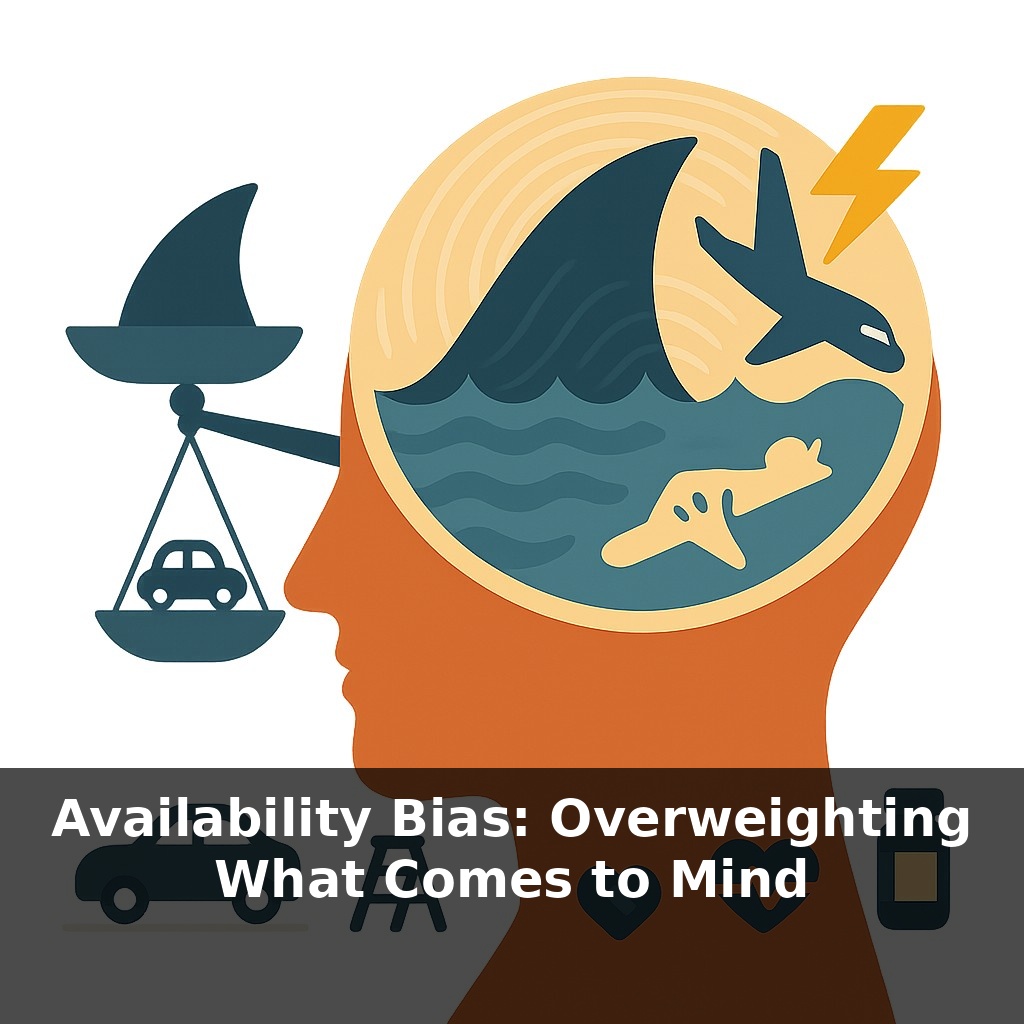
Newsrooms once ran over a thousand stories on shark attacks in a single summer—during a year when fewer than ten people worldwide actually died from them. So why do rare dangers feel huge, while everyday risks barely register? Let’s press pause on your instincts and start unpacking that.
You don’t just misjudge dramatic threats; you also misjudge yourself. In one classic study, people who listed 12 examples of their own assertive behavior actually decided they were *less* assertive than people who listed only six. Straining to recall more instances made assertiveness feel rare, so they quietly rewrote their self-story to match the feeling.
This is availability bias turning inward: when your memory search feels easy, you assume “this happens a lot”; when it feels hard, you assume “this is unusual”—even if both impressions are wrong.
That same mental habit shapes how you view social problems, politics, and public health. The issues you’ve recently scrolled past, argued about, or seen dramatized on screen swell in importance, while slow, invisible threats fade into the background.
Scroll through a news feed and you’ll feel it: crime waves “everywhere,” disasters “nonstop,” some controversy “all anyone is talking about.” But that feeling quietly depends on what you’ve been exposed to, not on what’s actually most urgent. Just as markets overreact to a few loud signals and ignore slow, compounding trends, our attention chases what’s loud, vivid, and recent. This doesn’t just distort private worries; it reshapes elections, funding priorities, and which communities get help first—because what voters and leaders *remember* most easily starts to look like what matters most.
Open a political poll, a medical forum, or a stock subreddit and you’ll watch the same pattern play out: a few dramatic stories dominate, and people quietly treat them as the norm. A friend’s cousin has a bad vaccine reaction? That single post can outweigh millions of safe doses in people’s mental math. A viral video of a chaotic protest? Suddenly “the whole country” seems on fire.
This isn’t just about fear. Availability also distorts what we’re *optimistic* about. Hear three friends brag about crypto gains, and your brain acts as if “everyone” is getting rich, even if most buyers lost money and went quiet. Wins are loudly shared; losses vanish into private shame. Your sense of “how things usually go” is built on a skewed sample of what people choose to talk about.
Institutions do this too. Hospital administrators may overfund headline-grabbing technologies after one widely discussed near-miss, while underinvesting in boring infection control that statistically saves far more lives. City councils may rush to install cameras after a publicized assault, yet neglect traffic redesign where residents silently die in ones and twos.
Notice how repetition multiplies the effect. A risk repeated a hundred times in your feeds doesn’t just feel familiar; it starts to feel *representative*. If every conversation about schools is about a single controversial topic, it’s easy to forget that most students’ daily struggles are far more mundane: asthma, hunger, broken heating, understaffed counseling.
The analogy to finance is blunt: your attention is like a momentum trader, piling into whatever just spiked in visibility. Without deliberate correction, you’ll overinvest time, worry, and political energy in whatever happens to trend, while underweighting slow-burn issues like climate resilience, lead exposure, or chronic loneliness.
And because people often vote, donate, and volunteer based on these distorted impressions, availability doesn’t just warp private beliefs; it reallocates real power and resources across society.
A city council hears hours of emotional testimony about one tragic elevator accident and rushes to mandate expensive upgrades in every public building. In the same meeting, a quiet report on poorly lit crosswalks—where far more people are hurt each year—gets tabled “for later.” The difference isn’t the numbers; it’s which story sticks in memory.
Or take philanthropy: a single viral video of a collapsed bridge can trigger millions in donations within days, while long-running efforts to remove lead pipes or fund community health workers struggle to raise a fraction of that. One disaster is cinematic; the other is slow and mostly invisible.
Availability also shapes whose suffering is legible. A celebrity’s rehab stay becomes a national conversation on addiction, yet neighborhoods with decades of underfunded treatment centers remain practically unnamed. Public agendas tilt toward what can be easily recalled at a microphone, not what quietly does the most damage.
A democracy that forgets slowly brewing problems will keep “cooking” the same crises. As AI, media, and politics compete for your attention, they don’t just report reality—they draft the menu of what citizens think is urgent. Some harms never make the list, so they never get funded, researched, or voted on. The risk isn’t just personal misjudgment; it’s whole societies mistaking what’s loud for what’s large.
Your mind will keep serving the “greatest hits” of recent headlines unless you change the playlist. Treat attention like a shared public budget: every rumor, trend, or outrage that “feels huge” crowds out quieter issues, like underfunded clinics or crumbling pipes. The more people learn to correct for this skew, the fairer our collective priorities can become.
To go deeper, here are 3 next steps: 1) Grab Daniel Kahneman’s *Thinking, Fast and Slow* and read the chapter on “Availability” with a highlighter, then open a fresh note in Notion or Google Docs titled “My Availability Traps” and log 3 recent decisions (news, health, or money) where vivid stories outweighed actual data. 2) Install a news-aggregation tool like Ground News or AllSides and, for the next headline that triggers a strong reaction, use their bias/coverage comparison feature to see how often the event really occurs versus how often you *see* it, then screenshot and save it to a “Bias Receipts” folder on your phone. 3) Open Our World in Data (ourworldindata.org) and pick one domain the episode mentioned—like crime, plane crashes, or natural disasters—then bookmark 1–2 charts that directly contradict your gut feeling and set them as quick-access bookmarks labeled “Check before I panic” in your browser.