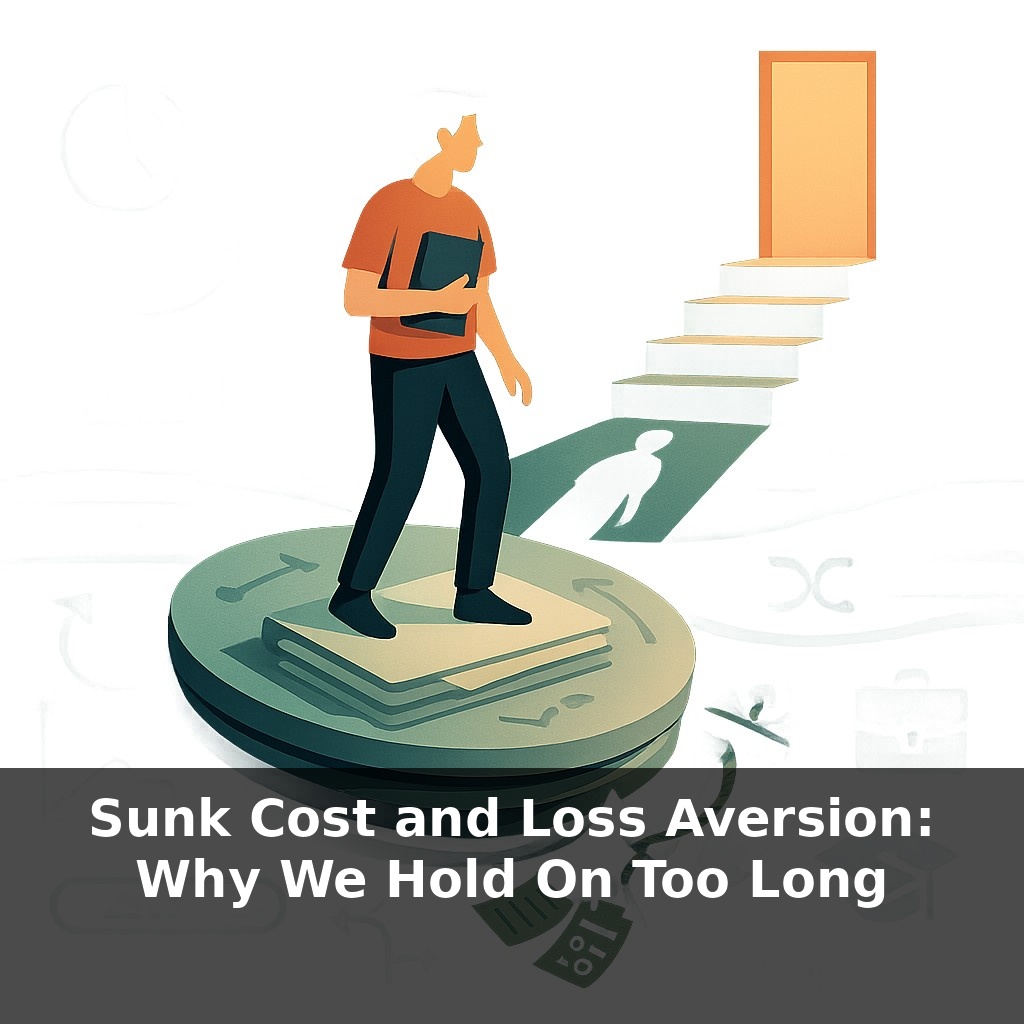
Studies show we feel financial losses about twice as strongly as gains. So why do smart people keep funding apps no one downloads, or stay in jobs they quietly hate? In this episode, we’ll explore why “walking away” can feel more dangerous than slowly sinking.
Kahneman once wrote that “organisations are factories for sunk costs.” It’s not just about money; it’s your late nights at a failing startup, the years in a degree you no longer want, the campaign your team keeps tweaking even though the audience has moved on. Our brains quietly convert “effort already spent” into “reasons to keep going,” even when the world is clearly giving us new information.
You’ve likely felt it outside of finances: staying in a committee role you dislike because you “owe it” to the group, or clinging to a strategy in activism or politics because you’ve publicly defended it. In each case, the past tugs hard on the steering wheel. In this episode, we’ll look at how sunk cost and loss aversion combine to trap not just individuals, but entire institutions—and how simple, pre-committed exit rules can turn painful U‑turns into normal course corrections.
Leaders aren’t the only ones vulnerable here; whole communities can double down together. A grassroots movement might cling to an outdated tactic because years of rallies, posters, and meetings feel too precious to abandon. Startups keep clinging to a product because the codebase represents thousands of late-night commits. Even at home, we keep a weekly tradition alive long after it’s joyful, because “we’ve always done it this way.” When shared identity and reputation get wrapped around past effort, sunk cost and loss aversion stop being private quirks and start becoming collective traps.
Think of what actually happens inside a team when a plan starts failing. The numbers soften, deadlines slip, morale dips—but the conversation often turns not to “What now?” but to “We can’t stop after all we’ve put in.” That quiet shift from evaluating the future to defending the past is where sunk cost and loss aversion start to fuse into a single, powerful drag on good judgment.
Behavioural researchers find that escalation is strongest when three ingredients are present: personal responsibility, public commitment, and uncertainty. If you argued hard for a policy, your name is on the slide deck, and the data is noisy rather than clearly catastrophic, you’re in the danger zone. Under those conditions, people don’t just misread evidence; they start selectively searching for anything that justifies “one more round.” Weak signals of success get amplified; strong signals of failure get reinterpreted as “temporary setbacks.”
You can see this in how alternatives are evaluated. A struggling initiative is rarely compared to a clean slate; it’s compared to a fantasy version of itself where all the earlier investment finally “pays off.” Competing options are burdened with every possible risk, while the current path gets credit for “momentum” and “synergies,” even when those are mostly emotional.
Culture can intensify or soften this. Environments that glorify grit—“never give up,” “failures are for quitters”—make it harder to distinguish perseverance from entrapment. In some organisations, changing your mind is framed as betrayal or weakness, rather than as responsiveness to reality. Unsurprisingly, those are the places where doomed projects linger, budgets get quietly padded, and honest post‑mortems are rare.
Notice too how these biases leak into domains we rarely label as “decisions.” Activists stick with a messaging frame that no longer lands because switching feels like erasing the identity they built around it. Scientists keep defending a fading theory because their careers and reputations are woven through its citations. Parents maintain an educational path for their children long after it stops fitting, partly because it once felt like the “right” sacrifice.
From the outside, it’s easy to see that none of this past effort can be recovered. From the inside, the story feels different: quitting doesn’t just mean losing time or money; it feels like admitting you were wrong—about yourself, your judgment, your group. That’s why technical fixes, like better forecasts, help less than you’d think unless they’re paired with practices that make changing course socially safe and even praiseworthy.
A neighbourhood coalition keeps pouring weekends into a petition platform that barely reaches new supporters, while a simpler SMS tool sits unused because “we’ve already trained everyone on this system.” A city council funds a faltering surveillance program for one more year, not because results are strong, but because canceling now might look like admitting the original vote was misguided. In a lab, participants asked to design a public health campaign routinely stick with their first slogan long after feedback shows it confuses people; they tweak colours and fonts instead of scrapping the core message.
One tech startup set “three failed experiments and we pivot” as a rule. When their flagship feature stalled, the rule forced a conversation: not “do we deserve another chance?” but “what would we build if we started fresh today?” That small shift opened space to redirect staff to a new product line that better matched how users actually behaved, rather than how the team had hoped they would.
A culture that rewards timely course‑changes could reshape careers and institutions. Boards might celebrate leaders who shut down pet programmes early, just as chefs are praised for cutting a dish from the menu when ingredients are no longer at their best. In politics, transparency dashboards could show voters not just promises made, but dead ends abandoned. Over time, “strategic quitting” may become a signal of competence, not weakness, redefining what progress looks like.
Treat your future attention like prime shelf space in a tiny kitchen: every new jar forces something else out. When you notice that queasy pull to “keep going,” pause and ask, “What am I *not* starting because this still sits here?” That question doesn’t erase past effort, but it can unhook your next move from it—and, over time, reshape what your group normalises as progress.
Try this experiment: Pick one “maybe I should quit this” thing from your life today—a subscription you barely use, a show you’re hate-watching, a project at work you secretly think is dead—and for the next 7 days, act *as if* you’d just inherited it from a stranger (ignore all the time/money you’ve already put in). Ask yourself only: “If I didn’t already have this, would I start it today on these terms?” and make your keep/quit decision based purely on that. Then, notice how your body reacts right after you decide—tension, relief, fear, excitement—and jot a quick 1–2 word note about it in your phone. At the end of the week, look back at those notes and see whether the choices that felt scary or “wasteful” in the moment actually created more relief or space in your life.