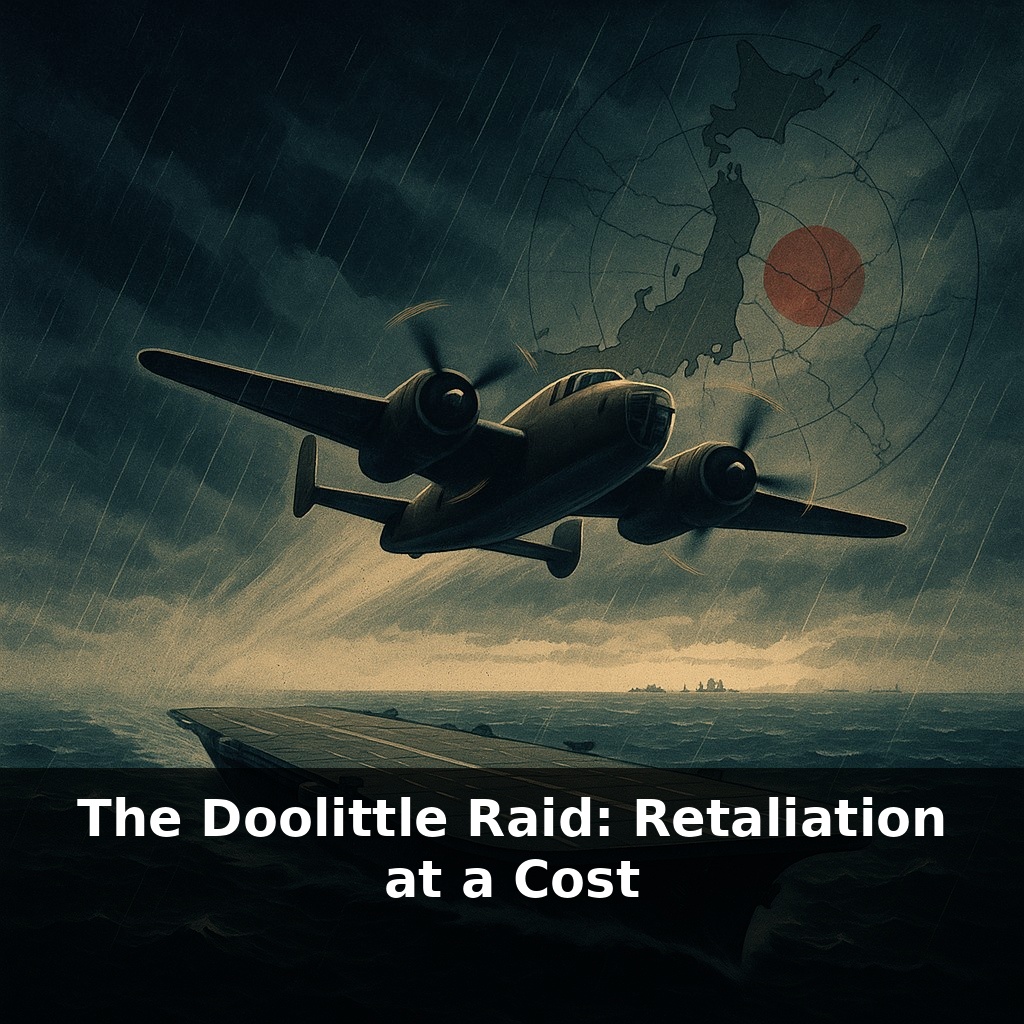
Bombers too big for carriers, a mission with almost no chance of return—and yet it launched anyway. In the spring of 1942, fewer than twenty American planes took off in a stormy Pacific gamble that would shake an empire and quietly doom tens of thousands who never saw the raid.
The raid’s real target wasn’t factories or shipyards—it was confidence. Four months after Pearl Harbor, Americans were still reeling, scanning newspaper maps that seemed to show Japan winning everywhere. In that climate, leaders in Washington were hunting for any way to prove to their own people—and to the world—that the U.S. could hit back. That’s why they greenlit a mission that looked, on paper, like a bad bet: no fighter escort, fuel margins shaved razor-thin, and no plan for the bombers to return to the carrier. The crews knew this. They trained anyway, skimming their B-25s low over water and fields the way a stone rides the surface of a pond—fast, flat, and unforgiving if you get it wrong. Every rehearsal flight was a reminder: this was less a round-trip than a one-way promise.
Washington’s planners weren’t just thinking about distance and fuel; they were reading maps like nervous weather forecasters, searching for a fleeting break in the storm of bad news. They needed a strike that would echo on radios in Tokyo and Washington alike, proof that Japanese cities were not untouchable. At the same time, they had to lean on allies in China and the Pacific, sketching out emergency landing fields and rescue plans that were more hope than guarantee. Each new briefing layered risk on diplomacy, like stacking cards higher and higher, waiting to see if the structure would stand.
They got their break in mid‑April. Japanese reconnaissance had missed the U.S. task force; weather over the Home Islands promised just enough cover. Then, early on the 18th, a Japanese picket boat spotted the carriers. The choice landed hard and fast: close the distance and risk the whole fleet, or launch immediately, hundreds of miles early, and accept that every bomber would be short on fuel. Doolittle chose to go. Crews scrambled topside, engines roared against the wind, and one by one the Mitchells clawed into gray air, lifting off a deck never meant for them.
The raiders flew in small groups, low over the water, guided mostly by dead reckoning and glimpses of the coastline. Japan below them was not expecting hostile aircraft; air‑raid sirens and flak guns sputtered into action only when bombs began to fall. Ten planes went for Tokyo, the rest for Yokohama, Nagoya, Kobe. They aimed at oil depots, factories, docks—targets chosen less for strategic delicacy than for visibility. This strike needed to be heard on radio broadcasts and seen in newspaper photos.
On the ground, damage varied: a few industrial sites hit, some fires, disrupted rail lines. The burned area was small, but the shock was not. Japanese civilians had been told enemy bombers could not reach the capital. Now smoke marked the sky over the emperor’s city. In Washington and Chongqing, that smoke looked like proof: Japan’s perimeter was porous after all.
For the airmen, the aftershock came quickly. Night, worsening weather, and dwindling fuel erased optimism about reaching the planned airfields. Crews talked quietly over intercoms: ditch at sea, bail out, or gamble for the dark shapes of inland hills. Most jumped into blackness, landing alone or in small knots across rural China. Local villagers, at great personal risk, hid and moved them—passing Americans along like a forbidden melody carried from valley to valley.
Tokyo’s leaders heard that melody as humiliation. Determined to seal the breach, they pushed for a decisive fleet action that would culminate at Midway. At the same time, they unleashed a brutal “cleanup” in the Chinese regions that had sheltered the raiders, ordering sweeps, executions, and biological attacks whose victims would never see their names in war bulletins. The raid had landed; its ripples were only beginning.
In military terms, the Doolittle Raid was a tactical pinprick that triggered a strategic landslide. Japanese naval planners, already debating how far to push into the Pacific, seized on the shock to argue for drawing out and crushing the U.S. carrier force. That argument helped harden support for the Midway operation, where four frontline Japanese carriers would be lost in a few days—an irreversible change in the balance of sea power. At the same time, leaders overseeing occupied China treated the American overflight as proof that local resistance and foreign aid were dangerously intertwined. Their response folded the raid into a larger campaign of terror designed to sever those links: mass killings, scorched villages, and the deliberate spread of disease in selected areas. For Chinese guerrillas and civilians, that meant a new phase of occupation—one where simply guiding a downed airman or passing a message might draw collective punishment, yet networks of helpers still formed, improvising rescue chains that outlived the brief raid itself.
Success in war isn’t just counted in craters and wreckage; it reshapes what leaders think is possible. The Doolittle Raid showed how a small strike could rearrange strategy, public fear, and alliance politics all at once. Today’s long‑range drones and cyber tools offer similar levers. They can sting far from the front line, humiliate rivals on live feeds, and still leave civilians exposed to backlash—like thunder that rolls far past the flash that started it.
The raid leaves us with an unsettled question: when leaders reach for bold gestures, who ends up paying the quiet bill that follows? In an age of precision weapons and viral images, small strikes can still echo like distant thunder—felt most by people far from the decision rooms. Your challenge this week: notice headlines that celebrate “impact” and ask, “Impact on whom?”