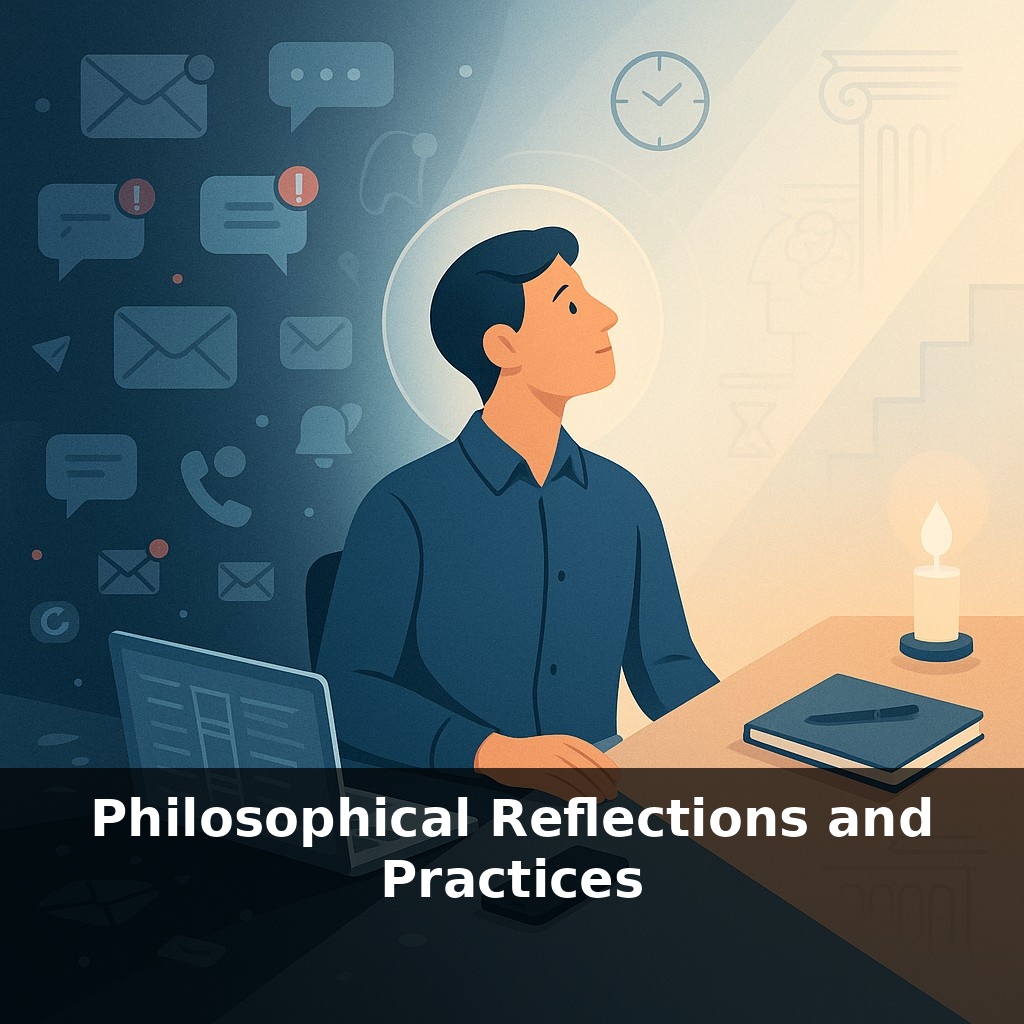
A group of busy managers adds just 15 minutes of reflection to the end of each day—and their performance jumps noticeably. Now shift to you: racing through emails, decisions, tiny crises. Where, in all that noise, does your thinking actually get sharpened instead of just exhausted?
You already know that a small pause at the end of a hectic day can change how you show up tomorrow. Let’s widen the lens: philosophy is simply what happens when that pause stops being random and starts being intentional, structured, and a little bit courageous. Not grand theories on a bookshelf, but tiny, repeatable moves you can drop into a commute, a meeting transition, or the quiet three minutes before sleep. Think of the way athletes run drills: not because they’re glamorous, but because they become automatic under pressure. Socrates treated conversations like those drills—short, focused sessions where assumptions were tested and priorities quietly rearranged. In a world of constant alerts and shifting norms, you don’t need more information; you need a few reliable prompts and rituals that help you decide what actually matters, right now, in your real life.
Your day is already full of “micro-moments” that slip past unnoticed: waiting for someone to join a call, standing by the kettle, scrolling before bed. Those gaps are usually paved over with quick hits of distraction, but they’re also the most realistic entry points for a lived, daily practice. History’s philosophers didn’t disappear to mountaintops; they built habits into ordinary routines—walking, writing letters, talking over meals. Modern research quietly backs this up: brief, regular mental shifts change how your brain wires itself. The opportunity isn’t to add one more task, but to slightly repurpose time you already spend.
A practical way to start is to give each day a “shape” in your mind. Not a grand life plan—just a quiet, working theory like: “Today is an experiment in saying no clearly,” or “Today I’m noticing where I rush.” That small hypothesis turns random events into data. A tense email, a delayed train, a compliment you brush off: instead of being just “stuff that happened,” they become test cases. Philosophers have always done this with big questions—what is justice, what is courage?—but you can narrow the scope to 12 hours and one theme.
This is where journaling stops being a diary of events and becomes a lab notebook. You’re not trying to be eloquent; you’re quickly capturing evidence: “When my calendar double-booked, I…,” “When I felt defensive in that meeting, it was because….” The goal isn’t self-criticism but curiosity. Over a week, patterns appear: maybe your worst decisions cluster after 4 p.m., or you notice that certain people reliably pull you toward your better self.
Dialogue adds another layer. Socrates did his work out loud because talking with someone exposes blind spots you can’t see alone. You don’t need a formal “philosophy partner”; you need one person willing to trade questions rather than advice. For instance, after a difficult choice, you might ask each other: “What value was really driving me there—comfort, loyalty, status, honesty?” You’re not debating who was right; you’re mapping the values actually in play, which is where ethics becomes concrete.
Mindfulness ties this all to your nervous system. Not as a generic stress hack, but as a way to notice the split-second gap before you act. Studies of experienced meditators show stronger connections in brain regions involved in monitoring impulses and shifting attention. That’s exactly the circuitry you’re recruiting when you pause long enough to ask, “What story am I telling myself about this?” Under pressure, this question can be as stabilizing as a goalkeeper planting their feet before a penalty kick—just enough grounding to choose, not just react.
Over time, these tiny moves create a feedback loop: a morning hypothesis about your day, quick notes on what actually happened, a conversation that surfaces values, and a few breaths that keep you inside the moment long enough to adjust.
A CEO blocks off 7:55–8:00 a.m. each day, not for email, but to write one sentence: “Today I will practice…” followed by a specific virtue—patience, courage, fairness. During a tense board call, that line quietly steers how she speaks and where she holds the line. A nurse on night shift keeps a pocket notebook; between rounds, he notes one moment when he felt proud and one when he felt uneasy. After two weeks, he notices the uneasy moments cluster around staying silent when a junior colleague is dismissed. That pattern becomes a prompt for a different choice on the next shift.
You can try a lighter version. A student picks a “question of the day” on her phone lock screen: “What am I optimizing for in this hour?” Before opening a new tab or saying yes to a favor, she glances at it. The effect isn’t dramatic; it’s cumulative. Small, visible cues keep her from drifting far from her chosen priorities, the way a weather app’s hourly forecast helps you decide whether to carry an umbrella even when the sky still looks clear.
Twenty years from now, skipping inner work may feel as odd as never brushing your teeth. As external tasks get handled by code and sensors, your “job” tilts toward choosing aims, priorities, and trade‑offs. Schools might grade not just answers, but how students revise their own questions across a semester. Workplaces could promote people partly on how clearly they articulate the values behind decisions. The quiet skills you rehearse alone may become your most public qualifications.
Treat this as an open‑ended craft, not a self‑improvement project you’re supposed to “finish.” Some days your notes will feel sharp; others, scattered. Both are useful, the way rough sketches teach as much as finished paintings. Over months, you’re not just collecting insights; you’re slowly shaping the kind of person future dilemmas will meet.
Try this experiment: For one day, every time you face a mildly annoying situation (slow line, email delay, traffic, someone interrupting you), silently ask yourself the Stoic-style question: “What part of this is actually under my control right now?” and then immediately act only on that part (e.g., adjust your posture, your tone, your next word, or your plan—nothing else). At night, replay just three of those moments in your head and, like a practical philosopher, briefly test an alternative interpretation for each (e.g., “What if this wasn’t an insult but a misunderstanding?”). Tomorrow, repeat the same experiment but now deliberately choose one situation to “flip” into a mini-practice of virtue (patience, courage, or honesty) and see how the emotional tone of your day shifts.