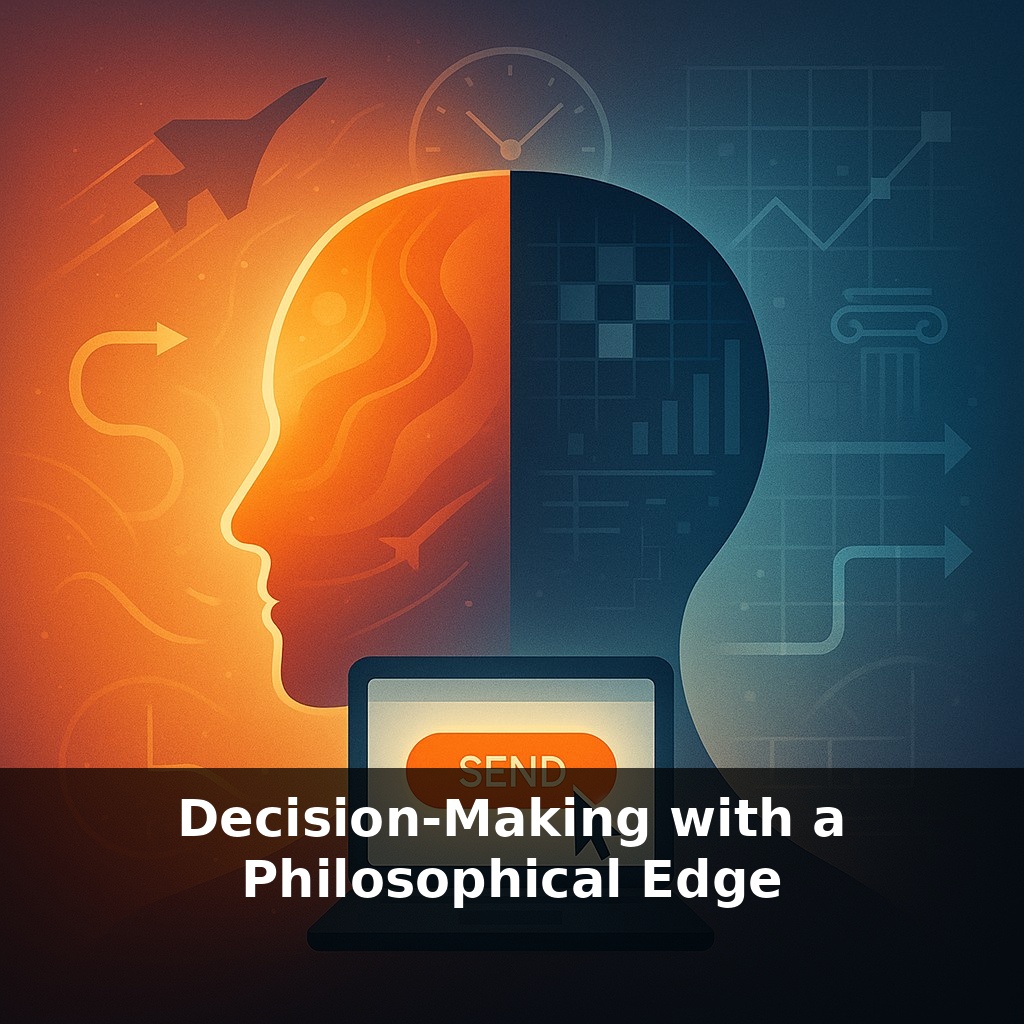
A fighter pilot once said, “Whoever can handle the quickest rate of change survives.” You’re at your desk, cursor hovering over “Send”: a risky email, a big purchase, a hiring decision. Time’s ticking. Your gut shouts one thing, your spreadsheet another. Which voice should you trust?
Kahneman showed that your brain runs two “decision engines”: one fast and intuitive, the other slow and effortful. Most days, you’re leaning on the fast one—especially under pressure, when that cursor hangs over “Send.” But philosophy adds a third layer: it doesn’t just ask *how* you decide, it asks *who you are* when you decide.
Aristotle would push you to ask, “What kind of person does this choice train me to be?” Kant would ask, “What if everyone acted like this?” A utilitarian would zoom out: “What total impact will this really have?”
Modern decision tools—OODA loops, decision matrices, even Bezos’s regret test—quietly borrow from these old questions. They give structure to moments that would otherwise be ruled by habit, anxiety, or office politics, like a seasoned coach calling plays from the sidelines when the game gets chaotic.
Most real decisions don’t fail because we lack options; they fail because we don’t have a *way* to think through them under pressure. Behavioral economists would warn you that in those moments, loss aversion and status quo bias quietly steer the wheel: you overweigh what you might lose, and cling to whatever feels familiar. Philosophical frameworks give you a disciplined way to override that pull. Instead of asking, “What feels safest right now?” they nudge you toward, “What aligns with my core principles, my long-term aims, and the broader consequences at stake?”
main_explanation: Here’s one way to fuse all of this into something you can actually use when stakes are high.
Start by separating **three layers** of any big decision: 1. **Values** – What must not be violated? 2. **Outcomes** – What are you trying to maximize or minimize? 3. **Psychology** – How is your own mind likely to mislead you here?
Most people jump straight to #2 (“What works?”) and skip #1 and #3. That’s how you get clever strategies that quietly corrode trust, or “safe” choices driven more by fear than by judgment.
A practical move: turn famous theories into *short prompts* you can run through quickly.
- **Aristotle → Virtue check:** “If I repeated this kind of choice for 5 years, what sort of leader / colleague / friend would I become?” This filters out options that slowly make you smaller: a bit more cynical, more timid, more manipulative.
- **Kant → Rule check:** “If this became the normal way of operating in my team or industry, would I still endorse it?” That’s where you catch things like quietly hiding bad news, or using “just this once” excuses.
- **Utilitarianism → Consequence map:** “Who are the winners and losers if this works? If it fails? What’s the *second-order* effect six months from now?” Here you’re forcing yourself to see beyond the obvious stakeholders or the next quarterly report.
Now add the **cognitive science lens**: instead of asking “Am I biased?” (answer: yes), ask **“Which bias is most likely here?”**
- Facing a risky career move or product bet? Flag **loss aversion** and **status quo bias** explicitly. - Facing a hiring or promotion decision? Flag **halo effect** and **similarity bias**. - Facing a complex strategy choice with lots of data? Flag **confirmation bias** and **overconfidence**.
Call them out by name *before* you decide. That single move often loosens their grip just enough to widen your view.
You can combine all of this in a short **decision script** you run when something actually matters:
1. “What am I really optimizing for?” (clarify success in one sentence) 2. “What am I afraid of losing that might be distorting this?” (name the fear) 3. “What kind of person will this choice nudge me toward becoming?” (virtue check) 4. “Would I be okay if this became standard behavior for everyone here?” (rule check) 5. “Who benefits, who pays, and how could this play out over time?” (consequence map) 6. “If I look back from 10 years out, which option will I most regret *not* trying?” (future self as tie-breaker)
Run through it quickly, then act, and treat the outcome as feedback for sharpening your framework—not a verdict on your worth.
A startup founder weighing a pivot might use this script like a coach reviewing game tape between periods. They pause before chasing the hottest trend and ask: “If we keep choosing the flashiest short-term revenue, what culture are we reinforcing?” That virtue check can tilt them away from a quick cash grab toward a model that respects customers and employees. Then the rule check kicks in: “If every company in our space handled bad quarters by quietly slashing quality, would I respect that market?” If not, red flag.
For consequences, think of a retailer deciding whether to introduce aggressive surge pricing. Near-term profit looks good, but mapping out second-order effects highlights staff stress, brand distrust, and regulatory attention. On the psychology side, a VP about to block a younger colleague’s proposal can name their bias: “Am I protecting my older strategy because it’s familiar—or because it’s actually better?” Once spoken, that attachment loosens.
Fortunes, laws, and even friendships will increasingly hinge on *auditable* choices: not just what we did, but how we thought. As AI tools join the loop, expect “decision logs” to matter like medical charts—step‑by‑step records of reasoning that others can inspect. Schools may train kids to run mini “ethics drills” alongside math drills, rehearsing trade‑offs the way athletes practice set plays before the real game forces split‑second judgment.
Treat decisions as prototypes, not verdicts. Each tough choice becomes a tiny lab: you set a hypothesis, run the “philosophy + bias” checks, act, then review what actually happened. Over time, this turns your calendar into a quiet training ground—like a musician using every rehearsal to refine ear, timing, and taste, not just to play the right notes.
Try this experiment: For the next 24 hours, whenever you face a non-trivial choice (what project to start, which invitation to accept, how to respond to a tricky email), pause and run it through three “philosophical filters”: (1) Stoic filter – ask, “What parts of this are actually under my control, and what choice best reflects that?”, (2) Existentialist filter – ask, “If I had to own this choice publicly as part of who I am, would I still choose it?”, and (3) Utilitarian filter – ask, “Which option likely creates the most net benefit for the people affected?”. Make your decision only after you’ve answered all three, even if it feels a bit slow or awkward. At the end of the day, quickly scan your choices and see which filter you naturally trusted most and where the filters disagreed, so you can notice your real decision style in action rather than the one you think you have.