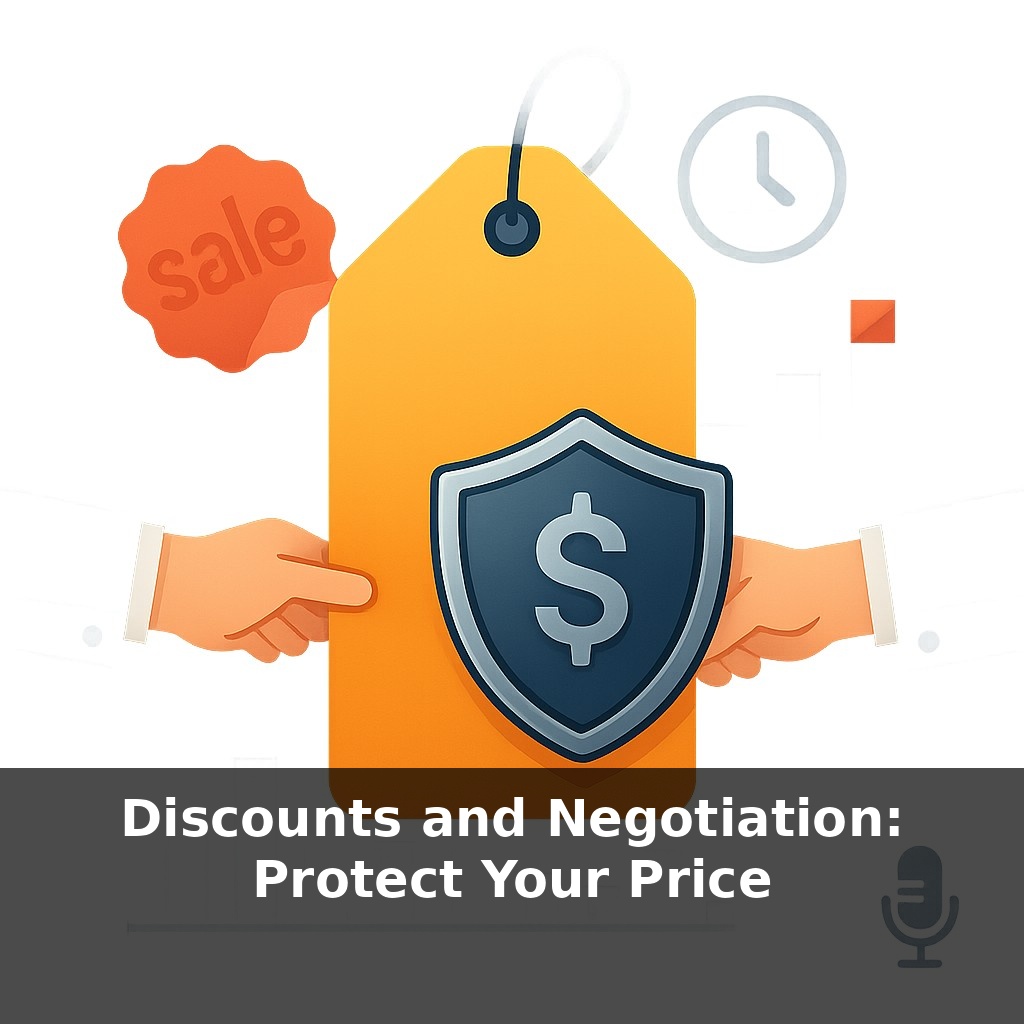
About half your customers are quietly waiting for a sale—even when they’re ready to pay full price. A client of mine learned this the hard way: one “limited-time” discount turned into their new normal. In today’s episode, we’ll explore how that happens—and how to stop it.
Harvard Business Review estimates the average company gives away roughly 1–2 % of revenue every year in unnecessary discounts. Not bad, until you remember most profit lives in that thin slice at the bottom of your P&L. Today we’re going to treat your price like an asset to be defended, not a number to be negotiated away.
We’ll look at why “just 10 % off” can quietly destroy your margins, how constant promotions train customers to distrust your list price, and what disciplined discounters do differently. Instead of arguing that discounts are “bad,” we’ll explore how to use them as precise tools: when to say yes, what to ask for in return, and how to keep your full price as the unquestioned reference point.
By the end, you’ll be able to spot the moment a healthy incentive turns into a habit that undercuts your brand—and know exactly how to pull it back.
Now we’re going to zoom in on what actually happens in those tense pricing moments—when a buyer leans back and says, “Can you do any better?” This is where most profit slips away, not in boardroom strategy decks. You might have a beautifully crafted price, but if your front line is improvising under pressure, that number becomes a suggestion, not a standard. Think of your discount policy less like a sales script and more like a pre-flight checklist: clear conditions, no guesswork, and no “creative” shortcuts when the pressure is on and the clock is ticking.
“Just send me your best price.” That line shows up in emails, RFPs, and casual chats—and it’s the fastest way to push you into defensive discounting. The real danger isn’t the one deal you shave; it’s the pattern your response teaches buyers: “If I push, they move.”
Let’s slow that moment down.
When a buyer asks for a better price, they’re usually testing three things: how confident you are in your number, how much flexibility you have, and how badly you want the deal. Most salespeople answer all three at once with a knee-jerk percentage off. That feels cooperative, but it silently resets your true price from “what’s on the proposal” to “whatever we settle on after some haggling.”
Disciplined sellers flip the script. Before touching price, they change the conversation from “how low can you go?” to “what problem are we really solving and what’s that worth?” Notice what happens when you respond with curiosity instead of a concession:
Buyer: “Can you do any better?” You: “Possibly. Help me understand—are we talking about budget limits, internal comparisons, or just trying to get the best deal on principle?”
Each answer calls for a different response. A budget cap might justify changing scope. An internal comparison might require reframing value. A “best deal on principle” often evaporates when you hold your line calmly and explain how your price was built.
Here’s where structure matters more than charisma. Strong teams use guardrails like:
• Floors: absolute minimum prices for products, segments, or deal types. Below this, the deal needs higher approval—or a “no.” • Trade rules: any reduction in price must be matched by something meaningful: longer commitment, higher volume, faster payment, fewer customizations, public testimonial. • Triggers: predefined conditions that do unlock discounts—strategic logos, big pilots, end-of-life inventory—so exceptions are intentional, not improvised.
Over time, buyers learn your pattern. If your pattern is “push = discount,” you’ll keep getting pushed. If your pattern is “push = a structured conversation with give-and-take,” your list price regains its role as the serious starting point, not a suggestion.
“Can you do any better?” lands differently when you have examples ready. Think of a software firm quoting $50,000 for an annual license. The buyer pushes back. Instead of slicing 15 % off, the rep offers: “If you can sign a two‑year term and pay annually upfront, I can move to $45,000.” The buyer gets savings; the seller locks in cash flow and retention. The discount funds itself.
Or a design agency facing a startup with a tight budget. Rather than cheapening the headline fee, they trim deliverables: fewer concepts, a lighter research phase, stricter revision limits. The invoice holds; the scope flexes. The “discount” lives in effort, not in rate.
Now contrast that with a retailer who reflexively hands out 20 % coupons at the register. No data, no criteria, just habit. Within a season, regulars only buy with the magic code, and full price becomes a prop. One side is trading; the other is slowly training customers to never believe the tag.
Discounts will soon feel less like broad sales and more like private offers. As AI watches patterns in clicks, visits, and churn risk, it will quietly tailor who gets a break and when. Two buyers may see different numbers for the same item, raising “Is this fair?” debates and new regulations. Some brands will respond by shifting from cash cuts to extras—priority support, members‑only access, extended protection—treating the base price as sacred while flexing the surrounding experience.
Treat every price cut like changing a recipe: a pinch can enhance the dish, a handful can ruin it. The next step is to map your “must‑win” offers and decide where, if ever, you’d bend. Then practice saying, “Here’s what I can do if…” until it feels natural. You’re not blocking deals—you’re building a market that takes your price seriously.
Before next week, ask yourself: Where in my current offers am I quietly discounting (waiving onboarding fees, “friends and family” rates, throwing in extra calls) and what would it look like to name and price those things explicitly instead? The next time a prospect asks for a discount, how will I respond in the moment—what exact sentence will I use to protect my price while maybe adjusting scope (fewer deliverables, shorter term, lighter support) instead of cutting my fee? Looking at your last 3 proposals, which one still makes you feel resentful or underpaid, and what minimum price or terms would you now set as your non‑negotiable “walk‑away” line before you ever send the next proposal?