Introduction to Electronic Music Production
📝 Transcript
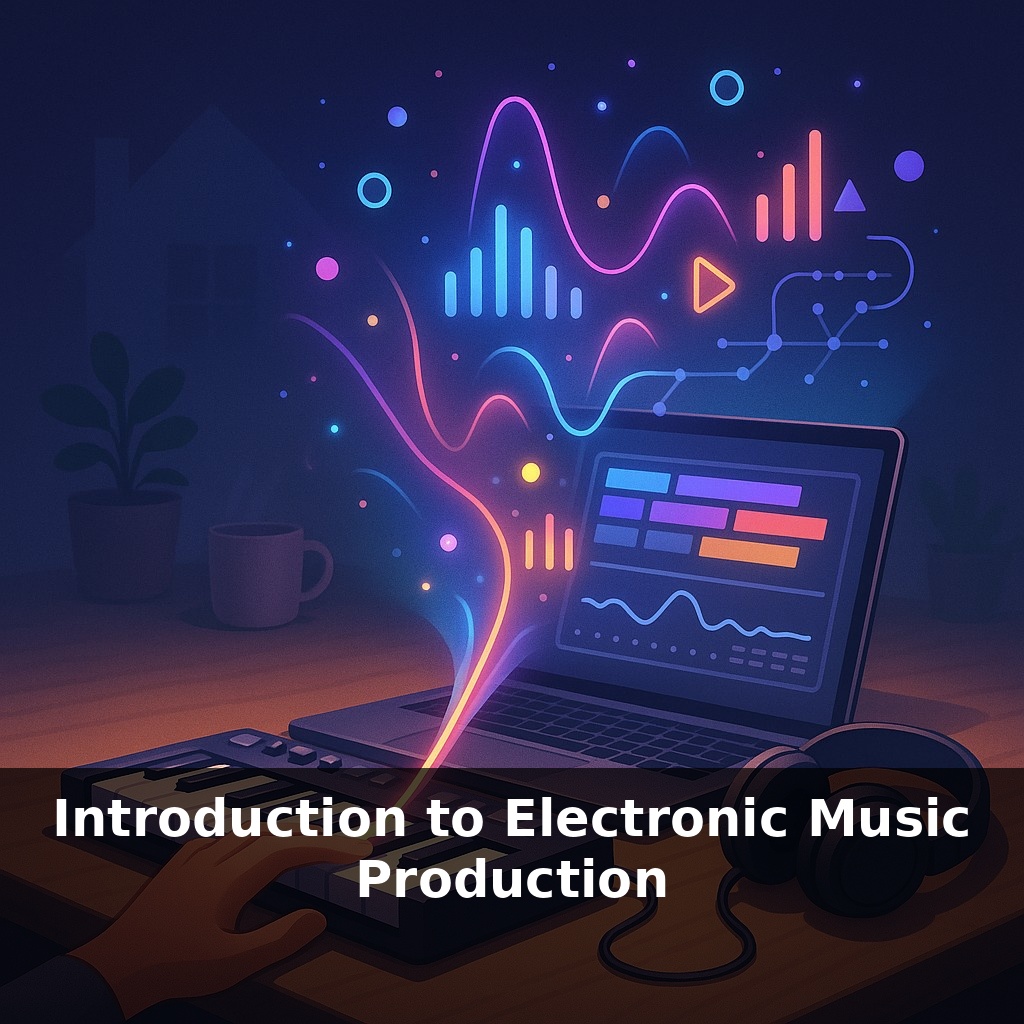
A song topping today’s charts might be produced on a laptop at a kitchen table. No studio, no band—just software and curiosity. You press one key, and a whole universe of sound reacts instantly. The paradox is simple: electronic music feels futuristic, yet it’s more accessible than ever.
In this series, we’ll slow down and actually look under the hood of how a track comes to life. Not with abstract theory, but by tracing the real path your sounds travel—from the first note you trigger to the final file you export and send to a friend. Think of it less as “learning software” and more as learning a new instrument whose keys just happen to be mouse clicks, MIDI notes, and waveforms.
We’ll unpack the core tools you’ll touch on your very first day: the DAW where all your ideas live, the virtual synths that generate tones, the samplers that reshape recorded sound, and the simple controller gear that turns your hands into performance. Along the way, you’ll see how structure, sound design, and technology quietly team up in every track you love—so you can start shaping your own.
On day one, it’s tempting to chase a “pro” sound, but the real starting point is understanding how audio actually moves through your setup. Every click, key press, or recorded note becomes a signal that travels through your computer, picking up color and character at each step before it reaches your ears again. That trip can feel nearly instant—under about 10 ms of latency, it’s perceived as real-time. This is why your choice of audio interface, drivers, and basic settings matters more at first than having hundreds of plugins: they determine how responsive and playable your entire system feels.
The core journey your sound takes has a simple spine: source → processing → arrangement → mixing → mastering. You’ve already met the idea of a signal moving through your system; now the question becomes: what are you actually doing to it at each stop?
Start at the source. Instead of thinking in terms of “instruments” vs “electronics,” think in terms of raw material. A kick drum sample, a recorded vocal, a quickly drawn MIDI melody—they’re all just different starting points for a signal you can sculpt. Many beginners try to collect as many sources as possible; in practice, a few well-chosen sounds that complement each other beat a folder with thousands you barely know.
Processing is where sculpting begins. Effects like EQ, compression, saturation, delay, and reverb don’t exist to make things “fancier” by default; they solve concrete problems. EQ clears space so parts don’t trample each other. Compression evens out dynamics so quiet details stay audible. Reverb creates a sense of space so a dry, close sound feels like it’s in a room, a hall, or even something surreal and impossible. Each processor answers a specific question: louder or softer, brighter or darker, closer or farther.
Arrangement is where you start thinking over time instead of in loops. A four-bar idea can become a whole piece by deciding what appears, disappears, and evolves as the track unfolds. That might mean slowly opening a filter, dropping elements out before a chorus, or reserving your heaviest bass for one key moment. Many electronic tracks you love are built from surprisingly few parts; the drama comes from when those parts are allowed to speak.
Mixing ties these threads together by focusing on relationships. Faders and pan knobs are your primary tools here: which element leads, which supports, and where each sits left-to-right. Instead of asking “Does this sound good in isolation?” you start asking “Does this still help the song when everything else is playing?”
Finally, mastering zooms out even further. You’re no longer adjusting individual tracks; you’re nudging the finished stereo file so it translates across headphones, cars, and club systems. Think of it like adjusting the final blueprint of a building so it stands safely in different climates and environments, without changing the rooms inside.
At every stage, the process is iterative: you’ll bounce between them, nudge a source, tweak processing, re-balance the mix, then refine again. Each pass teaches your ears what truly matters for your own sound.
Listen to a few well-known tracks with “producer ears” and you’ll notice how deliberately each stage is handled. In a track like Billie Eilish’s “Bad Guy,” the minimal bass and vocal leave space for tiny details—finger snaps, breaths, subtle effects—to feel huge. That isn’t about having rare sounds; it’s about choosing a small, focused set of elements and letting contrast do the heavy lifting. Notice how the bass drops out before key moments, or how certain sounds only appear once; these are arrangement decisions that create surprise without adding clutter. A more club-focused track, like something from Disclosure, might use automation to slowly reshape a single synth over minutes, proving that evolution can be more powerful than constant novelty. Producing an electronic track is like cooking a meal: you pick ingredients, season them with effects, follow a structure, then “plate” it so it holds up on headphones, speakers, and a loud party. Studying these choices trains your instincts faster than any manual.
A track you start today might one day “breathe” on its own. Emerging tools can suggest chord changes, remix your stems into immersive 3D spaces, or even tailor alternate versions for workouts, films, or games. Think of your project as a flexible world rather than a fixed file: listeners might solo your drums, mute your vocal, or buy a custom edit for their stream. As these options grow, the skill that matters most is still yours—choosing what serves the emotion you want to deliver.
As you start, treat each project like exploring a new city at night: follow one bright sign at a time instead of trying to map everything at once. In the next episodes, we’ll zoom into specific moves—crafting drums, shaping bass, and building tension—so your sessions feel less like button‑clicking and more like discovering your own accent in sound.
Before next week, ask yourself: What kind of track do I *actually* want to make first—chill lo‑fi beat, house groove, or cinematic ambient—and which 3 reference songs best capture that vibe in terms of drums, bass, and overall energy? When you open your DAW today, which single tool are you most curious to explore in depth—MIDI piano roll, drum rack, or basic synth—and how will you know you’ve really learned it (e.g., you can program a 4–8 bar loop from scratch)? As you listen back to your first rough loop, what specific element are you most proud of (kick pattern, chord progression, sound choice), and what one thing would you deliberately simplify or mute to make the main idea feel clearer?
From this course
Produce Your First Electronic Music Track
10 episodesUnlock all episodes
Full access to 10 episodes and everything on OwlUp.
Subscribe — $1.99/monthLess than a coffee ☕ · Cancel anytime