A silent room. No melody, no lyrics—yet your foot starts tapping anyway. That’s rhythm working before any song exists. Here’s the twist: most hit tracks today are built from just a few repeating drum hits, nudged in time until they feel irresistibly alive.
In this episode, you’ll start turning that foot-tap feeling into something you can actually build with. Instead of thinking about “making a full song,” you’ll zoom in to a tiny slice of time: a short loop that repeats over and over. This is where most modern electronic tracks are born—not in a full arrangement, but in a 1–4 bar pattern that feels so good you don’t mind hearing it 100 times.
We’ll explore three core ideas: tempo (how fast your loop moves), the grid (how time is divided inside your DAW), and micro-variation (tiny changes that stop repetition from feeling robotic). You’ll see why 128 BPM feels different from 72 BPM, even with the same pattern, and how a small timing nudge can shift a loop from stiff to head-nod-friendly. By the end, you’ll know how to set up a simple, professional-style loop you can actually build songs on.
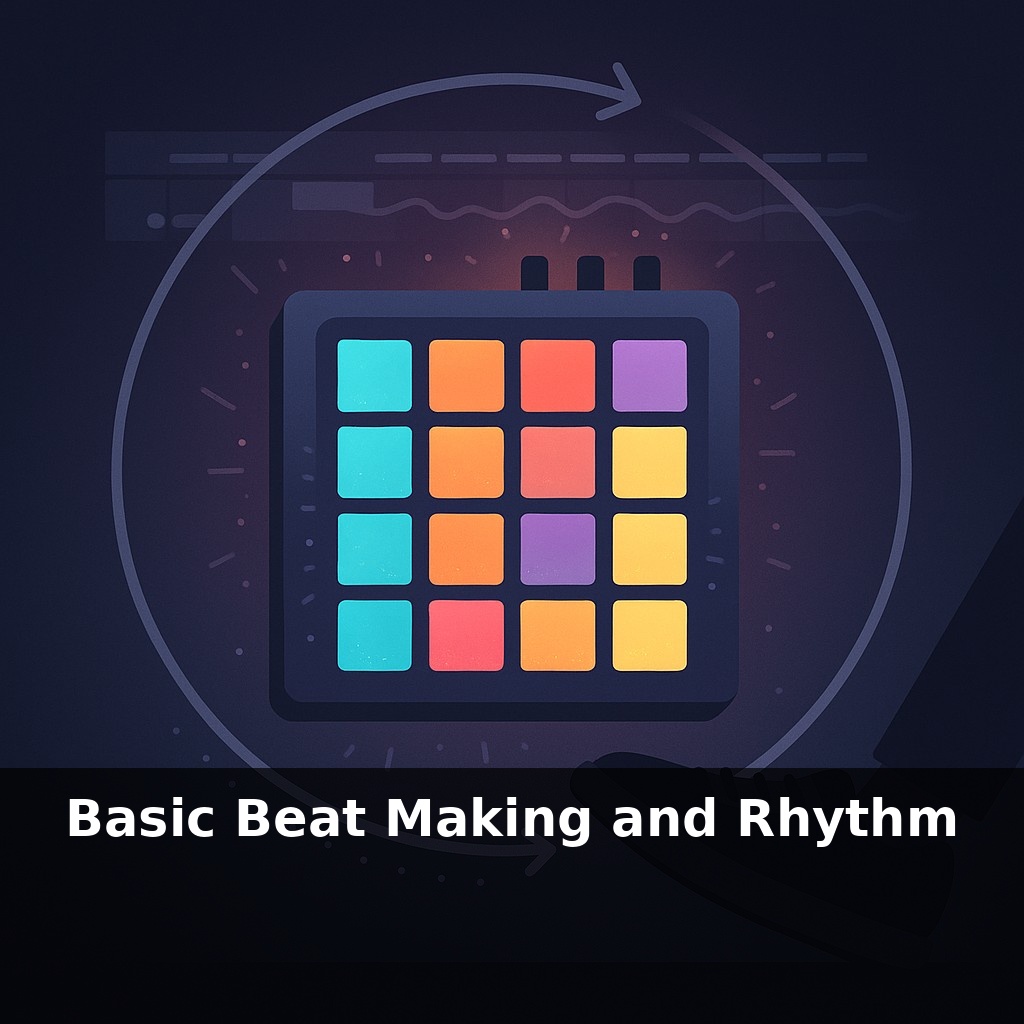
Right now your DAW’s empty grid is more like a blank calendar than a song. This episode is about deciding what actually lands on those spaces—and why. We’ll zoom in on just four sounds: kick, snare or clap, hi-hat, and one extra percussive layer. You’ll see how different genres use the same basic pieces in wildly different ways: steady four-on-the-floor for EDM, half-time kicks and 808s for trap, or sparse, punchy patterns for pop. We’ll also touch on time signatures and subdivisions so you can choose whether your loop feels like a march, a strut, or a late-night shuffle.
Start by shrinking your world down to 1 bar. Not a song, not an intro—just that tiny loop. Set your DAW to 4/4 and pick a tempo that matches your goal: something like 124–128 BPM if you’re leaning dancey, 70–75 BPM (or double-time 140–150) if you’re chasing a trap feel. Don’t overthink the number; you can always change it later. The important thing is committing long enough to feel how patterns behave inside it.
Now, look at that single bar on your grid as four strong steps: 1, 2, 3, 4. Place your main low drum on 1 and 3, and your sharper backbeat on 2 and 4. You’ve just created a basic pulse that will work in almost any genre. From here, everything is about what you *don’t* hit as much as what you do. Leaving a tiny gap before or after those main hits gives space for tension and release.
Next, turn to subdivisions. Switch your grid to 1/8 notes and sprinkle short ticks between the main beats. Straight 1/8s across the bar create momentum; skipping every other one opens breathing room. Then try 1/16s for more detail—but resist filling them all. A sparse pattern emphasizes groove far more than a solid “machine gun” line.
This is where swing and dynamics come in. Instead of hard-quantizing everything, experiment with your DAW’s groove controls. A slight push toward classic MPC swing (around the mid-50% range) will delay certain subdivisions just enough to change the emotional tilt—from rigid march to loose strut. Pair that with velocity tweaks: make the first tick after each main beat slightly louder, the next slightly softer. You’re shaping a contour, not just turning notes on.
Finally, think in 4-bar phrases. Duplicate your 1-bar loop three times, then change one small detail in bars 2 and 4: remove a kick, add a ghost note, open a hi-hat right before the loop restarts. That tiny evolution is what keeps a 7.5-second loop at 128 BPM from feeling like copy-paste fatigue. Treat those four bars as your “unit of feeling”: if you want to listen to it 20 times without boredom, you’re close to something worth building a track around.
Think of your 4-bar loop like a tiny sports drill: you’re running the same route, but changing one move so your timing and reactions sharpen. To *feel* this, pull up three real-world references and rebuild just their drum bones by ear.
Start with a big festival EDM track: focus only on when low and high sounds arrive. Don’t worry about matching samples—treat it like tracing over a play in slow motion. Then do the same with a trap track, and finally a stripped pop song where drums leave more silence. You’ll start hearing how space and density are doing as much work as loudness.
As you copy, notice where producers *break* the pattern. Is there a missing kick right before a chorus? A sudden burst of fast hats in bar 4? Tag those “moves” as ideas you can steal later.
Your challenge this week: rebuild three favorite tracks’ drum patterns on your grid, using only four sounds. No extra instruments. When you’re done, mute the references and tweak each pattern until it still feels good—even when it’s only your loop left standing.
Soon, starting a loop might feel less like dragging notes and more like sketching in mid-air. AI tools will whisper “try this groove” the way autocomplete guesses your next word, while motion controllers turn a wrist flick into a roll or fill. As spatial formats mature, you’ll be deciding *where* sounds orbit, not just *when* they land. Combined with trackable ownership for tiny ideas, a simple 4‑bar sketch on your laptop could seed collaborations—and income—far beyond your bedroom.
As you keep looping, notice how tiny shifts start shaping mood—like changing camera angles on the same scene. A late hat can make a groove swagger; a soft extra hit can hint at tension. Over time, you’ll collect these moves the way skaters collect tricks: small, personal signatures that turn a blank session into something unmistakably yours.
Here’s your challenge this week: make a 4-bar drum loop at 90–100 BPM using just kick, snare, and hi-hat, and program it in your DAW (or drum machine) using a simple kick on 1 and 3, snare on 2 and 4, and 8th-note hats. Then create two variations of that same groove: one where you add a single ghost note on the snare, and one where you shift a hi-hat slightly off the grid to add swing. Export all three loops and listen back-to-back, paying attention to how tiny timing and velocity changes affect the feel. By the end of the week, you should have three saved patterns labeled “Basic,” “Ghosted,” and “Swung” that you can reuse in future tracks.