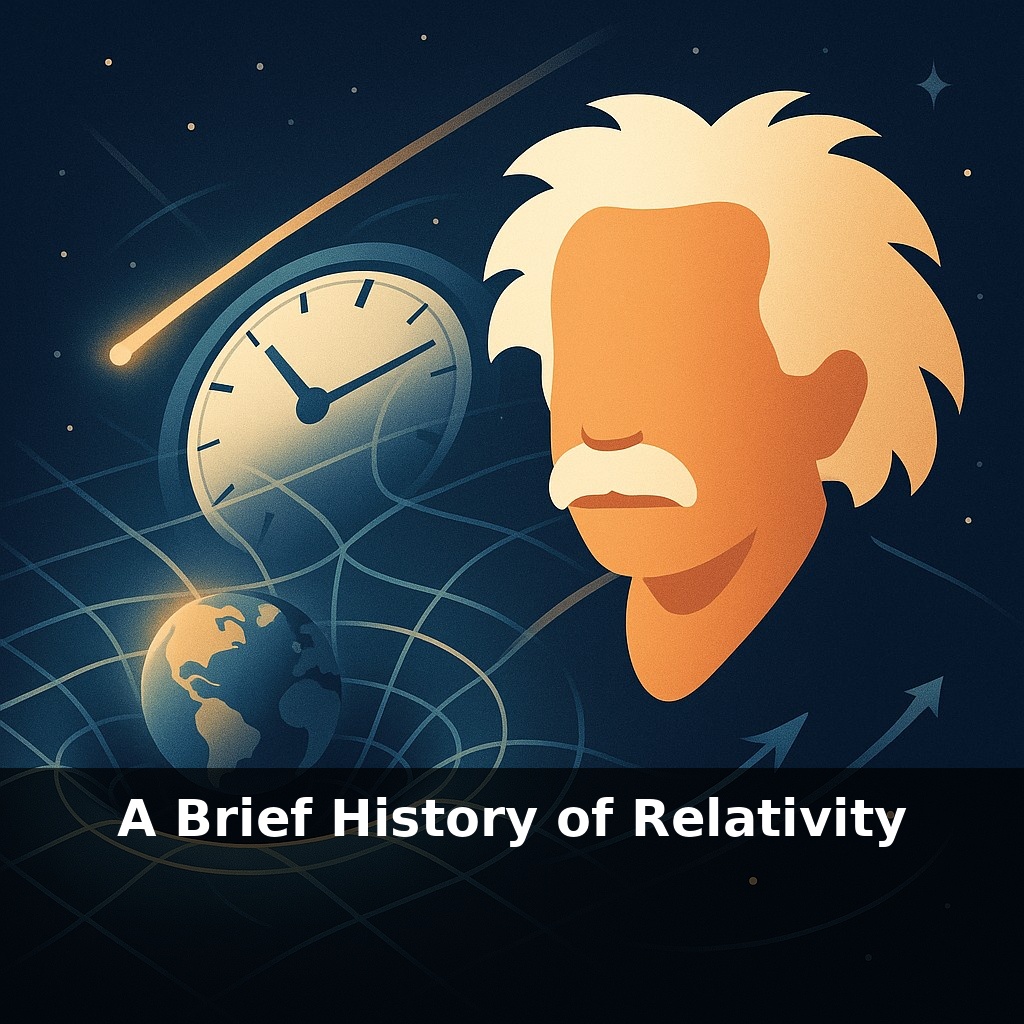
A Brief History of Relativity
📝 Transcript
You’re late for work—but it’s not your fault. Your clock ticked slower than your boss’s, and both of you are right. That’s not science fiction; that’s how time actually behaves near Earth. In this episode, we’ll step into a universe where “now” depends on where—and how—you move.
Einstein didn’t just tweak old physics; he rewrote what “where” and “when” even mean. Before him, most scientists pictured space as a rigid, invisible grid and time as a universal, perfectly synchronized clock. Relativity shatters that comfortingly simple backdrop and replaces it with a four‑dimensional stage where distances, durations, and even straight lines depend on motion and gravity.
In this episode, we’ll zoom out from personal experiences of shifting time and look at how relativity reshaped the whole map of the universe: from Mercury’s off‑beat orbit to the bending of starlight around the Sun, from the energy locked inside atoms to ripples in space‑time crossing the cosmos. We’ll trace how a handful of papers in 1905 and a bold leap in 1915 turned philosophical arguments about motion into precise tools that guide spacecraft, power reactors, and test our deepest ideas of reality.
Relativity didn’t arrive as a single, polished theory; it grew out of centuries of friction between ideas and experiments. Philosophers argued about absolute motion; engineers built ever more precise instruments; astronomers kept spotting tiny mismatches between predictions and the sky. Einstein stepped into this ongoing puzzle as a patent clerk sifting through other people’s inventions. In 1905 and 1915, he offered a new rulebook that finally made those stray details click together, like a map that suddenly lines up with every landmark sailors had logged for generations.
In 1905, working full‑time in a Swiss patent office, Einstein published five papers that quietly detonated across physics. One explained the photoelectric effect (and later won him the Nobel Prize). Another used jittery “Brownian motion” of pollen grains to make the case that atoms are real, countable things. A third introduced the mathematics now called Special Relativity. Tucked into that framework, a short follow‑up note gave the most famous equation in science: E = mc².
Mass–energy equivalence meant that a tiny amount of mass hides an enormous amount of energy. Decades later, that insight would underpin nuclear reactors and bombs: in fission and fusion, a small “missing” mass shows up as a huge energy release, exactly as E = mc² demands. Modern power grids, medical isotope production, and even some deep‑space probes lean on that bookkeeping of mass turning into energy and back.
But Special Relativity still treated gravity as an external input, not part of the same geometric story. The orbit of Mercury nagged at astronomers: its closest‑approach point to the Sun slowly rotated, and Newton’s equations missed the rate by 43 arcseconds per century. Tiny, but persistent. Einstein spent almost a decade wrestling with this and related puzzles, pushing toward a theory where gravity emerged from the structure of the cosmos itself.
In 1915, General Relativity provided that leap. Suddenly Mercury’s odd precession dropped out naturally from the new equations. So did the prediction that light would bend as it passed near massive bodies. In 1919, during a solar eclipse, Arthur Eddington’s team measured starlight deflected by the Sun by just the amount Einstein had calculated, turning an abstract set of field equations into front‑page news.
Since then, the tests have only grown more extreme. Radio signals skimming past planets, binary pulsars slowly spiraling together, and finally the 2015 LIGO observation of GW150914—gravitational waves from colliding black holes—have all lined up with Einstein’s rulebook. Even the few‑centimeter daily corrections required to keep GPS satellites honest are quiet, continuous confirmations that this geometric description of the universe is not just elegant, but indispensable.
Your challenge this week: treat every “perfectly obvious” straight line in your daily life—a road, a beam, a skyscraper edge—as a local compromise with a larger curve. When you use a map app, look up how far you are from the center of Earth and recall that your directions assume a specific geometry of the planet and its gravity. If you pass a construction site with laser levels or surveying gear, pause and ask: under what conditions would these lines need to be rethought because space itself curves differently? By the end of the week, you’ll have trained yourself to notice how many technologies quietly assume—and depend on—Einstein’s reshaped picture of the world.
Think about how often your devices quietly depend on relativity without announcing it. When your phone guides a plane across continents, it’s relying on satellite clocks that have to be corrected because of both their speed and their height above Earth. Those tiny adjustments are the difference between a smooth landing and a runway missed by kilometers. In cosmology, distant galaxies aren’t just “far away”; their light stretches as the universe expands, letting astronomers read their recessional speeds and reconstruct how the cosmos has grown over billions of years. Even in laboratories, beams in particle accelerators must be steered with equations that assume velocities flirting with light speed; otherwise, collisions wouldn’t happen where detectors wait. One fresh way to picture all this: like a long‑distance hiking trail that crosses multiple climates and terrains, physics now uses a single, continuous route—relativity—to connect technology, astronomy, and subatomic experiments into one coherent journey.
Relativity’s next tests will come from instruments that listen instead of look. Space‑based detectors will tune in to slower, deeper cosmic notes, like a violinist suddenly hearing the bass section. Those signals could expose how black holes formed, whether dark energy shifts over time, and whether gravity itself ever breaks its own rules. Closer to home, ever‑finer models will guide dense satellite swarms and autonomous craft threading crowded orbits with meter‑scale confidence.
Relativity is still a work in progress, more like an unfinished mural than a sealed museum piece. Future collisions of data—from quantum experiments, deep‑space probes, and next‑generation observatories—may reveal tiny cracks in Einstein’s picture. Following those hairline fractures could guide us toward a deeper theory, where gravity and the quantum finally share the same canvas.
Try this experiment: Grab a laser pointer (or bright flashlight), a mirror, and a watch, then shine the beam at the mirror and imagine the light’s path as a “light clock” bouncing back and forth between you and the mirror. Now walk slowly toward and away from the mirror while keeping the beam steady, and picture how, from a “side view,” that light path would trace a longer diagonal line—just like in Einstein’s thought experiment about moving clocks and time dilation. To push it further, look up the exact speed of light (about 300,000 km/s) and calculate how far light travels in one second compared to something familiar, like the distance around Earth, so you can feel how dramatic it is that this speed stays fixed no matter how you move.
From this course
Relativity Beyond Einstein
7 episodesUnlock all episodes
Full access to 7 episodes and everything on OwlUp.
Subscribe — $1.99/monthLess than a coffee ☕ · Cancel anytime