Light is both our universe’s speed champion… and still not fast enough. By the time sunlight hits your face, it’s already old news. In today’s episode, we drop into a race where catching up with the cosmos might mean bending reality’s rulebook itself.
Einstein drew a hard line under how fast anything can move *through* space—but he never said space itself had to behave politely. In fact, our best cosmological measurements show distant galaxies slipping beyond our reach, not because they’re rocketing away in the usual sense, but because the very distances between us are stretching. That strange detail cracks open a deeper question: is “faster than light” truly forbidden, or just misunderstood?
To probe this, physicists push particles to extreme energies, watch pulsars tick with absurd precision, and sift through gravitational waves for the slightest hint that spacetime can be coaxed into doing something unusual. Meanwhile, quantum experiments keep teasing us with correlations that act instantaneously, yet refuse to carry a usable message. In this maze of limits and loopholes, we’ll ask a sharper question: not just “how fast can we go?”—but “how differently can reality arrange motion?”
Physicists now probe these limits by asking a sharper question: not “how fast can we go?” but “what exactly is doing the going?” In particle colliders, beams are pushed so close to light speed that tiny changes in energy reveal whether nature secretly allows shortcuts. Astronomers compare the ticking of distant supernovae and gamma‑ray bursts, hunting for delays that would hint at cracks in our current rules. Even GPS satellites must account for relativity just to tell your phone where the nearest café is, quietly stress‑testing Einstein every time you check a map.
“Nothing can outrun light” sounds absolute, yet the universe keeps offering edge cases that force physicists to sharpen what that sentence really means.
Start with a practical limit: acceleration. Even if you had unlimited energy and a perfectly efficient engine, pushing a spaceship closer to c doesn’t just make it go faster; it makes each extra nudge of speed exponentially more expensive in energy. At 10%, then 50%, then 90% of c, you pay increasingly steep energy costs. Near c, most of what you add turns into extra kinetic energy and relativistic mass‑energy, not extra speed in the usual sense. So the barrier isn’t a literal wall—it’s an economic cliff.
Particles in accelerators show this clearly. Protons in the Large Hadron Collider carry energies comparable to a flying mosquito, yet crawl only a whisper below c. Give them more energy and their “gamma factor” soars, but their speed barely budges. That behavior is one of the cleanest confirmations that our speed limit isn’t just a human convention baked into equations; it’s encoded in how energy and motion relate.
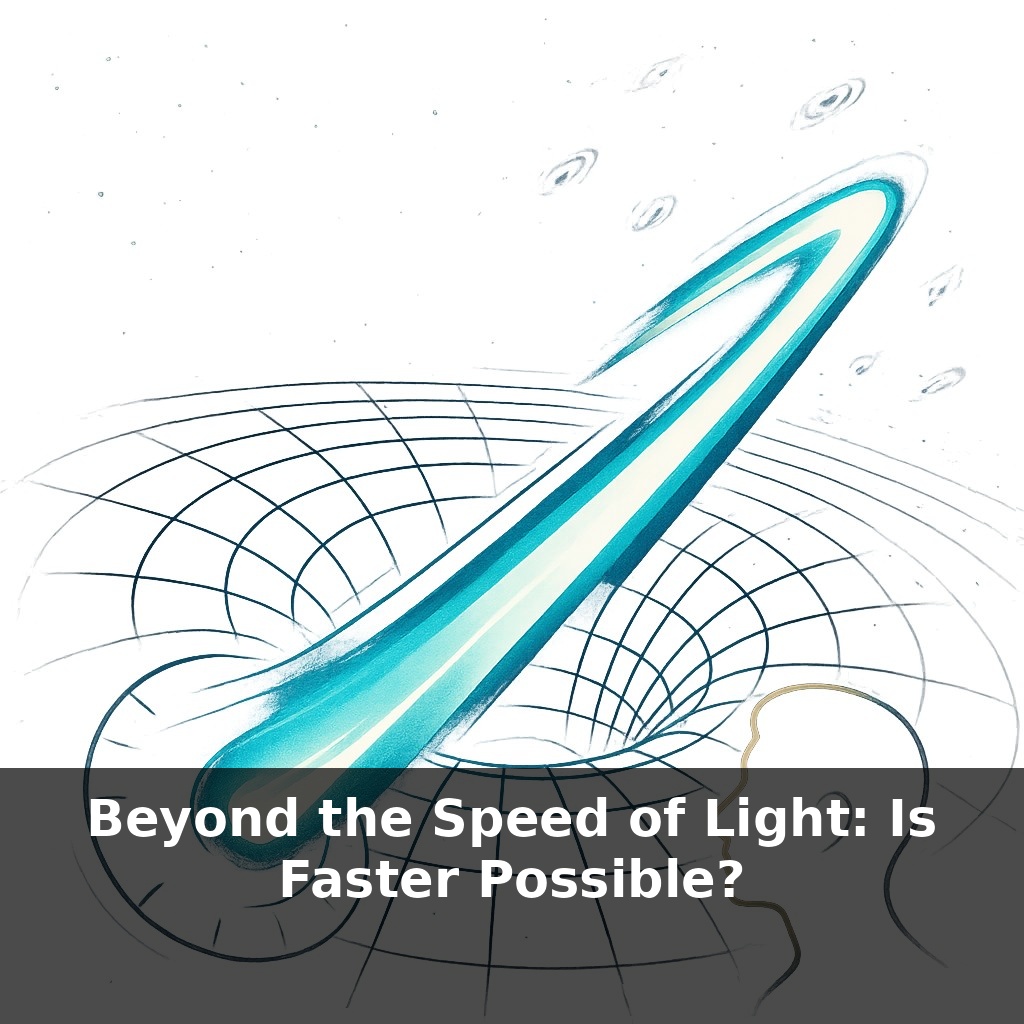
Then there are proposals that try not to beat the limit, but to route around it. Wormhole solutions in general relativity connect distant regions so that a shortcut could exist entirely within the rules of local motion—no segment exceeding c, yet endpoints linked in less time than a light beam would need in normal space. In theory, you could depart after a light signal is sent and still arrive before it. The catch is immense: known wormhole geometries demand exotic stress‑energy distributions that violate the energy conditions ordinary matter obeys.
The same issue haunts warp‑style concepts: you don’t push a ship faster; you engineer a moving bubble of geometry. Calculations suggest you’d need negative energy on astrophysical scales and exquisite control over curvature itself. Quantum field theory allows tiny, fleeting negative energy densities, but nothing close to the stable, structured reservoirs these ideas require.
And lurking behind every apparent loophole is causality. Whenever a model seems to permit usable signals that outpace c, careful analysis almost always uncovers time loops or paradoxes. The rule holds not just because experiments say so, but because breaking it tends to break “before and after” in the process.
Your challenge this week: pick one speculative idea—wormholes, warp bubbles, or any FTL concept you like—and trace it back to the *specific* physical ingredient it would need that we have not yet observed in nature. Don’t stop at “exotic matter” or “new physics”; hunt down what, exactly, would have to be different about energy, fields, or geometry. By the end of the week, see if you can phrase that missing ingredient as a single, sharp constraint: “This would be possible *if*…”.
Some of the strangest “maybe” routes beyond our familiar velocity limit come from places that sound almost mundane at first. Take refractive index engineering: in certain crystals and metamaterials, carefully tuned structures let light pulses slow, stop, or appear to jump ahead, so the peak of a pulse exits before the peak fully enters. No rule is broken because the reshaped pulse isn’t carrying new information faster than a front edge can move, but it hints at how much room there is to sculpt propagation.
Or look at astrophysical jets: around black holes, magnetic fields funnel plasma into narrow beams that skim so close to our directional line of sight that their apparent motion across the sky exceeds any naive speed limit. It’s a geometric mirage, yet it shows how perspective and timing can conspire to fake super‑speed. Together, these lab tricks and cosmic alignments sketch a quieter lesson: you don’t need new physics to blur intuition about “how fast” something seems to get from here to there.
Treating c as non‑negotiable forces technology down creative side roads. Instead of outrunning beams, we learn to *lean* on geometry, timing, and fields. That nudges engineers toward swarms of slow probes, beamed sails, and autonomous explorers that think for us far from home. Communication lags turn mission control into more of a gardener than a pilot. Even at home, navigation, timing networks, and particle tech quietly inherit the same discipline: design every system as if delay itself were a raw material.
So for now, every wild drive concept is really a sketch of what tomorrow’s physics might demand: stranger energy, subtler geometry, new ways to braid gravity and quantum rules. Think of today’s equations as a rough map; the “here be dragons” regions may never host starships, but they already guide where we point telescopes and particle beams next.
Start with this tiny habit: When you see the word “light” anywhere during your day (a light switch, a lamp, sunlight, your phone screen), pause and silently ask yourself, “What would it *feel* like if information couldn’t go any faster than this?” Then, imagine for just one breath that every message, signal, or spaceship in the universe is stuck with that same ultimate speed limit. If you’re near your phone, take 10 seconds to Google “cosmic speed limit c” and glance at one image or diagram of spacetime or light cones—no reading required, just a visual. Let that little moment be your daily nudge to keep the weirdness of relativity and “faster than light” ideas at the front of your mind.