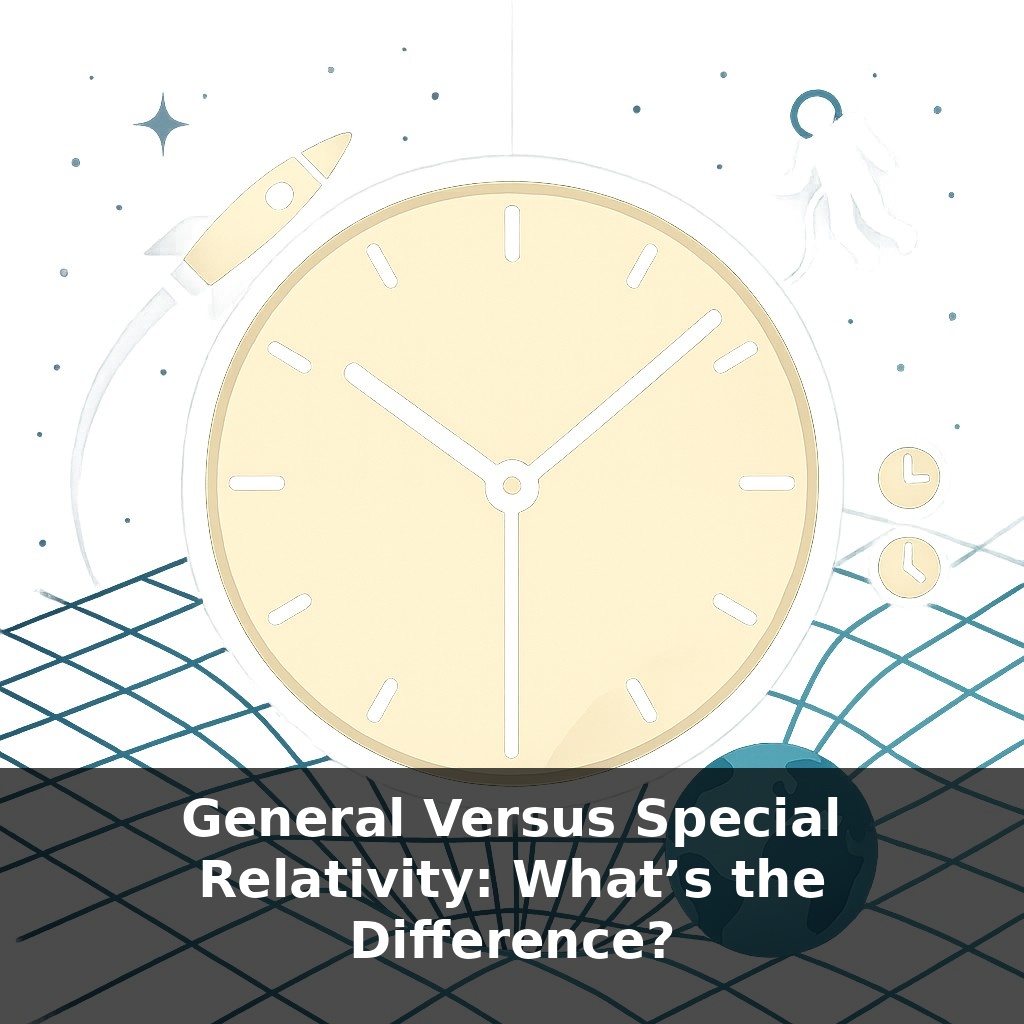
Time runs slower for astronauts than for you, but faster for a clock on your shelf than one on your floor. Same universe, two different rules of time. In this episode, we’ll step into that tension and ask: when does Einstein’s “special” relativity stop being enough?
We left off with clocks disagreeing—on rockets, in orbit, even between your shelf and your floor. Those quirks already pushed us past everyday intuition, but they still played by one quiet rule: motion was the main culprit. Now we widen the lens.
This time, the question isn’t just “Who’s moving?” but “What kind of spacetime are they moving through?” That shift is as dramatic as going from a flat city map to a relief map that suddenly reveals mountains, valleys, and winding passes. Straight lines no longer mean what you thought they did.
In this episode, we’ll contrast two worldviews. One treats gravity as a pull between masses; the other treats it as a change in the very stage on which matter and light perform. We’ll connect that shift to real tools—like GPS, gravitational waves, and black holes—and see why “special” relativity, powerful as it is, had to give way to a deeper, more flexible theory.
To move forward, we need to decide *when* each theory is trustworthy. That choice quietly steers everything from spacecraft navigation to the timing of signals in particle colliders. One way to think about it: special relativity is like a perfectly straight, well‑paved highway—great as long as the landscape stays flat and you don’t turn too sharply or climb too steeply. General relativity steps in when the “road” itself twists, buckles, or dips. Near Earth’s surface, around black holes, or across cosmic distances, those subtle bends stop being optional details and start becoming the main story.
Call two physicists into a room and ask them to “draw the universe.” One starts with a clean sheet and a ruler: straight gridlines, evenly spaced ticks, neat axes labeled space and time. That’s the domain where the earlier theory shines: motion can be fast, but the background behaves itself. The other physicist hesitates, then reaches for a flexible sheet and starts stretching and pinching it. Distances between ticks change. Angles drift. Lines that *were* straight now lean into unexpected paths.
That second drawing isn’t just artsy flair; it encodes when the simpler picture breaks. The giveaway is *acceleration* and *mass-energy piled up in one place*. Both create telltale signatures that the straight-grid universe can’t fully capture.
Start with acceleration. A lab in deep space, drifting steadily, can use the simpler theory to track particles flawlessly. Fire its rockets, and oddities creep in. Light beams curve relative to the lab’s floor. Identical clocks at the top and bottom tick at different rates. You can patch these effects locally—over a small region and short time—by pretending you’re back in a drifting lab. But stitch many such patches together and the clean grid refuses to reassemble without wrinkles. Those wrinkles are what the later theory promotes to first-class citizens.
Mass-energy does something similar but without the drama of roaring engines. Cluster enough matter—stars, planets, gas clouds—and you find that every attempt to cover a large region with a straight grid runs into contradictions. Triangles on cosmic scales don’t add up to 180°. Planetary orbits precess by tiny, stubborn amounts that no amount of tweaking in the older framework can erase. Even light, which should trace the sharpest possible paths, bends around galaxies and black holes.
A useful rule of thumb emerges: if you can treat your lab as tiny, unaccelerated, and far from huge masses, the older description is not just convenient, it’s astonishingly accurate. The moment you widen your view—years instead of seconds, star systems instead of rooms, free-fall toward something massive instead of gliding past it—the newer picture stops being optional decoration and becomes the only way to keep all the observations consistent.
Stand on a mountain ridge watching two hikers: one follows a straight, well-marked path; the other weaves along a faint trail that hugs the contours of the land. Both eventually reach the same viewpoint, but their routes reveal different details. Physics works similarly. For high-speed particles in a collider, the “straight path” description lets us predict how beams smash together and create new particles. The moment you involve an entire galaxy, or a signal crossing from satellite to ground, you need the contour‑hugging route to see how subtle bends accumulate.
Consider three concrete cases. In particle accelerators, engineers lean on the simpler framework to time collisions to fractions of a nanosecond. For satellite timing systems, designers must overlay an additional layer of correction to keep your phone’s map from drifting kilometers off course each day. And when astronomers listened for colliding black holes, only the contour‑aware equations could decode the faint ripples they heard into masses, spins, and a distance of over a billion light‑years.
As detectors sharpen and clocks grow more precise, the boundary between the “straight‑grid” lab and the wrinkled cosmic sheet turns into a testing ground. Tiny mismatches in how signals arrive from pulsars, how galaxies rotate in their dark halos, or how black holes ring after merging could hint that Einstein’s picture is only an approximation, like a good city map that blurs the side streets. Following those faint discrepancies may be how we learn whether spacetime itself has atoms—or something stranger.
We’ve now seen two maps of reality, each accurate in its own territory. The next step is to ask where they might *both* fail. Quantum fuzziness at tiny scales, cosmic mysteries like dark energy, and hints from black‑hole interiors all suggest today’s picture is still provisional. In the coming episodes, we’ll follow those cracks to whatever comes after Einstein.
Before next week, ask yourself: 1) “Where in my everyday life could I actually *see* special relativity at work—like in GPS signals, particle accelerators in the news, or time dilation for fast-moving satellites—and how does picturing spacetime as a 4D ‘stage’ change the way I imagine those examples?” 2) “If I treat gravity not as a force but as curved spacetime (à la general relativity), how would that reshape how I picture an apple falling, the Earth orbiting the Sun, or light bending around a massive object?” 3) “What’s one confusing bit from the episode—like simultaneity, reference frames, or the equivalence principle—that I can revisit today by sketching a simple diagram or finding a short explainer video, and then re-explaining it in my own words as if I were teaching a curious friend?”