A star can die so completely that its “corpse” erases its own past and future. Astronomers now treat these black holes not as rare monsters, but as standard parts of galaxies like ours. So how does relativity turn ordinary starlight into a one‑way ticket out of the universe?
A century ago, Karl Schwarzschild solved Einstein’s equations from a World War I trench and found a startling result: some solutions didn’t describe gentle cosmic curvature, but a point of no return. Most physicists treated this as a mathematical curiosity, like a strange side street on a carefully drawn city map that no one expected to find in the real world. Yet the universe turned out to be full of such “streets.” We’ve since tracked stars whipping around an unseen mass at our galaxy’s center, watched matter heat up and flare as it spirals inward, and even measured spacetime itself ringing like a struck bell when black holes collide. In this episode, we’ll follow that trail: from skeptical equations to images, signals, and shadows that reveal how far relativity can be pushed before it breaks.
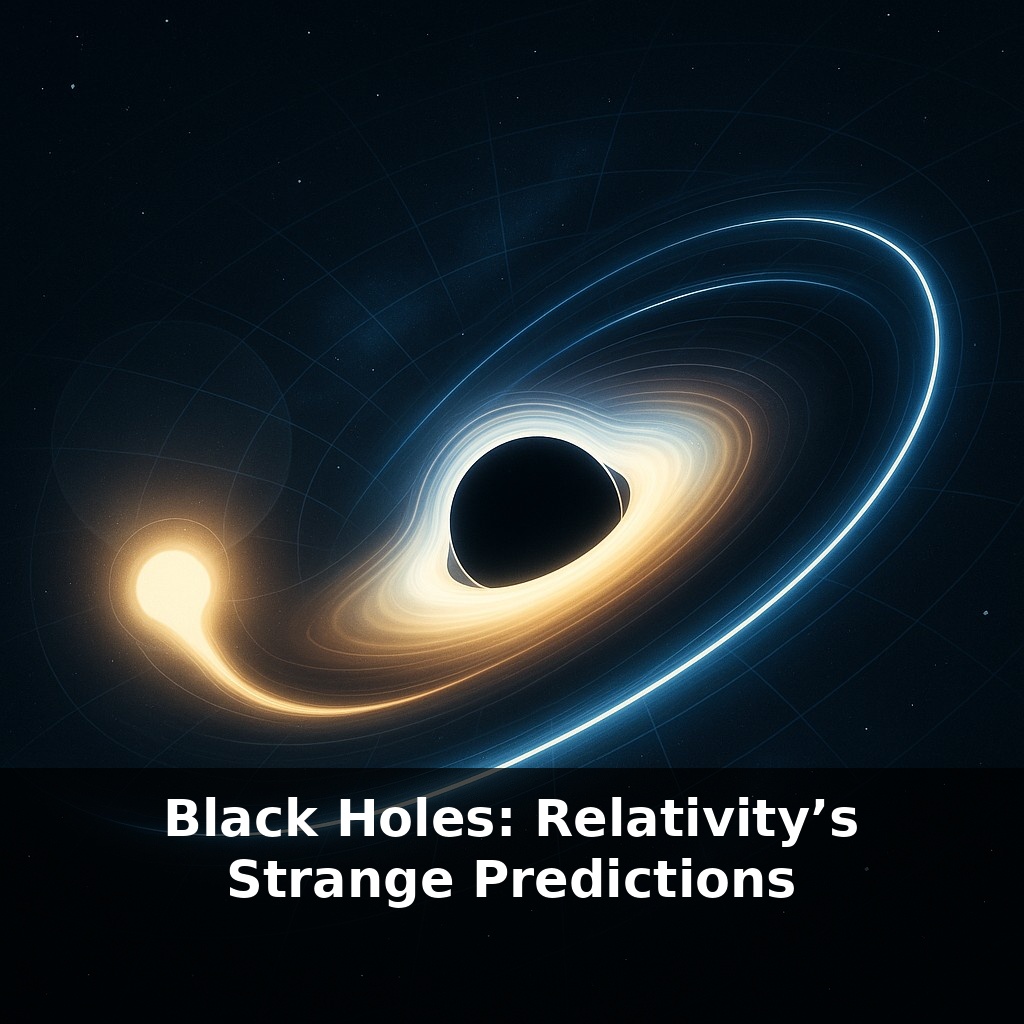
Einstein’s equations say black holes are allowed; the universe goes further and treats them as construction sites. Around many galaxies, stars, gas, and even smaller black holes orbit an unseen anchor, and the way they move lets us weigh that hidden mass with surprising precision. Where the environment is messy, matter falling inward forms whirling disks that blaze in X‑rays and jets that can outshine entire galaxies, sculpting where new stars can form. In this episode, we’ll treat these “cosmic engines” as laboratories, asking what they reveal—and conceal—about how gravity really behaves.
Near the threshold where a massive star collapses, physics starts speaking two different languages. One uses familiar quantities—mass in solar units, radii in kilometers. The other uses pure geometry: how tightly you can bend light paths and squeeze time. The “no‑escape” surface where those descriptions collide is the event horizon, whose radius scales neatly with mass: about 3 km per solar mass. A black hole ten times the Sun’s mass hides behind a horizon roughly 30 km across; scale that up to Sagittarius A* and you’re still talking about a region smaller than Mercury’s orbit quietly steering an entire galaxy’s core.
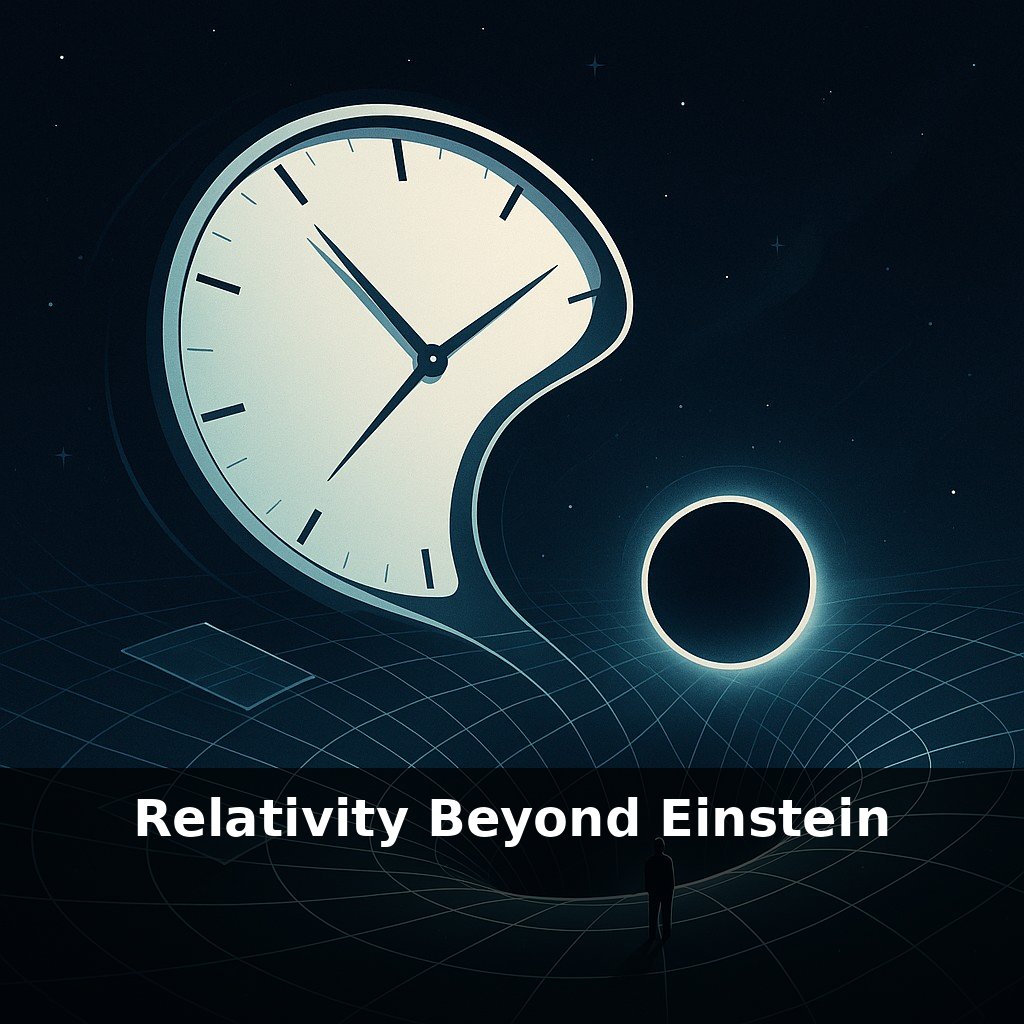
The strangeness ramps up as you approach that surface. Clocks that fall toward it keep ticking normally by their own measure, but a distant observer would see them slow, redden, and fade, never quite crossing. This isn’t an optical trick; it’s what the equations say about how time itself stretches. Near rapidly spinning black holes, this stretching is joined by twisting: spacetime is literally dragged around, forcing nearby objects to swirl even if they’d “prefer” to sit still. X‑ray observations of hot gas close in let astronomers map how fast that swirl happens and infer the spin.
Black holes also set up clean experiments in extremes. Smash two together and you generate a burst of gravitational waves whose shape encodes the masses and spins of the pair, and tests whether the merged object “rings down” exactly as relativity predicts. LIGO and Virgo have seen that ring‑down obey the rules again and again, up to tens of solar masses. At galactic centers, mergers of supermassive black holes should produce slower, longer waves; pulsar timing arrays have now glimpsed a background hum that likely comes from such titanic pairings.
On the electromagnetic side, the Event Horizon Telescope turns our whole planet into a dish to silhouette the shadow cast by M87* against its glowing surroundings. That shadow’s size and near‑perfect circularity match relativity’s expectations to within tens of percent—a demanding test in a messy, magnetized environment.
In all these cases, the strategy is the same: push into conditions no lab can reach, then ask whether the universe still follows Einstein’s playbook right up to the brink of the singularity.
A good way to see how far we’ve pushed these ideas is to look at specific “stress tests” nature offers. Take stellar corpses: when collapsing cores overshoot the neutron‑star limit, we don’t just infer a new category—we see sudden gamma‑ray flashes, fading X‑ray afterglows, and, in rare cases, a gravitational‑wave chirp arriving within seconds of high‑energy light. That timing pins down how sharply the transition to a black hole must occur. Or consider galaxies whose centers flare unpredictably: careful monitoring has caught a few in the act of shredding unlucky stars, their debris lighting up in patterns that reveal how close the star grazed before being torn apart. On much larger scales, astronomers stack data from many such outbursts and mergers, building population statistics: how often do the most massive holes collide, how quickly do they grow, how many are spinning rapidly? Each catalog update is less like adding a new exotic beast and more like revising a field guide to a very busy cosmic ecosystem.
Black holes may become precision tools, not just distant curiosities. Future detectors should “listen” to mergers across the universe, tracing when the first giant holes lit up young galaxies. Space observatories could catch subtle distortions in flickering light near their edges, hinting at quantum corrections. One fresh analogy: like restorers examining a cracked painting to infer the artist’s technique, physicists will read tiny deviations in black‑hole behavior to probe new physics beyond Einstein.
Next in this series, we’ll head closer to the “forbidden center,” where quantum rules should clash with Einstein’s smooth geometry. Hawking radiation, information puzzles, and exotic ideas like firewalls turn these regions into theoretical sketchbooks, with every new observation like adding a faint pencil line that might later reveal an unexpected doorway.
Before next week, ask yourself: “If I stood just outside the event horizon of a black hole, what everyday thing (a clock, my own heartbeat, a friend calling from far away) would look or feel different because of extreme time dilation—and how does that change how I picture ‘time’ in my normal life?” “When I hear that spacetime itself is curved by mass, can I pick one real object around me (a car, a building, a mountain) and imagine how it subtly warps the ‘fabric’ I’m sitting in right now?” “If I had to explain the difference between the singularity ‘where the math breaks’ and the event horizon ‘the point of no return’ to a curious 10‑year‑old tonight, what simple story or metaphor would I actually use?”