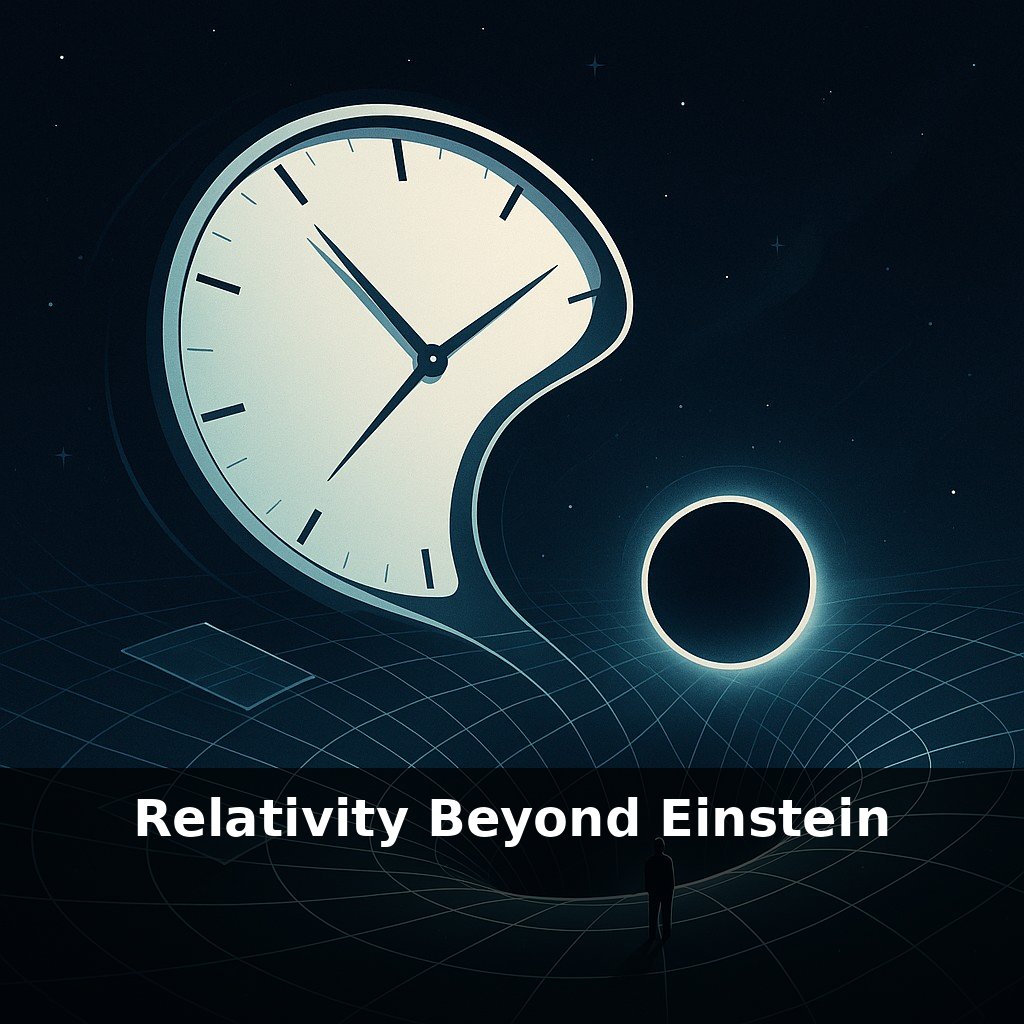
Light doesn’t travel in straight lines. During a famous eclipse, starlight near the Sun bent, as if space itself were warped. On your daily walk, you trust the map in your phone—guided by satellites whose clocks tick differently because space and time are not what they seem.
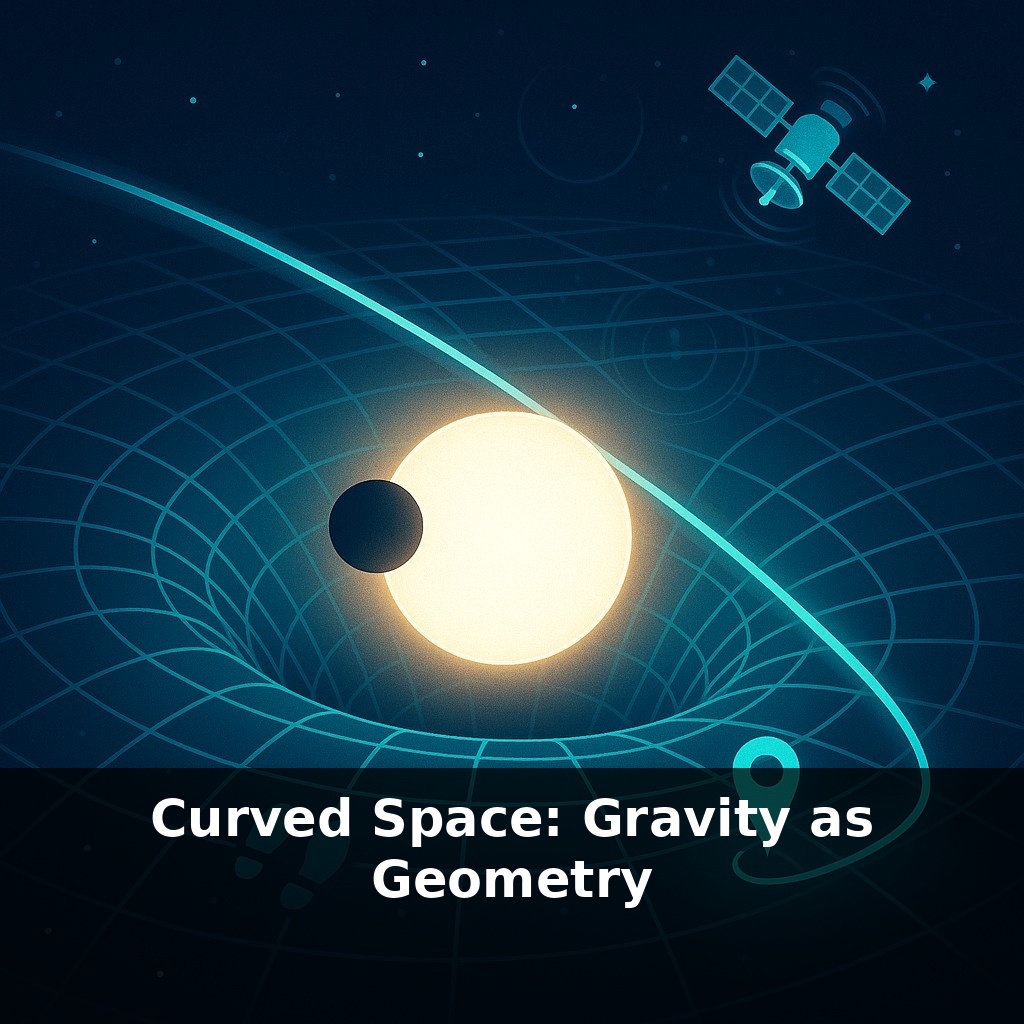
Einstein’s leap was to say: gravity isn’t a force pulling things down—it’s the shape of the stage everything moves on. Once you accept that, everyday events start to look different. A falling apple is quietly tracing out the straightest possible path through a twisted landscape of space and time. Planets are not leashed to the Sun by invisible strings; they surf along the contours of a cosmic terrain sculpted by mass and energy.
This shift from “force” to “geometry” solved old puzzles and opened new tools. The extra twist in Mercury’s orbit, the delicate timing of GPS, and the faint shiver LIGO recorded are all different ways the universe reveals its underlying architecture. Like a hiker reading contour lines on a map, physicists learn to read curvature in equations—and then go looking for its fingerprints in the sky and in our technology.
Curved space-time is more than a poetic description; it’s a precise blueprint that tells us how to predict motion, time, and even the limits of what can escape from where. Near Earth, this blueprint lets engineers correct GPS orbits with almost casual confidence. Near a black hole, the same rules become extreme, stretching time and squeezing paths so tightly that even light can’t turn back. Mathematically, all of this is encoded in curvature: numbers that say how much triangles fail to add up to 180°, how much parallel paths drift, and how clocks disagree when they reunite.
To see what “curved space-time” really buys us, start with something deceptively simple: how you decide what counts as “straight.” On a flat table, it’s obvious. But draw a route on a globe from New York to Paris, and the shortest path looks oddly curved on a flat map. The plane is not constantly “turning left”; it’s following the closest thing to a straight line available on a round surface—a geodesic.
General relativity takes this idea and deepens it: free-falling objects follow geodesics in space-time, and curvature tells those paths how to diverge or converge. Put two satellites in nearly identical orbits. Newton’s picture says they should cruise along with a predictable separation. Einstein’s picture says: check more carefully. Their worldlines thread through subtly different regions of curvature, so the distance between them will grow or shrink in ways only a geometric theory can fully capture. This isn’t a philosophical flourish; it is literally how we model satellite constellations and detect tiny tugs from Earth’s uneven mass distribution.
Curvature also shows up whenever you compare clocks. Take one clock on a mountain and one at sea level. Bring them back together later. According to the geometry around Earth, the higher clock ages more. This “gravitational time dilation” isn’t an add-on; it is what you get when you insist that time be part of the same curved structure as space, and that everyone—stones, photons, astronauts—moves along its geodesics according to the same rules.
Even the strength of tides becomes geometric. In Newton’s language, tides arise because gravity is stronger on one side of an object than the other. In Einstein’s language, they arise because neighboring geodesics converge or diverge: two falling particles starting side by side near a massive body don’t stay side by side. Their separation encodes components of the curvature itself, described mathematically by the Riemann tensor. Measuring how freely falling paths shear, squeeze, or twist is, in practice, how we “feel” the shape of space-time without ever stepping outside it.
On a long-distance hike, the lines on your topographic map don’t push you, yet they quietly dictate where water will collect, how hard the ascent will feel, and which passes are even possible. In physics, curvature plays a similar hidden role, setting what orbits are stable, how signals can weave through the cosmos, and where energy can safely flow. The Sun’s pull shapes safe “highways” for missions like the Voyager probes, whose paths thread through gentle valleys in the gravitational landscape of the Solar System.
Zooming out, we use the same geometric language to chart galaxy clusters. Their combined mass sculpts channels that guide entire swarms of galaxies and bend the glow of background objects into arcs and rings. Astronomers call this gravitational lensing, and it acts as a natural telescope and a weighing scale at once, revealing dark matter by the geometry it imposes. Even in the early universe, tiny ripples in curvature seeded the vast web of structure we now map with surveys like DES and Euclid.
Einstein’s geometry isn’t just a better map; it hints the map itself may be incomplete. Future detectors like LISA and the Einstein Telescope will “listen” for ripples that don’t quite match our expectations, like a jazz note out of key. Subtle mismatches could betray hidden fields, extra dimensions, or cracks where quantum effects leak in. Curved space-time then becomes a starting sketch, not the final painting, in a deeper theory of how the universe organizes motion, energy, and information.
Curved space-time is less a final answer than a new language we’re still learning to speak. As detectors sharpen and surveys widen, we may find notes that don’t fit Einstein’s score—tiny timing quirks, mismatched lensing patterns, unexpected ripples. Your own footsteps, phone, and sky all carry clues; the puzzle is training ourselves to listen.
Here’s your challenge this week: Build your own “curved space” map of your neighborhood using only straight-edge lines. First, draw a flat, bird’s-eye map with a ruler and mark three familiar locations (like home, a store, and a park) as points A, B, and C. Next, actually walk the routes between each pair with a measuring app or step counter and record the real-world distances and angles you have to turn. Finally, compare your drawing to your measurements and circle every place where your straight-line, flat map fails to match reality—those “mismatches” are your personal glimpse of how geometry changes when space isn’t perfectly flat.