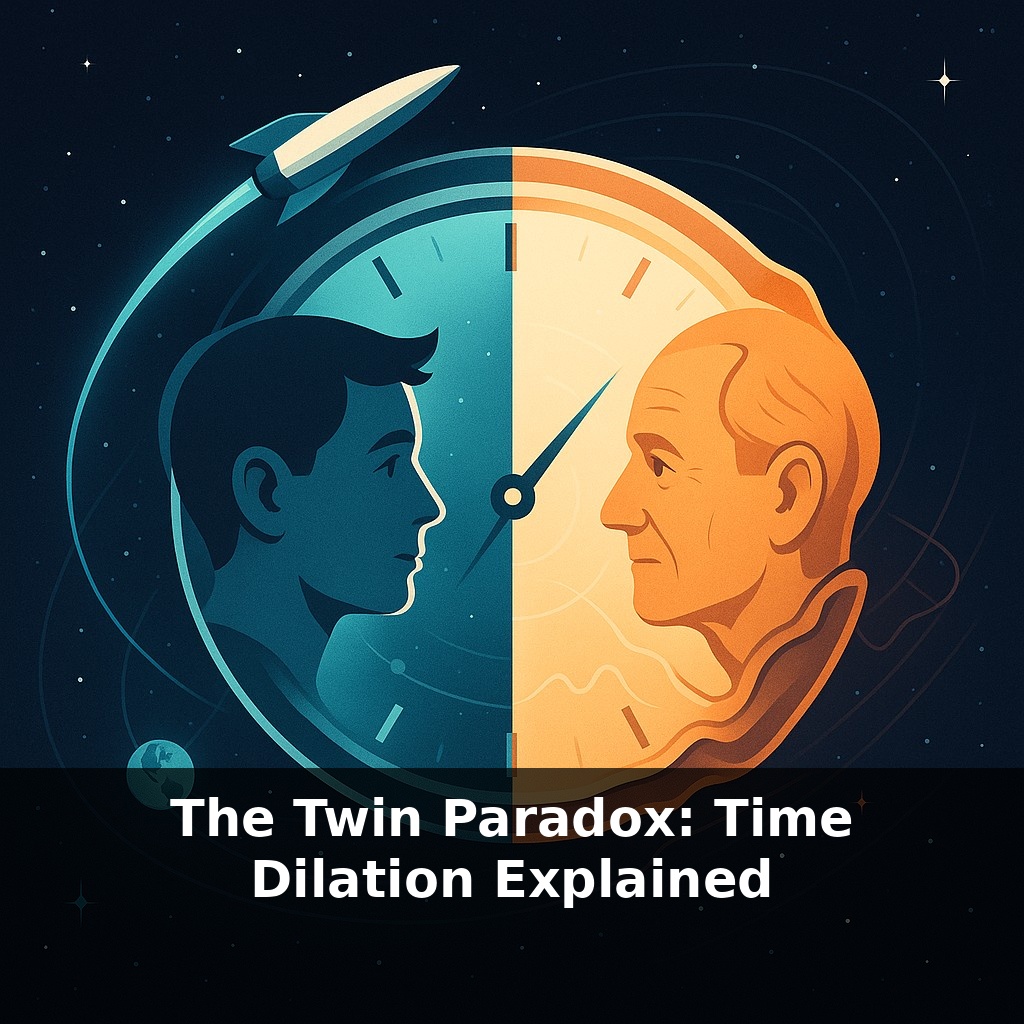
One twin boards a ship, flies out near light speed, and comes back younger than their sibling. Not just by seconds—by years. Same parents, same birthday, different ages. In this episode, we walk into that paradox and ask: what did time *do* while they were apart?
Einstein once wrote, “The distinction between past, present and future is only a stubbornly persistent illusion.” The twins’ age gap forces us to take that seriously: if time can pass differently for two people who reunite in the same room, then “now” can’t be universal. In this episode, we’ll push past the headline version of the paradox and ask a deeper question: whose time is “more real,” and does that question even make sense in relativity? We’ll see how physicists replace a single, shared timeline with each observer’s own clock, stitched into spacetime like individual brushstrokes on a vast canvas. Then we’ll connect this to hard evidence: flying atomic clocks, decaying particles, and the technology quietly correcting for these effects every time your phone finds its location. The goal isn’t to solve a riddle, but to update your intuition about what “happening at the same time” really means.
The strange part is: nothing “goes wrong” with either twin’s clock. Each tick is perfectly normal *from its own point of view*. The tension only appears when we compare histories after the reunion. To do that cleanly, physicists introduce a new tool: the **world-line**. It’s the record of everything that happens to you, plotted in a spacetime diagram the way a hiking route is marked on a topographic map. The Earth twin’s route is almost straight; the traveler’s bends sharply during departure, turnaround, and return. Those bends—changes of velocity—are where the symmetry between their stories quietly breaks.
The unsettling part is that, during the flight, each twin can honestly say, “My heart, my watch, my thoughts are unfolding normally.” No slow-motion effects from the inside. The discrepancy only becomes undeniable when they *reunite* and try to overlay their histories tick-for-tick. To predict that mismatch precisely, physicists stop talking about “time running slow” and start talking about a quantity that belongs to a *path*, not to a frame: **proper time**.
Proper time is what your own clock accumulates along your world-line, no matter how you speed up, slow down, or turn. Mathematically, it’s obtained by slicing your journey into tiny segments where you’re nearly inertial, applying the special relativity rule on each segment, and adding the pieces. The Earth twin’s almost straight path maximizes this accumulated time. The traveler’s path “bends” through a sequence of different inertial viewpoints, and when you add up all those segments, the total is smaller. The resolution of the paradox is not “whose perspective was correct,” but “which route through spacetime yields more proper time.”
This is why simply saying “but in the ship’s frame, Earth is moving” is incomplete. The ship does not keep a single, consistent frame for the whole trip. Outbound, they adopt one slicing of spacetime into “nows.” Inbound, they adopt another. At the turnaround, what counts as “simultaneous with me right now on Earth?” jumps discontinuously. On a spacetime diagram, lines of simultaneity pivot; a whole swath of the Earth twin’s aging gets reassigned from “future” to “present” for the traveler in an instant. That jump is where naive symmetry silently dies.
Crucially, none of this requires gravity. You can treat the outbound and inbound legs as separate inertial stories and knit them together. General relativity steps in only if you want to handle the accelerating phases in a single, elegant language, or include genuine gravitational effects—for instance, if the ship slingshots near a dense star and gains an extra aging difference from being deeper in a gravitational well.
All of this would be philosophical if it weren’t measurable. But nature keeps siding with the geometry: high-speed particles live longer than “should,” airborne clocks drift from ground clocks by the exact amounts the equations demand, and satellite systems quietly bake in these corrections so your map app doesn’t lead you miles astray. The universe behaves as if each world-line carries its own private tally of duration—and the straightest routes are the most generous with time.
When physicists say the straight world-line “wins” by ending with the older twin, they are making a concrete, testable claim. You can see echoes of this in places far from sci‑fi spaceflight. In particle accelerators, beams of unstable particles are routinely sent along carefully shaped paths: some nearly straight, some looping through magnetic fields. By tuning their speeds and curvatures, experimenters can control how much proper time those particles “experience” before they decay, and the statistics line up with the same geometric rule that settles the twins’ reunion.
On Earth, the Hafele–Keating flights and everyday GPS satellites offer quieter examples: each path—eastward, westward, orbital—builds up its own tally of duration. The fact that engineers must predict and correct for these tiny mismatches, or their systems fail, is a strong hint that proper time is not an abstract bookkeeping trick but a physical resource that different routes through motion and gravity genuinely allocate differently.
Your biological “clock” is also a path-dependent device. Future astronauts on very fast, looping missions won’t just see starfields shift; they’ll literally step off the ship biologically out of sync with those who stayed behind. Treat it like different people hiking routes at slightly different altitudes: small vertical offsets add up over distance. As missions, satellites, and even aircraft trace richer patterns, societies may need to *choose* whose accumulated duration defines official time.
So the “you” who comes home is literally built from a slightly different history of durations than the “you” who stayed. That’s more than a physics curiosity; it hints that identity itself is tied to the path you trace. Your challenge this week: notice every clock you see as a *local rulebook*, then ask what quiet journey through motion made it tick that way.