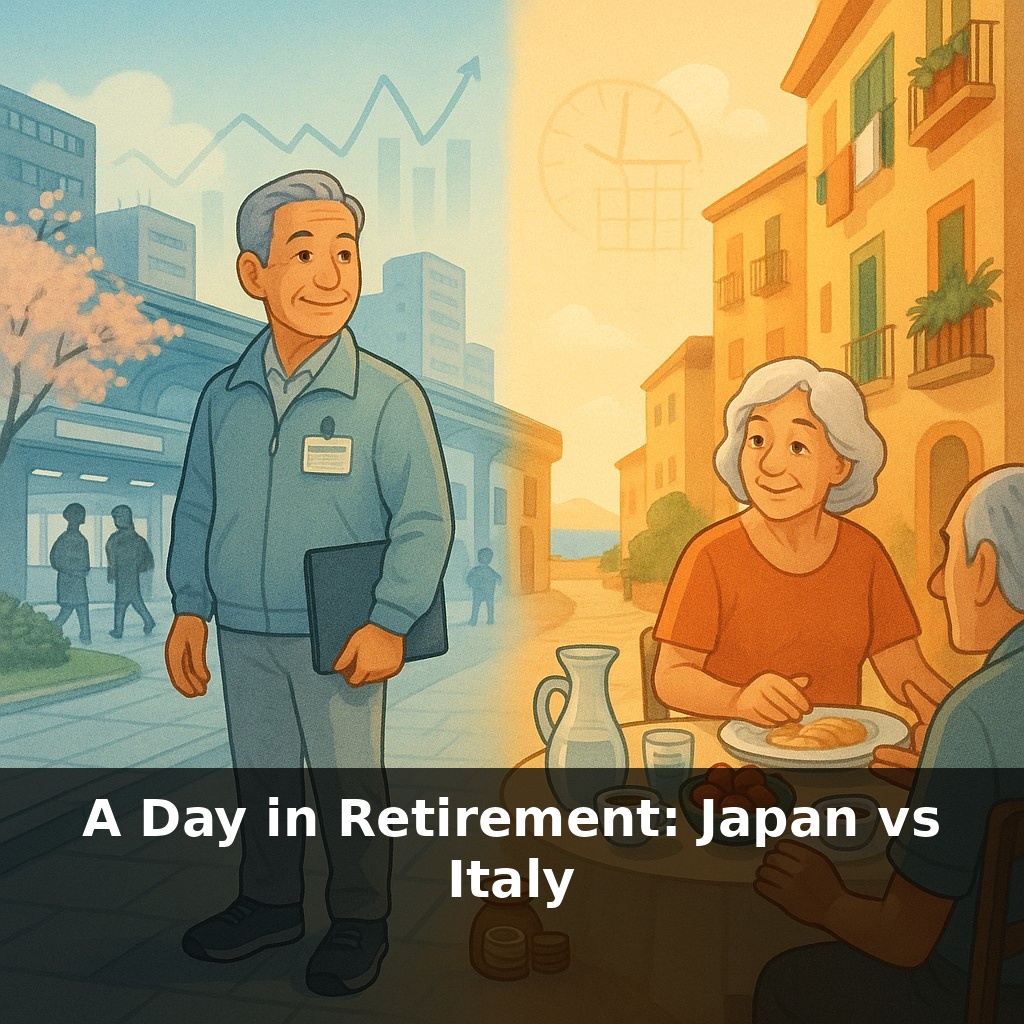
A Day in Retirement: Japan vs Italy
📝 Transcript
Each morning in Tokyo, more than a quarter of the people headed to the gym, train station, or park are past traditional retirement age. Some pull on uniforms for a few hours of paid work; others lace up walking shoes. Meanwhile, in Naples, nonni are already laying the table.
By mid-morning, the contrast sharpens. In Osaka, a 68-year-old might clock a three-hour shift guiding commuters at a busy station, then head to a tai chi circle in the local park. His schedule isn’t just about extra yen; it’s a scaffolding that keeps his week upright, like the metal frame around a building under careful renovation. Across the continent in Bologna, a retired teacher is helping grandchildren with homework before strolling to the corner bar, where the barista knows her order and her worries. Her pension pays the bills; the neighborhood pays attention. Both are “off the payroll” in the official sense, yet their days are quietly structured by the invisible architecture of national policy: how much arrives in their bank accounts, how their governments reward work, and how their communities expect elders to show up—or to slow down.
By lunchtime, the divergence widens. In Yokohama, a retired engineer heads to a community center not for bingo but for a coding workshop, swapping tips on tablet apps with peers who schedule their days like carefully balanced bento boxes: a portion of work, a portion of movement, a portion of social time. In Palermo, a former shopkeeper stirs a slow-simmering ragù while neighbors drop in unannounced, conversations stretching as long as the pasta. One country nudges older adults to keep a toe in the labor market; the other leans on long meals and long-standing ties to fill the hours.
Step into the early afternoon, and the contrast becomes less about “who still works” and more about “what feels like a good day.”
In suburban Saitama, many people in their late 60s log onto neighborhood portals that list micro‑jobs: three hours cleaning a park, staffing a museum desk, checking on vacant houses. These roles are often created through municipal “silver human resource centers,” which match older residents with short, low-pressure tasks. The pay is modest, but the real draw is rhythm and recognition: a name tag, a schedule, a team. Around these anchor points, retirees stack activities that speak to ikigai—calligraphy circles, choir rehearsals, vegetable plots tended with almost scientific care. Government-sponsored fitness programs and step-count campaigns quietly turn sidewalks into low-tech treadmills.
Fast-forward to an Italian hill town. After lunch and a brief rest, retirees fan out not to job portals but to social hubs. Parish halls host catechism classes where grandparents help, or charity kitchens where they peel potatoes beside teenagers. The Università della Terza Età might offer a lecture on local history at four, followed by a poetry group. These aren’t elite institutions; they’re more like public living rooms where anyone with a bus pass and curiosity can enroll. Instead of piecing together small jobs, many Italians piece together roles: the grandparent on school pick-up duty, the neighbor with spare keys to half the building, the volunteer who always says yes when the local festival needs ticket-takers.
By late afternoon, Japanese parks fill with synchronized radio calisthenics, while community centers host mahjong, language exchanges, or dance lessons. Attendance sheets are carefully stamped; progress is tracked. In Italy, streets grow busier for the passeggiata, that slow, shared drift through town where news travels faster than any official bulletin.
Both patterns show a subtle truth: time use in retirement behaves like a household budget. Japan “spends” more hours on structured tasks and movement; Italy “invests” heavily in unhurried encounters and family care. Each mix grows not from individual whim alone, but from decades of norms about what elders are “supposed” to do once the paycheck shrinks and free time finally swells.
In Japan, a retired nurse in Fukuoka might treat her day like a carefully tuned spreadsheet. She slots in 90 minutes at a neighborhood clinic, not for the paycheck, but because seeing her name on the rota feels like a quiet vote of confidence. Afterward, she meets a photography circle at a riverside park, experimenting with angles and light the way she once experimented with dosages. Even grocery runs become mini‑workouts, as she chooses stairs over escalators to hit her self-imposed step target.
In Italy, a retired mechanic in Bari keeps his calendar looser but his door more open. His pension covers the essentials, so his “appointments” are with people: a mid-morning espresso with the same three friends, an afternoon drive to pick up a cousin from a medical visit, an evening choir rehearsal in the parish hall. He jokes that his real job now is “centralino umano”—a human switchboard—connecting relatives who’ve fallen out of touch, sharing job leads with younger neighbors, and quietly slipping grocery bags to the widow upstairs when prices rise.
Retirement in Japan and Italy may foreshadow a new global mix-and-match phase of life. As robots deliver meds in Osaka and sensors quietly track falls in Bologna apartments, the “where” of aging could matter less than the “how.” Expect hybrid days: two hours of paid troubleshooting over video, a tele-health check, then logging off to walk a real piazza or join a local craft circle. This week, immerse yourself by journaling a 'Japan morning' and 'Italy afternoon': Detail not just activities, but capture ambient sounds, smells, and personal reflections on how each part influences your day.
Retirement, then, is less a finish line and more a playlist you keep editing. Some tracks are upbeat—side gigs, language apps, part-time caregiving—others are slower, like tending balcony tomatoes or lingering over street-corner chats. As more countries gray, the real experiment isn’t copying Japan or Italy, but borrowing riffs to compose a day that actually sounds like you.
With that understanding of Japan and Italy's retirement cultures, try a customized experiment: Build a 'retirement menu' for one day. Choose a morning activity from Japan: a pilgrimage-style walk, a Tai Chi practice, or crafting. Pair it with an Italian-inspired afternoon such as a neighborhood picnic, an art session by the park, or a passion project discussion with friends. Through this menu, identify specific elements you enjoy—whether it's community engagement, solitary creativity, or leisurely pacing—and select one to integrate into your weekly schedule.
From this course

Retirement Around the World
6 episodesUnlock all episodes
Full access to 6 episodes and everything on OwlUp.
Subscribe — $1.99/monthLess than a coffee ☕ · Cancel anytime