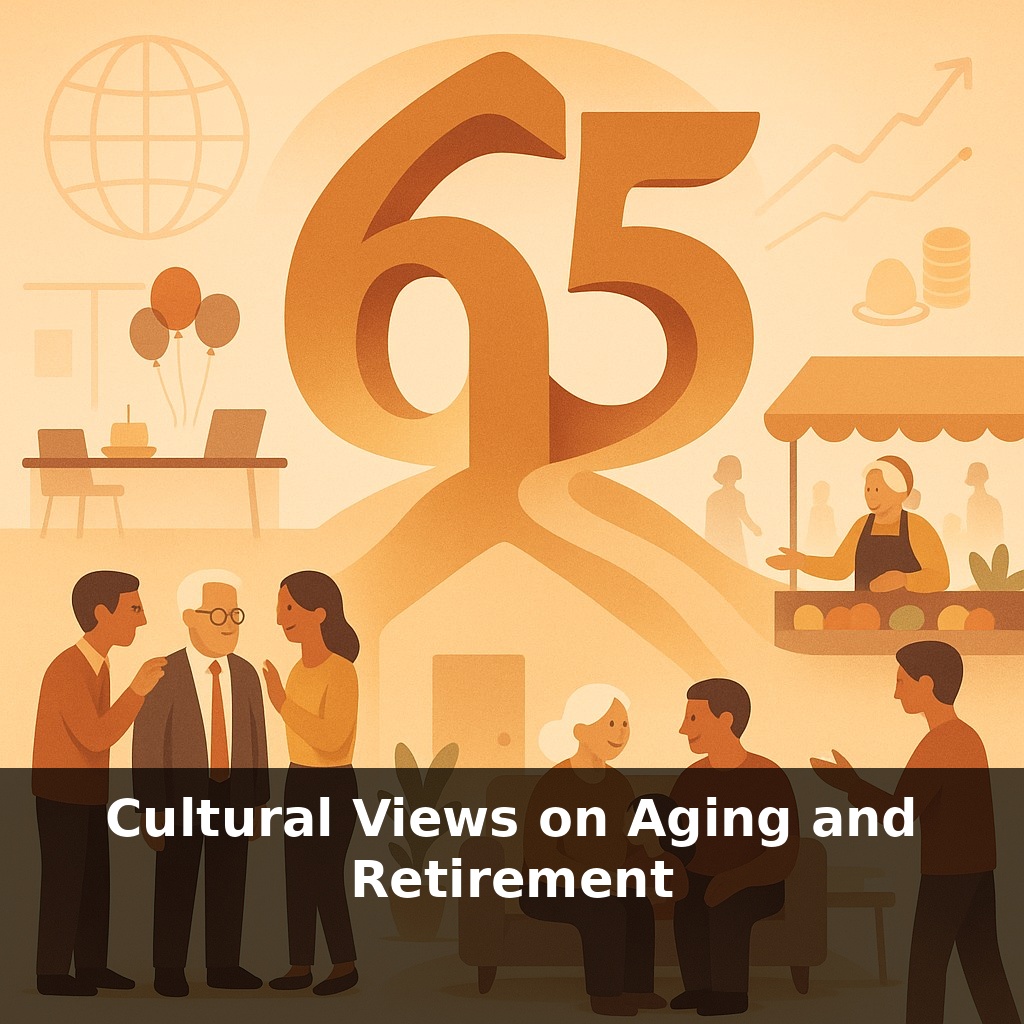
In one country, turning 65 means a farewell party at the office. In another, it means you move into your daughter’s spare room. Elsewhere, it means nothing changes—you keep working in the market. How can the same birthday trigger such different futures?
In finance, we’re used to asking: “What’s your risk tolerance? What’s your time horizon?” But we rarely ask the cultural question hiding underneath: “What story about aging are you planning around?” A 65‑year‑old Japanese engineer, a Ghanaian farmer, and a French teacher might share the same birth year and savings balance, yet face completely different “rules of the game” once paychecks stop.
Those rules aren’t written only in law—they’re written in expectations. In some places, you’re “selfish” if you don’t support your parents. In others, you’re “behind” if you’re still working past 70. Governments then layer policy on top of these norms, like software updates trying to keep an old operating system from crashing as populations age, families shrink, and careers stretch longer than ever.
Now zoom in one level: money habits quietly absorb these stories long before anyone opens a retirement account. A Korean worker accepting a low pension because children are the “real” plan will save and invest differently from a Dutch worker taught to trust a national system, or a Kenyan entrepreneur expecting support from a wide kin network. Even identical salaries produce divergent futures once you factor in dowries, remittances, bride prices, or multigenerational mortgages—costs and commitments that don’t show up on a standard retirement calculator but heavily shape who can “afford” to stop working.
Look at how three places answer the same quiet question: “Who owes elders a living?”
In much of East Asia, the official answer is shifting faster than the emotional one. Japan is nudging companies to keep people employed into their late 60s with subsidies and rehiring schemes. The subtext: the corporate “family” has to stretch a bit longer because real families are smaller, and public budgets are tight. In China, the state is pouring money into nursing homes, yet those empty rural beds show that a policy can exist on paper while culture still says, “A good child keeps parents at home.” That gap between concrete and custom is where financial stress often hides—adult children quietly funding both school fees and hypertension meds.
Contrast that with the US and parts of Europe, where the script leans heavily on systems and personal planning. The very idea of “full retirement age” for Social Security makes later-life income feel like a contract with the state. When that contract looks shaky—underfunded pensions, health‑care inflation—people respond not by calling their kids, but by pushing retirement back, taking gig jobs, or treating a home as an ATM via equity release. “Independence” is the virtue; working at 72 can signal resilience rather than family failure.
Across many African countries, formal promises are thinner. If only a sliver of elders receives a predictable pension, “retirement strategy” often means staying economically useful as long as physically possible, then leaning on a web of kin and neighbors. The trouble is that web is fraying: urban migration, HIV/AIDS, and climate shocks pull younger earners away just as older relatives need more help. A grandmother raising orphaned grandchildren can be both the “dependent” and the household earner.
For your own planning, the crucial move is recognizing which answer your environment assumes—and how stable that answer really is. If your culture historically assigned the “elder support” role to someone else (the state, the firm, the family), the new reality may be that you are that “someone else,” whether you’ve budgeted for it or not.
A useful way to test your own assumptions is to watch how people “price” elder support when no one is talking about retirement at all. Think about a cousin declining a promotion abroad because “someone has to stay near mum,” or a colleague quietly sending half their bonus back home every year. Those choices are like financial subtitles under a movie that seems to be about careers and lifestyle; they reveal who’s implicitly expected to fund whose old age.
Consider three friends earning similar incomes in London: one wires money monthly to parents in Lagos, another is saving aggressively because her US‑based parents insist they’ll never move in with kids, and the third assumes a French public pension will cover most basics. Same city, similar salaries, but radically different invisible obligations. From the outside, it’s easy to call one “behind” or another “over‑cautious.” Up close, each is solving for a different, culturally shaped equation about what a “good” later life—and a “good” child—looks like.
Governments now quietly test how far they can stretch “normal” work lives without revolt. You see it in pilot programs: tax breaks for phased retirement, visas for “silver” migrant workers, lifelong-learning credits that feel more like patch notes than true upgrades. The tension: extending work can preserve pensions, yet it also risks crowding out younger workers. Your own future may hinge on how well your country rewrites this script—before demographics force an emergency rewrite.
So as you sketch your own later years, think less “When do I stop working?” and more “Who am I planning to be useful to—and for how long?” Your culture offers a script, but you can edit the ending: maybe trading a bigger house for portable skills, or swapping a solo nest egg for shared ventures with siblings, friends, or even strangers who might become your future support circle.
Here’s your challenge this week: Have a 20-minute conversation with someone at least 20 years older than you and ask them three specific questions about how their culture shaped their expectations for aging, work, and retirement. Then, compare their answers with your own current assumptions (for example, about when you “should” retire, what older adulthood is for, and who you’ll live near). Before the week ends, choose one concrete shift inspired by their perspective—such as adjusting your target retirement age, planning to live closer to family, or rethinking what “productive” looks like after 65—and tell a friend or partner exactly what you’re changing.