Retirees in Sweden and Norway report some of the highest life satisfaction on Earth—despite long winters and high taxes. On a gray Tuesday morning in Stockholm, a former bus driver buys coffee, pays rent, joins friends—without once worrying, “Will my pension run out?”
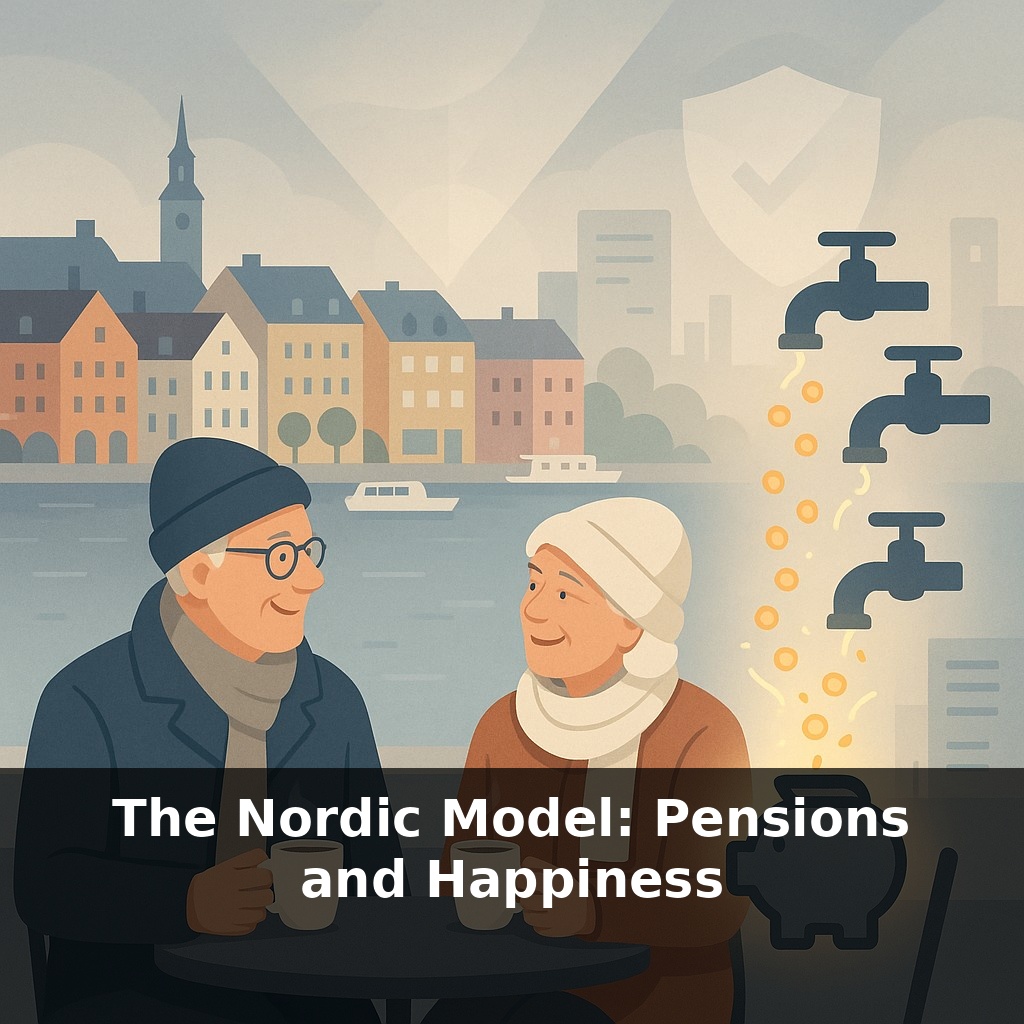
Instead of one fragile pot of savings, Nordic retirees effectively have several sturdy “income taps” that switch on as they age. One tap is linked to how much they earned and contributed over their working lives. Another is the basic, tax-funded guarantee that quietly tops up anyone who would otherwise fall behind. A third flows from services that don’t show up on a bank statement at all: low-cost clinics, capped eldercare fees, subsidised senior housing, even discounted public transport and cultural events.
These layers mean that when work stops, participation doesn’t. People in their late 60s and 70s still plan trips, take classes, and help with grandchildren—because the system is built to support activity, not withdrawal. And crucially, adjustments happen in the background: rules, not political whims, decide when to slow indexation or tap extra funding, so individuals can plan life, not legislation.
Behind those calm “income taps” sits a surprisingly hard‑edged design. First, pensions are near-universal: waiters, engineers, part‑timers, even many freelancers are covered, so gaps in your CV don’t automatically become gaps in old age. Second, benefits rise with your earnings, but with built‑in ceilings so high salaries don’t swallow the budget. Third, there’s a quiet link to national productivity: when wages grow, pensions tend to follow, keeping retirees roughly in step with workers’ living standards. It’s less about generosity, more about letting everyone share in the country’s long‑run growth.
Strip away the Nordic scenery and what’s left is a very specific financial engine. At its heart are two linked ideas: you earn rights during your working years, and the system self‑corrects so those rights can actually be paid—without lurching from crisis to crisis.
Start with how rights are earned. In Sweden, every year of work adds “notional” money to an individual account. It isn’t a real investment account, but it behaves like one on paper: contributions are recorded, grow in line with average wage growth, and are later converted into lifelong income. Crucially, the conversion rate depends on the life expectancy of your birth cohort. If your generation is expected to live longer, the annual payout per krona is a bit lower—but it lasts over more years. Norway uses a different formula, yet the logic is similar: more years of contributions and later retirement ages translate mechanically into higher yearly income.
Then comes the stabiliser. Sweden’s famous “brake” monitors the system’s balance sheet. If the value of promised benefits starts to exceed assets and future contributions, indexation slows automatically. The cut in growth is modest but early, preventing much sharper pain later. Norway’s buffer works through the Government Pension Fund Global (the oil fund). Its 3.5% real return since 1998 has made it one of the world’s largest sovereign funds, but current retirees don’t simply spend it down. Instead, strict fiscal rules cap how much of the fund’s expected return can flow into the budget, smoothing shocks over decades.
Think of it like a well‑coded app running in the background of the economy: algorithms, not last‑minute political bargaining, adjust parameters when demographics or markets shift. That predictability shapes behaviour. Because people trust that formulas won’t be rewritten overnight, they are more willing to work a bit longer, choose partial retirement, or mix wage income with drawing benefits.
The payoff is visible in outcomes. Replacement rates around 72–74% mean most people keep a lifestyle broadly similar to their working years. Very low poverty among over‑66s reflects not only cash income, but also the way public services compress essential costs. And higher life expectancy at 65 suggests that financial security and accessible care compound, year after year, into something harder to quantify but easy to recognise: the freedom to treat retirement as a long phase of life, not a cliff edge.
In practice, a retired Norwegian teacher might blend three flows: her public benefit, an occupational plan from the municipality, and a modest private index fund. Instead of maximising withdrawals early, she times them so income stays steady whether she is 68 or 88. Her Swedish counterpart, a former part‑time shop worker, may never have earned a high wage, yet years of covered employment and union‑negotiated workplace schemes still yield a baseline that lets her choose: keep a small side job at the bakery, or quit completely and volunteer at the local library.
Observe how risk is shared. Market swings hit the oil fund and private portfolios, but day‑to‑day living still leans on rules‑based benefits and services. It’s closer to how a good chef builds a menu: one reliable staple, a couple of seasonal specials, and only then a risky experiment. The result isn’t luxury for everyone—it’s that very few people face all‑or‑nothing stakes once paychecks stop.
Nordic rules quietly reshape what “old age” means. As ages nudge toward 70, mid‑career choices start to look more like tuning a playlist than hitting stop: downshifting hours, retraining, or pausing work for caregiving without wrecking future income. For other countries, the deeper lesson isn’t to copy formulas line by line, but to hard‑wire similar guardrails—so that every extra year of life expectancy feels like bonus time, not a longer financial tightrope.
So the real Nordic lesson isn’t “copy our rules,” but “anchor retirement in predictability plus room to roam.” When basics aren’t a monthly cliff‑hanger, people dare to start late careers, care for relatives, or move cities at 67. Your challenge this week: sketch a version of 70 where your time, not your fears, does most of the budgeting.