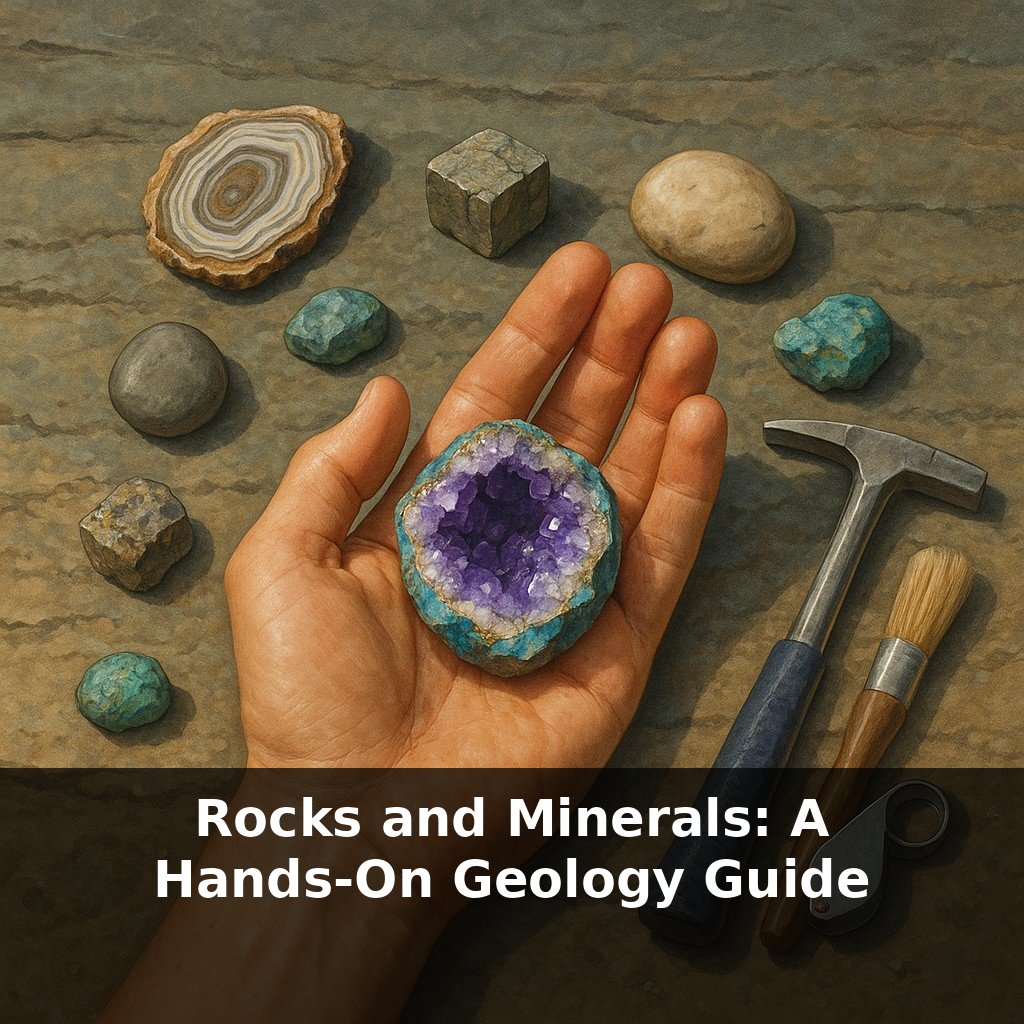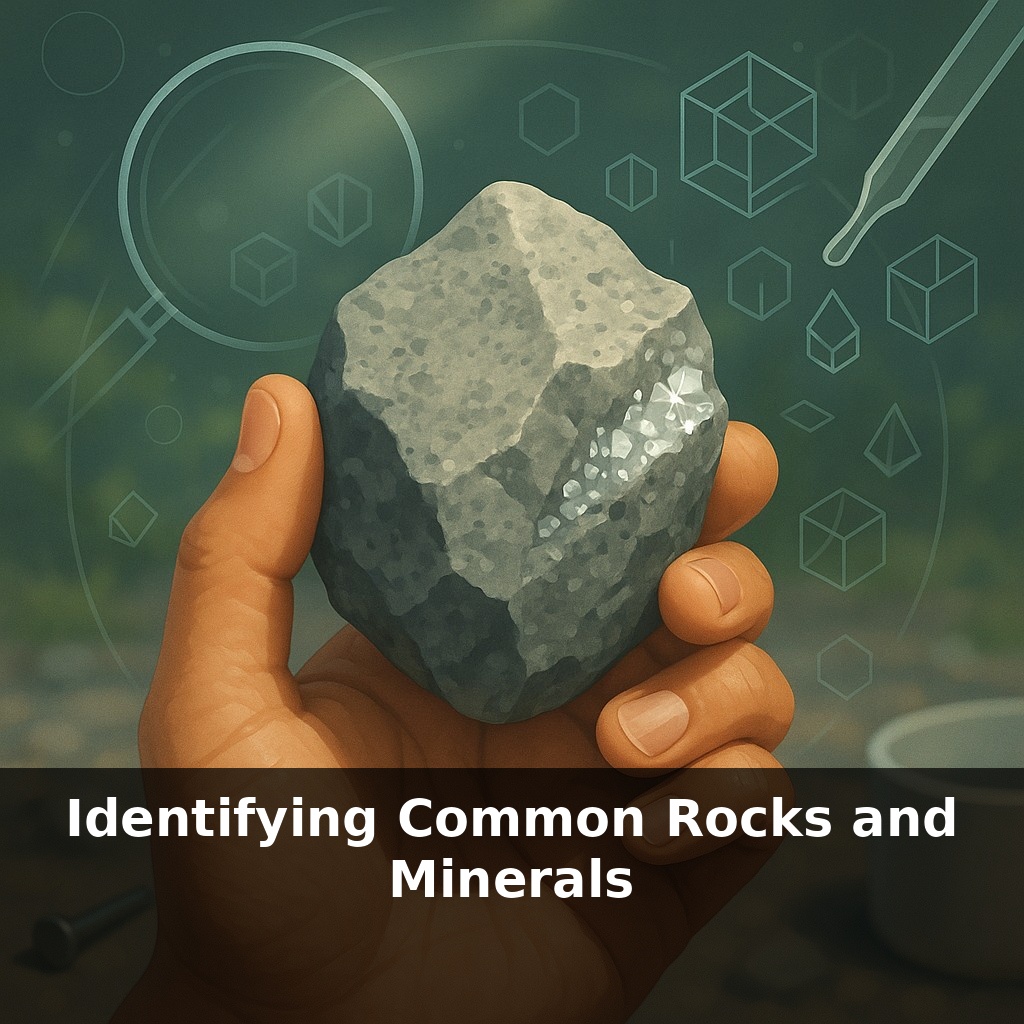
Your phone, your countertop, the gravel under your shoes—almost everything solid around you is built from just a handful of common minerals. Yet most people can’t name even three. Today we step outside, pick up “just a rock,” and discover it’s anything but ordinary.
That “just a rock” in your hand is basically a crime scene waiting to be investigated. A few scratches with a nail, a rub on the back of a ceramic mug, a drop of vinegar from your kitchen—that’s enough to start narrowing down suspects. Is it hard enough to scratch glass? Does it leave a colored streak? Does it fizz when the acid hits? These tiny tests turn guesswork into evidence. Soon you’ll notice patterns: beach pebbles that all seem related, dark dense stones along old lava flows, light speckled blocks in city buildings that match cliffs miles away. With practice, you can walk through a park or along a trail and “read” the ground the way some people read a subway map—recognizing the routes, transfers, and hidden layers beneath your feet.
Soon you’ll notice that certain clues like hardness or fizzing don’t just label “what” a rock is, but hint at “where” it came from and “what” it’s been through. A dark, fine-grained stone at a roadside cut might whisper “lava cooled fast here,” while a pale rock full of broken shells on a hilltop quietly insists “this was once a seafloor.” The puzzle gets richer when you add context: nearby mountains, a river, a construction site using local stone. You’re not just sorting samples—you’re reconstructing a landscape’s biography from tiny, silent witnesses in your hand.
Think of each new rock as arriving with a short “ID badge” already printed on it. You can’t read everything at once, so you scan line by line. Start with luster: does it look glassy, dull, metallic, silky? That one word already narrows dozens of possibilities. A metallic shimmer often points you toward ores; a pearly sheet might nudge you toward mica instead of quartz.
Next line on the badge: how it breaks. Some pieces split into neat, flat faces—cleavage. Others shatter in jagged or curved patterns—fracture. Feldspar loves flat steps, quartz prefers shell‑like curves. Break style is one of the fastest ways to separate “look‑alike” minerals that share similar color or shine.
Now step back and look at the whole rock, not just the pieces. Texture is the big one. Are the grains large enough to see clearly, or do they blur into a fine, even mass? Coarse crystals that interlock like a tight brick wall usually point to slow cooling deep underground—typical of granite and its cousins. A uniform, fine‑grained dark rock often signals something basaltic, born from lava that cooled quickly at or near the surface.
If the rock is made of visible fragments—rounded pebbles, sand‑sized grains, or bits of shell—your badge is probably shouting “sedimentary.” Rounded pebbles cemented together hint at a river or beach past; thin, planar layers suggest quiet waters like a lake or sea floor. Look for fossils, cross‑bedding, or mud cracks: subtle textural features that record ancient environments in surprising detail.
Sometimes that badge shows stress marks. Minerals stretched, squashed, or aligned all in one direction—mica flakes all pointing the same way, for example—suggest metamorphism. Heat and pressure have reorganized the minerals without fully melting them, giving you foliated textures like slate, schist, or gneiss.
Finally, consider density and magnetism. A rock that feels oddly heavy for its size might be rich in iron or other metals. A quick magnet check can separate ordinary basalts from iron‑rich meteorite candidates, especially when combined with hints like fusion crust or regmaglypts.
Like debugging a piece of code, you don’t fixate on one output; you cross‑check many signals until a consistent story emerges. That story—written in texture, breakage, luster, and weight—is what turns “just a rock” into a specific chapter of Earth’s history you can actually read.
A granite countertop is a convenient training ground. Those glossy black, white, and pink patches aren’t random decorations—they’re interlocking mineral “teams” frozen in place. The milky rectangles are usually feldspar, the glassy gray or clear bits are quartz, and the darker flakes or needles may be mica or hornblende. Once you’ve matched those patterns indoors, spotting a similar rock in a park suddenly becomes trivial: you’re seeing the same lineup in a rougher, less polished stadium.
Walk past a building faced with pale, uniform stone full of tiny sand grains all the same size and shape. That consistency hints at long, methodical sorting by wind or water before burial and lithification. A nearby monument carved from darker, banded rock—with shiny sheets all pointing the same direction—records a different story: deep burial, squeezing, and reheating that reorganized older layers without erasing them. Each structure you pass on a city block is quietly sampling a different depth or chapter of the crust, turning your commute into a cross‑section of Earth’s architecture in disguise.
Soon, field kits may shrink to a phone and a pocket loupe. Point your camera at a boulder and an app could flag likely minerals, suggest a rock type, and link it to known formations nearby. Your local trail might double as a live geology overlay, with labels hovering like captions on a streaming show. Shared photos and IDs could feed global maps, so a kid logging a backyard find quietly improves datasets that researchers use to trace resources, hazards, and even past climates.
Soon you’ll notice that every trail, driveway, or city plaza is a quiet archive, like shelves of unlabeled books waiting to be opened. Each sample you pick up adds a sentence to your mental field guide—linking landscapes, past environments, and even other planets. Your challenge this week: pick three “ordinary” rocks and try to give each one a one‑line life story.