Earth’s thinnest layer holds our entire world. Beneath your feet, almost all of the planet’s volume lies hidden, hotter than any lava you’ve seen, moving so slowly you’d swear it was solid. Yet those deep motions quietly decide where mountains rise and oceans crack open.
We’ll stay on the surface for a moment, because that’s where the clues are. A cracked sidewalk after winter, a distant earthquake on the news, a compass needle twitching toward north—each is a tiny status update from far below, sent through rock, metal, and molten motion we’ll never touch directly. Almost everything we know about Earth’s interior comes from reading those updates with better and better instruments. Seismometers turn global earthquakes into CT scans of the planet. Lab presses squeeze minerals until they behave like they’re thousands of kilometers deep. Satellites watch the magnetic field drift, ripple, and occasionally weaken in odd patches. Piece by piece, these signals reveal a layered world whose hidden machinery quietly sets the rules for life at the surface.
Those tools don’t just sketch a cross‑section; they let us watch Earth change over time. Geologists match distant quakes with tiny shifts in GPS stations as continents drift centimeters per year. Ocean‑bottom instruments record how new crust is born at mid‑ocean ridges while old seafloor sinks back into the deep. Chemists read volcanic gases like receipts, hinting at which depths the melts came from. Even changes in day length—measured with the precision of atomic clocks—betray how mass slowly redistributes inside the planet, as if the whole Earth were subtly rearranging its internal furniture.
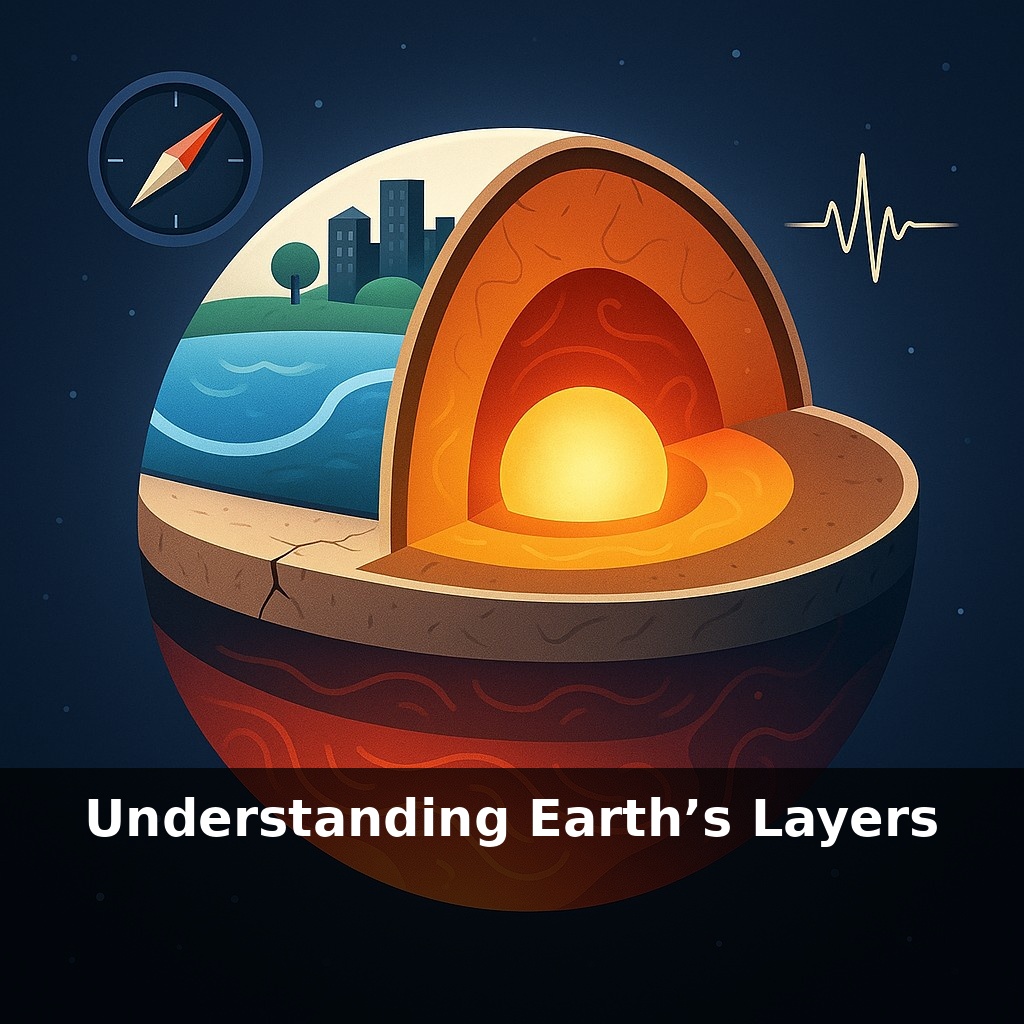
Start with the simplest layer we can actually touch: the crust. It’s chemically diverse, cracked into plates, and comes in two main flavors. Oceanic crust is dark, dense, and thin—mostly basalt and gabbro. Continental crust is lighter, thicker, and a patchwork of granites, sediments, and ancient metamorphic roots. When these two meet at a convergent margin, density decides who sinks. Oceanic plates usually dive underneath, dragging surface water and sediments downward, feeding arcs of volcanoes that recycle material back up.
Beneath lies the mantle, overwhelmingly dominant in volume and mass. It’s mostly peridotite, rich in magnesium and iron, yet it doesn’t stay the same with depth. Pressures thousands of times higher than at the surface force the same elements into new crystal structures. Mineral names change—olivine, wadsleyite, ringwoodite, bridgmanite—but the chemistry is broadly similar. What matters is that each transition subtly alters density and stiffness, creating depth “boundaries” that guide how rocks deform and how seismic energy bends and reflects.
That deformation is slow but relentless. Mantle rock creeps like an ultra‑viscous fluid, letting heat escape outward. Some of that heat is left over from planetary formation; some comes from radioactive decay; some leaks from the core below. Where rising mantle approaches the surface, decompression can trigger partial melting. Only a small fraction actually turns to liquid, but that melt is buoyant enough to collect, segregate, and eventually punch upward as magma feeding volcanoes and mid‑ocean ridges.
Deeper still, the outer core is a churning metallic layer, mainly iron alloyed with lighter elements like sulfur, oxygen, and perhaps silicon. It convects vigorously because enormous heat must move outward through a material that conducts electricity well. As liquid metal shears past the solid inner core and spins with Earth’s rotation, it organizes electric currents that sustain the global magnetic field. That field is not fixed: changes in flow patterns can weaken it, create odd patches like the South Atlantic Anomaly, or in extreme cases flip its polarity entirely.
At the center, the inner core is solid despite temperatures comparable to the surface of the Sun. Immense pressure wins over heat, locking iron into crystalline structures. Seismic waves reveal that this region is anisotropic and possibly layered itself, hinting at a history of gradual growth, changing crystallization patterns, and complex interactions with the fluid shell above.
Stand on a rocky coastline during a storm and you’re watching different layers report in. Waves crashing against cliffs reflect how that outer skin responds to stress, while subtle shifts in tide gauges betray how mass moves deeper down. A GPS antenna on a city rooftop might creep a few millimeters a year as buried plates grind past; a gravimeter in a quiet lab can detect tiny changes when dense material sinks far below. Even fiber‑optic internet cables now double as seismic ears, feeling distant rumbles as strain in the glass.
Your phone’s compass quietly joins this network of witnesses, sensitive to slow twists in the magnetic field rooted in metal far beneath us. Cave formations record older patterns: slight changes in drip chemistry can echo shifts in circulation below the crust. And meteorites on museum shelves hint at what separated inside early planetary bodies, offering rough blueprints for how iron, silicates, and lighter elements partitioned when Earth’s own interior first sorted itself into distinct domains.
Future work will probe Earth’s interior like a doctor upgrading from stethoscope to MRI. Geo‑neutrino maps could reveal where heat is strongest, hinting which regions are primed for superplumes or long‑lived “dead zones” in the deep mantle. Better inner‑core models may sharpen forecasts of magnetic hiccups that threaten power grids and satellites. And by comparing Earth’s layered rhythm with that of the Moon or Venus, we’ll refine where to search for tectonically active, life‑friendly worlds.
We’re still only reading the planet’s “headline news.” Future landers on Mars and icy moons will add foreign editions, letting us compare interiors like architects comparing blueprints. As models sharpen, even subtle shifts—a drifting pole, a wobbling day length—may become everyday diagnostics, routine checkups for a restless, layered Earth.
Try this experiment: Build a mini “Earth” in a clear cup using layers of different materials—fine sand for the crust, packed clay or playdough for the mantle, small metal objects (like screws or coins) for the outer core, and a solid metal ball (or tightly packed foil) for the inner core. Gently shake or tap the cup and watch how the “tectonic plates” (the sandy crust) crack and shift over the softer “mantle” below. Then tilt the cup and shine a flashlight through the side—notice how light can’t penetrate the dense “core,” just like seismic waves behave differently in Earth’s real layers.