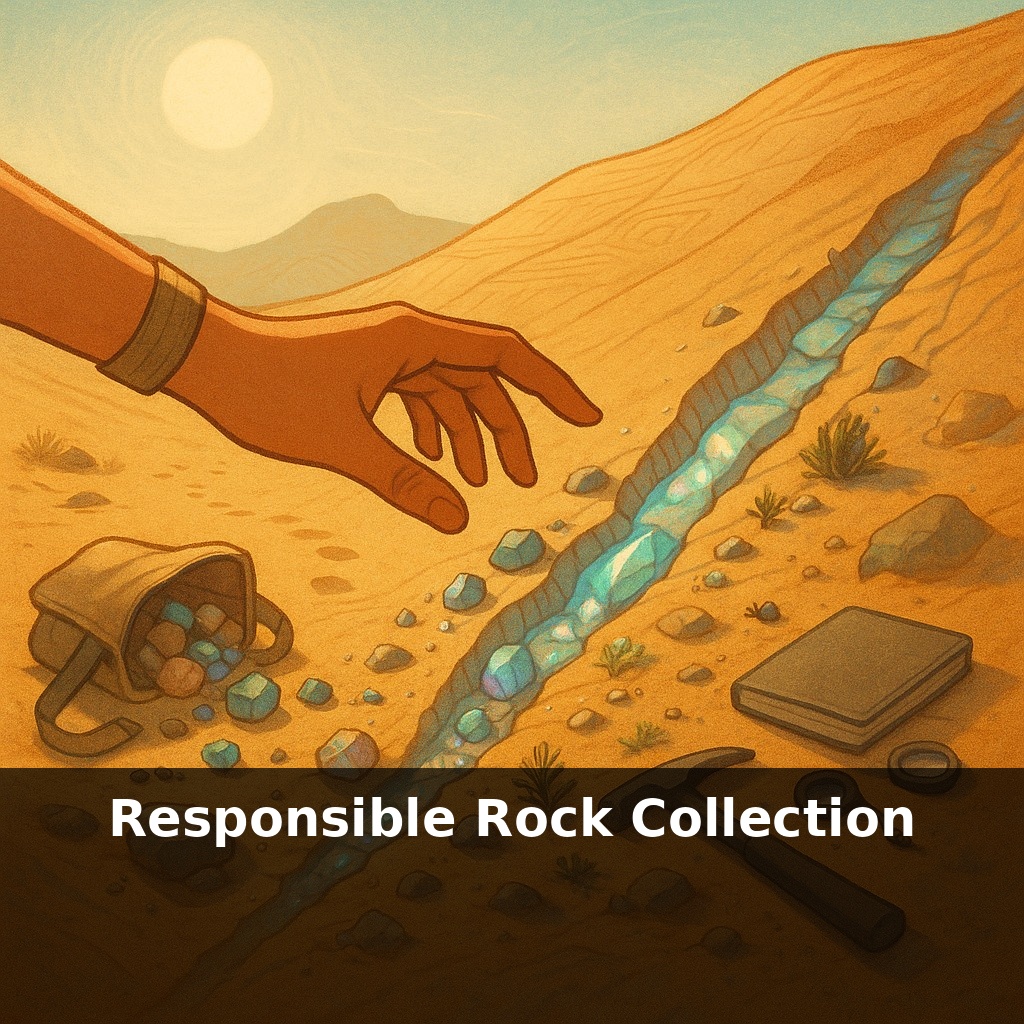
A single pocketful of rocks can quietly break federal law, disturb an ecosystem, and erase a scientific clue that took centuries to form. You’re kneeling on a sun‑baked slope, fingers on a sparkling vein—how do you know if this is a keepsake… or something you should leave exactly where it lies?
Collecting “the right way” isn’t about killing the fun; it’s about adding a new layer of skill. Instead of just spotting a pretty rock and pocketing it, you’re now playing a more advanced game: reading the landscape, reading the rules, and making quick decisions that hold up to scrutiny later. That sparkly geode on a river bar might be fair game, while an equally tempting fossil in an exposed cliff might be off‑limits because it’s part of an active research site or protected unit. Like refining a camera setup from “auto” to manual, responsible collecting means paying attention to settings you used to ignore: whose land you’re on, how much you’re taking, what else lives on or in that outcrop, and who might need this site intact in ten or fifty years. This isn’t about guilt; it’s about upgrading from casual souvenir hunter to thoughtful field geologist.
Now we zoom in from the big ideas to the actual ground beneath your boots: rocks live inside overlapping “rule zones” you can’t see on the surface—BLM parcels, private ranches, tribal nations, city parks, national monuments. Each can flip the answer from “take a handful” to “don’t touch” even when the outcrop looks identical. On top of that, the rock itself matters: a water‑worn agate in a gravel bar is treated very differently from a chunk of petrified wood, and both differ from a fossil bone peeking out of a hill. The art is learning to match place, material, and purpose before you reach into your pack.
Start with the rock in your hand, but judge it by three quiet questions: *where* is it from, *what* is it, and *who else* might care about it later?
**1. Where is it from?** Zoom past the invisible boundaries and think about *context on the ground*. A loose cobble rolling down a wash is usually lower‑stakes than a piece still locked into a layered cliff. Disturbed gravels, road cuts, tailings piles, and plowed fields are often the “least critical” sources because the original arrangement is already broken. In contrast, undisturbed layers, delicate crusts, and surfaces patterned by cracking, ripple marks, or tool scars are like pages still bound into the book of that site’s history—removing pieces tears sentences out of place.
**2. What is it?** Common stream pebbles, quartz veins in already‑blasted rock, and weathered float on a hillside are rarely unique. But some categories are red flags even before you check local rules:
- Anything that looks like bone, shell impressions, or leaf imprints in fine‑grained rock - Mineral coatings with vivid colors or intricate crystals growing directly on bedrock - Wood turned to stone, or logs aligned in place rather than isolated chunks - Rocks colonised by thick lichens, moss cushions, or tiny plants rooted in cracks
Those often hold data about climate, water, or biology that’s hard to recover once scattered across shelves.
**3. Who else might care?** Think beyond your collection. Land managers, researchers, and Indigenous communities may all have different stakes in a single outcrop. A boulder with carved markings or offerings nearby isn’t just “decorative stone”; it’s potentially a cultural record protected by law, even if it isn’t fenced or signed. Likewise, a hillside with numbered flags, paint dots, or neatly dug pits is effectively a field notebook in 3D—anything you move can scramble someone’s years of work.
A useful habit is to *downgrade* your choice whenever a doubt pops up. If an embedded fossil seems questionable, look for a loose fragment of the same layer downslope. If a lichen‑covered face draws your eye, search a broken block that fell from it instead. Over time you’ll develop an instinct for “high‑impact” versus “low‑impact” picking, and your best finds will come from places where taking a small, well‑documented sample keeps the story on the landscape readable for everyone else.
You’re crouched below a road cut and spot two candidates: a sharp, loose chunk that clearly tumbled from above, and a wafer still stacked neatly in a paper‑thin layer. Grabbing the loose piece is like pulling a fallen brick from a pile; prying out the wafer is more like sliding a brick from the middle of a standing wall. The story holds together in one case and buckles in the other.
Now shift to a wave‑pounded beach. Beach cobbles are constantly rearranged; taking a small, well‑scattered sample here usually changes little. Contrast that with a boulder field studded with tiny numbered tags—each tag is a silent “do not move” note from someone tracking weathering or slope movement over seasons.
Cultural context can be just as specific. A plain‑looking basalt boulder on an unmarked ridge might be aligned with other rocks on the skyline; to a local nation, that alignment can map stories, directions, or ceremonies you’ll never see on a sign. When you can’t tell, that’s your cue to ask, or to walk away.
Some collectors are already treating each find as a datapoint, not just a keepsake. As cheap GPS, phone lidar, and augmented‑reality overlays spread, your “day in the field” could sync instantly to shared maps that flag sensitive spots in real time. The catch: the same tools that help you avoid trouble can also broadcast fragile locations to bad actors. Your challenge this week: mock up a “collector’s passport” page for one rock—what fields would future users need?
Each trip becomes a small field experiment: test your judgement, record what you learn, and refine it next time. Treat notes, sketches, and photos as blueprints for how that outcrop looked before you arrived—like drafting plans before moving a single brick. Over years, that habit turns a box of “cool rocks” into a personal archive other people can actually use.
Before next week, ask yourself: “Looking at the rocks I’ve already collected, which ones might have cultural, spiritual, or scientific significance if they’d been left where I found them—and would I choose differently now?” “Next time I’m out, how will I decide when *not* to pick something up (for example, near tribal lands, protected areas, or fragile habitats), and what ‘personal rules’ will I use in that moment?” “If I treated my rock collection like a mini-museum, what stories about place, permission, and impact would each specimen need to ‘earn its spot’ on my shelf?”