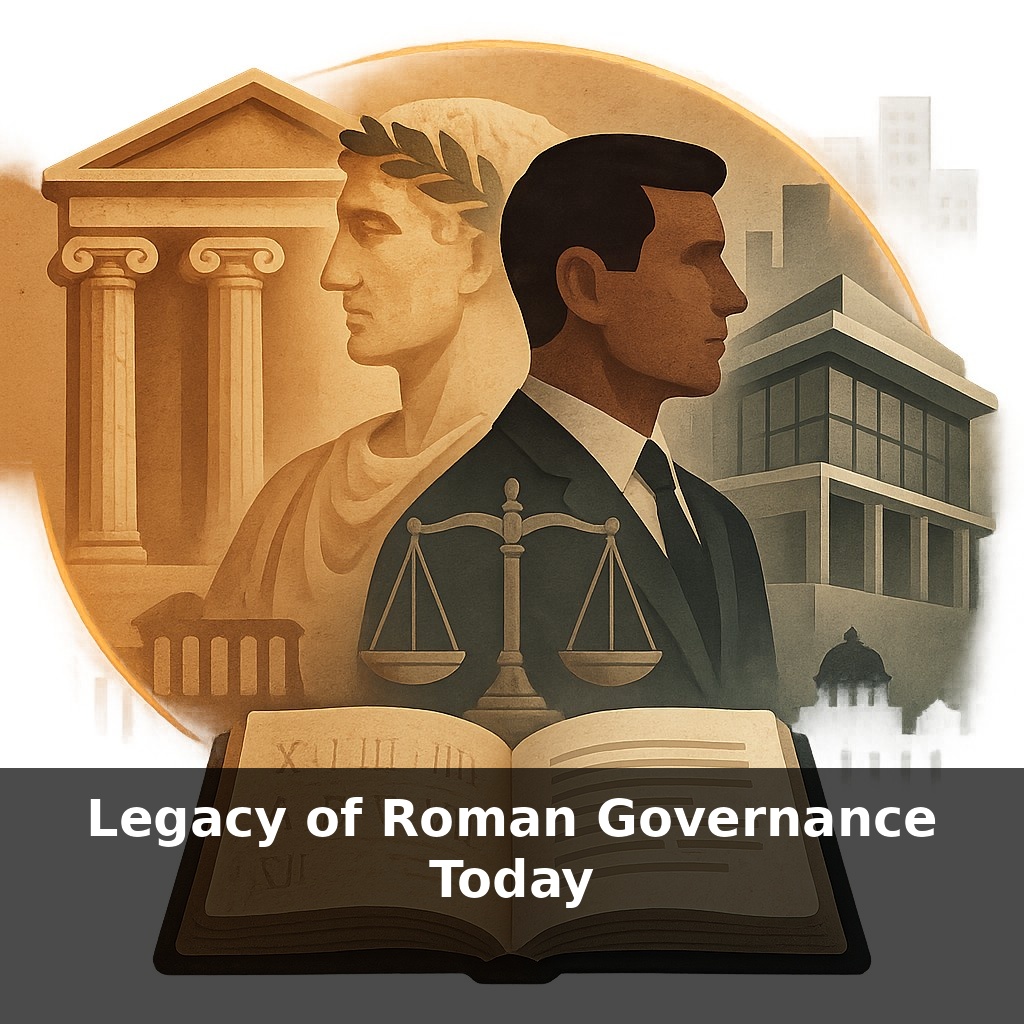
Right now, most people on Earth live under laws that are, in a sense, Roman—whether they know it or not. A senator in Washington, a judge in Brazil, and a law student in Japan are all working with ideas first stress‑tested in the Roman Republic.
Open a modern constitution at random and you’re likely to bump into a Roman ghost: “senate,” “veto,” “civil code,” “citizen.” They sit there on the page like familiar furniture, so ordinary we rarely ask who built the house. Yet behind those words lie very specific political bets Rome once made about how power should be shared, constrained, and written down.
Today, roughly 60% of the world’s population lives under civil-law systems that descend—sometimes through winding detours—from Justinian’s codification. Even countries that don’t use that family of law still borrow Roman-flavored structures and vocabulary. A debate in the U.S. Senate, a judicial review in Mexico, a parliamentary quorum in Italy: each is a local dialect of a much older political language that Rome helped standardize.
Listen in on a parliamentary debate in Canada, a court hearing in Mexico, or a constitutional reform in South Korea, and you’ll notice something odd: very different cultures arguing through very similar institutional shapes. That convergence didn’t happen by accident. Roman arrangements were copied, fought over, revised, and re‑exported across empires, revolutions, and independence movements. The Napoleonic Code, for instance, became a legal template from Europe to Latin America and parts of Asia, much like an architectural blueprint reused to design very different cities.
If you map out modern government structures on a world atlas, a striking pattern appears: dozens of countries have chosen a two‑chamber legislature, and one of those chambers is often explicitly called a senate. That choice isn’t just about prestige language. It reflects a structural problem Rome wrestled with early: how do you slow legislation down just enough to filter it, without freezing politics altogether?
In places as different as Italy, Argentina, and Nigeria, the “upper house” is tasked with being that brake. Sometimes it represents regions or states, sometimes social elites, sometimes simply “deliberation.” But the underlying Roman intuition is similar: decisions that bind everyone shouldn’t pass in a single rush. You can hear this logic when modern politicians defend bicameralism by talking about “checks,” “second readings,” and “cooling off” periods—arguments that would have made sense in a Roman political club.
Legal education is another quiet continuity. A modern law student in São Paulo or Seoul is trained to think in terms of written codes, commentary, and systematic classification of rules. That habit of carving the legal world into neat categories—persons, property, obligations, procedures—took recognizable shape in Roman juristic writing and was refined when medieval scholars pored over the revived texts. Later compilers, from early modern German princes to Napoleon’s drafters, reorganized those materials but rarely abandoned the basic skeleton.
You can see the same inheritance in how constitutions handle conflicts between rules. When a new statute clashes with a higher norm, courts in places like France, Spain, or Brazil reach for techniques—hierarchies of norms, presumptions, interpretive canons—that descend from centuries of wrestling with layered Roman and post‑Roman sources. Even where the terminology is local, the problem‑solving toolkit is not.
Citizenship shows a similarly long afterlife. Modern debates about birthright versus naturalized status, or about extending political rights to former subjects in ex‑colonial states, echo Rome’s gradual widening of its civic club. As empires fractured and new nations formed, leaders repeatedly turned back to that repertoire: using staged expansions of membership to integrate conquered peoples, bind elites, or stabilize frontiers.
Your challenge this week: follow a single political term—“citizen,” “senator,” or “code”—across three different countries’ news or official websites. Each time, note not just the word, but what concrete power or protection it marks. By the end of the week, you’ll have your own mini‑map of how one Roman‑era concept has been stretched, resized, and repurposed for very different societies, while still carrying a family resemblance you can now actually see.
Stand in three different places: outside the Capitol in Washington, on the steps of Brazil’s Congresso Nacional, and in front of Japan’s National Diet. The façades don’t match, the languages don’t match, but you can trace a shared design philosophy the way an architect spots a familiar load‑bearing beam behind very different walls. In Washington, the upper chamber is framed as a forum for states; in Brasília, the Senado Federal balances populous regions with sparsely settled ones; in Tokyo, the House of Councillors staggers its elections so only part of it turns over at once. Each choice tweaks how fast politics can move, who must be consulted, and what kinds of compromises are necessary. Likewise, when France rewrote its commercial rules after World War II, when Mexico restructured its judiciary in the 1990s, or when South Korea hardened safeguards for individual rights after democratization, they all treated law as something you publish, organize, and then argue through—rather than improvise from scratch.
New tools may soon push Rome’s legacy into unfamiliar shapes. Algorithmic drafting of statutes, cross‑border data courts, and real‑time public feedback on bills could make institutions behave less like marble monuments and more like adaptive software. The open question is whose values get encoded. As climate treaties, trade rules, and migration compacts knit states together, domestic “rules of the game” will increasingly collide with global expectations.
As digital charters, AI regulations, and climate compacts emerge, they layer fresh rules onto that old Roman scaffolding. The twist is speed: norms now spread like viral code, not decrees carried by courier. That accelerates both reform and backlash, forcing each society to decide which inherited features to keep—and which to finally uninstall.
Start with this tiny habit: When you open a news article or social feed about politics, pause for three seconds and silently ask, “Is this more like Roman ‘bread and circuses’ or a real Senate-style debate?” Then, deliberately look for one concrete example of checks and balances mentioned (like courts, councils, or voting rules) before you react or share. If you don’t see any, just mentally tag it as “spectacle, not structure” and move on. This takes under a minute, but it quietly trains you to notice the Roman-style governance patterns shaping today’s headlines.