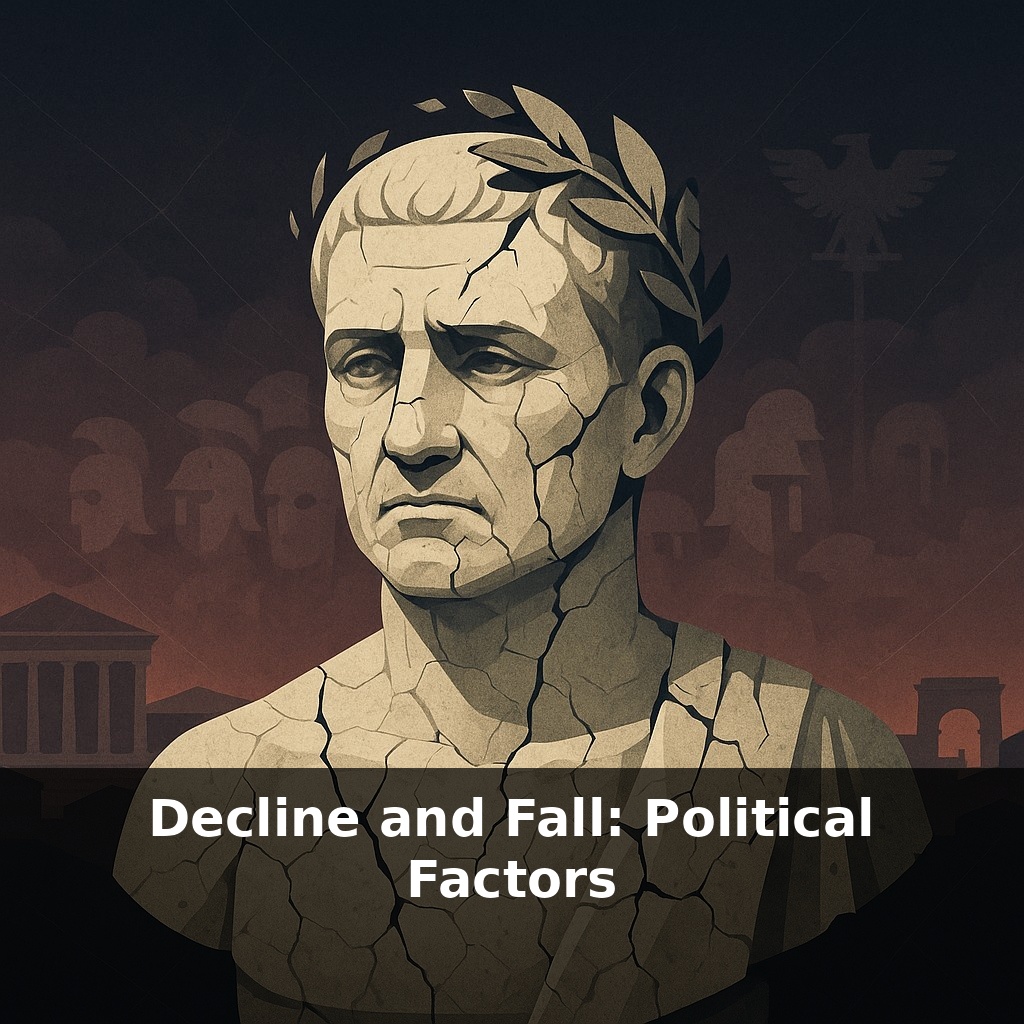
Twenty‑six Roman emperors rose and fell in just one chaotic half‑century—almost none died peacefully. In this episode, we drop into that turbulence: generals turning into rulers overnight, senators sidelined, and an empire slowly losing the ability to govern itself.
By the late Empire, Roman politics looked less like a steady hierarchy and more like a group project where no one trusted anyone else—but everyone still needed the final grade. Power was technically centralized in the emperor, yet real decision‑making frayed across court factions, regional commanders, and overworked bureaucrats. Laws multiplied, but consistent enforcement shrank. Governors might ignore edicts, soldiers might ignore governors, and local elites increasingly focused on protecting their own estates instead of the broader state. Even reforms designed to “fix” things—like splitting provinces or adding new layers of administration—often produced overlapping authorities and blurred accountability. In this episode, we’ll trace how that dense web of partial loyalties and half‑effective offices quietly hollowed out Rome’s ability to respond when real crises hit.
By the 3rd and 4th centuries, the real fault line ran through Rome’s institutions. Offices that once carried clear duties now overlapped like tangled cables: regional commanders could bypass civilian officials, imperial courtiers rewrote priorities overnight, and tax agents bargained as much as they obeyed. Reforms kept adding patches—new provinces, new titles, new layers of review—without simplifying the core system. Politically, this meant no one was quite sure who would still matter five years later, so short‑term survival routinely beat long‑term planning, even as pressures at the borders and in the countryside mounted.
“Sixty to seventy‑five percent of the imperial budget going to the army is not a defense policy—it’s a political system.” By the late Empire, the state’s finances, offices, and loyalties had been quietly rewired around the needs of constant military preparedness and internal competition.
One consequence was a creeping loss of civic participation. In the early Empire, holding a local magistracy or funding public works bought you status and influence. By the 4th and 5th centuries, many of those same municipal roles had become fiscal traps: curiales (city councillors) were personally on the hook if tax quotas weren’t met. Wealthy families responded rationally—they fled into imperial service, ecclesiastical careers, or sought exemptions. Town councils, once engines of local problem‑solving, hollowed out, leaving more weight on an already strained central bureaucracy.
At the top, reforms that looked tidy on paper generated new frictions. Diocletian’s division of provinces and creation of dioceses, and Constantine’s later separation of civil and military chains of command, were meant to prevent any one man from amassing too much power. In practice, they multiplied veto points. A general might blame a tax shortfall on a civilian governor who, in turn, blamed a court official who had quietly redirected resources elsewhere. Responsibility was dispersed just enough that failures belonged to “the system,” not to identifiable decision‑makers.
Meanwhile, coin debasement and in‑kind requisitions eroded everyday trust. When silver content plunged to a sliver, soldiers and suppliers demanded payment in gold, grain, or land instead. The state increasingly paid with privileges—tax immunities, legal advantages, hereditary offices—creating pockets of semi‑autonomous power that could resist later commands. Over time, more of the empire’s real capacity to raise men and money sat inside private or semi‑private networks rather than public institutions.
Like a complex software platform patched again and again without refactoring the core code, the imperial government technically kept running—until the accumulated workarounds made coordinated action in a crisis painfully slow and politically costly. External shocks exposed that lag, but the delay had been baked into the system long before the final crashes of the 5th century.
Sixty to seventy‑five percent of the late imperial budget going to the army meant that almost every “reform” had a hidden military clause. A new road in Gaul? Officially for trade—but it also let legions redeploy faster. An added tax on estates? Justified as civic improvement but quietly earmarked for frontier pay. Over time, even neutral‑sounding decisions tilted toward whoever controlled armed force.
You can see the results in specific flashpoints. When ~100,000 Goths crossed the Danube in 376, the issue wasn’t merely numbers; it was that no single civilian authority could reliably direct supplies, settle disputes, and discipline corrupt officers skimming rations. Local commanders bargained for short‑term calm instead of enforcing coherent policy, and the Adrianople disaster followed.
Like a modern tech platform where every team adds quick patches to keep their own feature running, late Roman administrators created localized fixes—special exemptions here, emergency levies there—until no one fully grasped the overall architecture. That fragmentation made coordinated recovery from any major shock far harder than in earlier centuries.
Modern risk analysts mine Roman data the way climate scientists probe ice cores: not to reenact the past, but to spot slow‑building fault lines. Political stress today often shows up as minor glitches—delayed budgets, contested appointments, opaque emergency powers. Your challenge this week: scan one current institution you rely on and list three such “hairline cracks.” Then ask: are fixes reinforcing shared rules, or just shifting leverage to whoever controls key choke points?
In the end, the West didn’t so much shatter as drift out of tune: tax rolls stopped matching real wealth, orders arrived late or never, and border units acted like semi‑independent clubs. Think of a stadium where the lights, ticketing, and security all run different schedules—the game can technically go on, but eventually the crowd just walks away.
Start with this tiny habit: When you hear a news story about political conflict or "decline," pause for 10 seconds and ask yourself, “Is this a problem of institutions, leadership incentives, or public trust?” Then, pick just one of those three and whisper a one-sentence explanation to yourself, like “This is really about weak institutions because…” Next time you scroll past a political headline, take one extra breath and mentally label it with one word from the episode—like “centralization,” “faction,” or “elite overproduction.” Over a week, you’ll quietly train yourself to see the deeper political patterns the episode described, without adding anything big to your schedule.