Break Your Auto-Pilot — 7-Day Awareness Starter Challenge
📝 Transcript
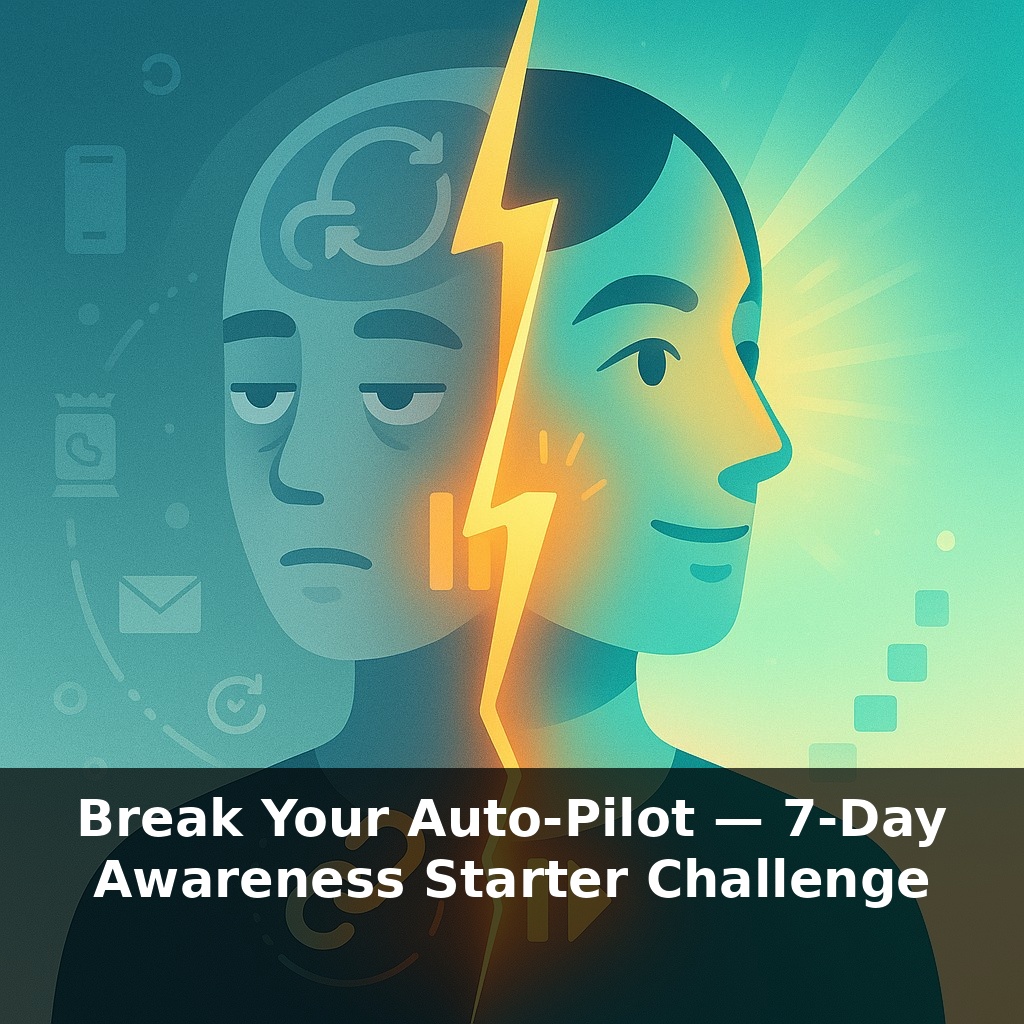
Right now, as you’re listening, almost half of what you’ve done today has been driven by habits you didn’t consciously choose in the moment. You turned, tapped, scrolled, replied…on autopilot. The twist is: your brain thinks that *is* you deciding. So whose day was it, really?
Most people try to change their life by wrestling with willpower at the hardest moment: late at night with the snack, on the couch with the remote, staring at the unopened email. That’s like walking into a movie halfway through and trying to rewrite the plot in real time. The 7-Day Awareness Starter Challenge flips the sequence: instead of forcing different choices, you first learn to *see* the moment before the choice.
This whole week is about micro-pauses, not massive overhauls. We’re going to use tiny, structured check-ins—about 60 seconds each—to catch the *lead-up* to your usual routines: the conversation before the doom-scroll, the feeling right before you say “yes” when you mean “no,” the tension that makes you open the fridge, not the book.
The log isn’t about judging yourself; it’s about collecting data on your day like a curious scientist, so change can become a side effect of seeing clearly.
Think of this week as running a quiet experiment on your own life. Three times a day, you’ll briefly “take attendance” of what’s happening inside and around you: Where am I? What am I actually doing? What just happened *before* this? You’re not looking for big breakthroughs; you’re collecting small clues—like noticing which errands always leave you drained, which conversations spark you, which environments make certain choices almost automatic. These notes turn vague discomfort into specific patterns you can work with, the way a chef tracks tiny tweaks to a recipe before serving it to guests.
Here’s the twist most people miss: awareness isn’t one big “aha” moment; it’s a muscle built from a lot of tiny, boring reps. And the reps that count most aren’t dramatic realizations—they’re the small times you *notice* something you usually gloss over and record it before it disappears.
In this challenge, your log is doing three specific jobs for your brain.
First, it slows down the “instant replay.” Normally, your day blurs into “pretty busy, kind of tired.” A 30–60 second note captures *what actually happened* in the last slice of time—who you were with, what you chose, what you felt right before. That’s the difference between “I always snack at night” and “I reached for chips right after reading one more work email at 9:40 pm.” One is a vague identity; the other is a pattern you can change.
Second, it upgrades vague feelings into usable signals. You might write “low-key anxious, scrolling” or “surprisingly calm after walking back from lunch.” You don’t need deep analysis. Over a few days, you’ll start to see repeated pairings: certain tasks with tension in your chest, certain people with a relaxed jaw, certain locations with the urge to escape. Your nervous system has been tracking this all along; the log simply gives its messages a visible channel.
Third, it expands the tiny gap between trigger and response. The moment you pause to write “about to open Instagram while waiting in line,” you’ve already created a fork: keep going, or choose differently. You don’t have to choose differently every time for this to work. Even if you continue the usual behavior, you’ve tagged it with a timestamp and a context. That “tag” is what your brain will recognize the next time, a subtle “we’ve been here before” that makes intentional action a little easier.
To keep this frictionless, you’re not writing a diary entry; you’re logging three quick ingredients: 1) What just happened externally (event or situation) 2) What shifted internally (body or mood) 3) What you did or are about to do next (behavior)
That’s enough to turn a foggy day into a map. Over seven days, those tiny map points connect, and your “that’s just how I am” stories start competing with actual evidence.
Notice how some moments in your day feel oddly “louder” when you pay attention for just a few seconds. That spike before you answer a text, the drop in energy when a meeting invite pops up, the subtle ease when you step outside—those are exactly the kinds of details this log is designed to catch.
To make it concrete, think of three everyday scenes:
You’re standing at the kitchen counter after work. You jot: “Empty house, shoulders tight, hovering near the pantry, thinking about today’s feedback.”
You’re opening your laptop in the morning. You write: “Desk cluttered, slight dread in my stomach, reaching for email instead of the project I care about.”
You’re getting into bed. You note: “Lights off, mind racing, hand already on my phone, telling myself ‘just ten minutes.’”
Over days, these tiny snapshots turn into a kind of personal “weather report.” You begin to see which forecasts reliably precede storms—certain tasks before late-night snacking, specific moods before avoidance—and where the small pockets of clear sky already are.
Your brain is about to become searchable. As wearables start logging sleep, movement, even micro-stress spikes, pairing that stream with your 30‑second notes could reveal patterns no app can guess alone—like why Fridays feel heavier or which meetings drain you. Your challenge this week: treat each log as a small “settings tweak.” At the end, review them once and identify just one environment change you can test next week.
By day seven, expect subtle shifts: you may catch yourself mid-scroll, or notice your tone soften before a reply. Treat that as a pilot light, not a finish line. Like tasting a dish as it simmers, these notes let you adjust the heat—less of what leaves you drained, a bit more of what leaves you clear—and quietly train your brain to check in before it checks out.
Here’s your challenge this week: For the next 7 days, set a 3‑times‑a‑day “Awareness Alarm” on your phone labeled: “What autopilot am I in right now?” and, when it goes off, immediately pause whatever you’re doing and say out loud: (1) what you’re doing, (2) what you were just thinking, and (3) what you’re feeling in your body (tight jaw, shallow breath, knotted stomach, etc.). Each evening, replay your day in your head like a short movie and spot *one* repeated autopilot pattern (such as scrolling during discomfort, snapping in the same conversation, or stress‑snacking at your desk) and give that pattern a nickname that makes you smile (like “The Doom Scroller” or “Snack Ninja”). By the end of the week, pick the one nicknamed pattern that showed up the most and decide in advance what your new “aware response” will be the next time it appears (for example, “When The Doom Scroller shows up, I stand up, drink a glass of water, and take 5 slow breaths before touching my phone”).
From this course
Self-Improvement Fundamentals Lab: Core Foundations
10 episodesUnlock all episodes
Full access to 10 episodes and everything on OwlUp.
Subscribe — $1.99/monthLess than a coffee ☕ · Cancel anytime