Most of today's actions unfolded without deliberate choice. Imagine this: you automatically reached for your phone, mindlessly browsed an app, poured a drink, or skipped that walk. These unconscious scripts dictate much of our behavior. In this episode, we're unearthing how to transform one small, routine moment into your most empowering habit.
Forty to forty-five percent of what you’ll do today will run on mental “scripts.” In earlier episodes, you learned to notice those scripts and choose where you actually want to grow. Now we’ll turn that intention into something tangible: a 15‑minute keystone habit that quietly reshapes the rest of your day.
Research shows a single well-designed habit can cascade into many others. When Alcoa’s CEO focused obsessively on one behavior—worker safety reporting—the company didn’t just get safer. Over 12 years, its market value jumped from $3 billion to $27 billion. That’s the power of one strategic habit.
You don’t need hours, discipline marathons, or perfect motivation. You need one small, consistent, well-placed behavior that runs every day—especially on “bad” days. In this episode, you’ll design that 15‑minute keystone and lock it to a moment you already live, so it becomes nearly impossible to ignore.
Most people try to “upgrade their life” with a full renovation—90‑minute workouts, strict diets, perfect morning routines. That usually collapses by week two. In this episode, we’ll do the opposite: one 15‑minute block, placed with surgical precision, that quietly upgrades everything else.
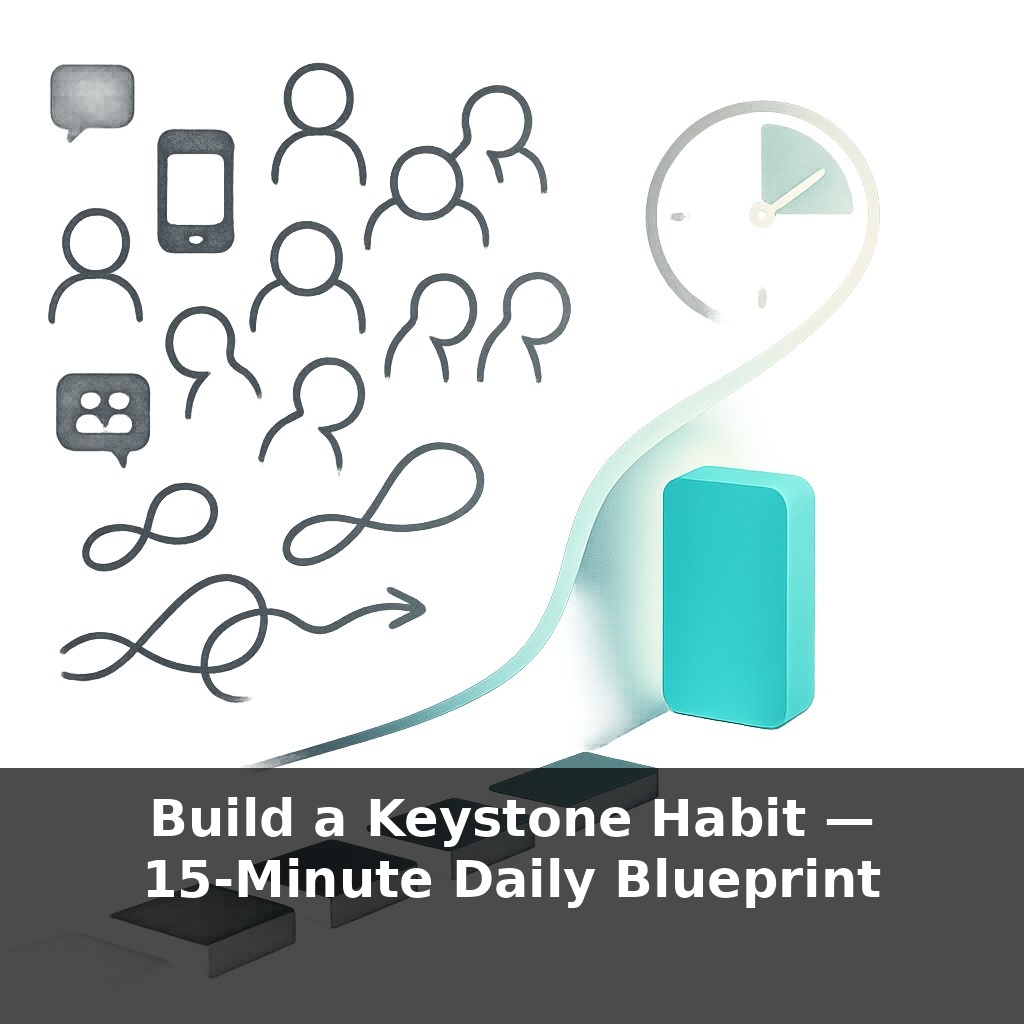
You’ll anchor this block to a specific daily moment—like locking your front door, finishing lunch, or plugging in your phone at night. Then you’ll choose one focused action: maybe a brisk walk, planning tomorrow, reading 5 pages, or a quick strength circuit. Finally, you’ll add a fast, deliberate reward so your brain learns, “When this cue happens, I do this, and it feels good.”
Here’s the hidden lever: not every daily behavior is equally valuable. Some actions are “dead ends” (scrolling, random snacking); others are “junctions” that influence lots of downstream choices. Your 15‑minute block only works as a keystone if it sits on a junction.
Think in terms of *collision points*—moments where your day can tilt in one of two directions. For most people, there are three high‑leverage zones:
1. **Wake-up + 60 minutes** This slice of time heavily predicts the rest of your day. Start with 15 minutes of intentional effort here and you’re more likely to make aligned choices later. For example, a 10‑minute mobility routine plus 5 minutes planning meals can, over a week, translate into: - +3–4 home‑cooked meals - +30–60 extra active minutes - Fewer late‑night snacks because the day felt “on track”
2. **First transition after work or school** This is where many people bleed time and energy. Walking through the door at 6:17 p.m. can lead either to 3 hours of passive screen time or a small pivot into something restorative or productive. A 15‑minute keystone here (walk, cleanup sprint, prep tomorrow) often stabilizes: - Bedtime (less “just one more episode”) - Evening nutrition (less random grazing) - Stress levels (lower evening cortisol, better sleep quality)
3. **Final 30 minutes before bed** This zone influences sleep onset, sleep depth, and next‑day focus. A short, device‑free block—reading, stretching, or reflection—can, within 2–3 weeks, move your average sleep duration by 30–45 minutes and cut next‑day “foggy” hours by 1–2.
When choosing where to place your 15 minutes, look for these patterns: - You hit the same wall at roughly the same time daily. - One small win here would remove multiple frictions. - When this window goes badly, the damage spreads (overeating, overspending, over-scrolling).
Then, narrow the *job* of your keystone. It should do one of three things:
- **Stabilize your physiology** (move, breathe, stretch, hydrate) - **Clarify your decisions** (plan, prioritize, review) - **Protect your attention** (read, think, learn, create)
Give your 15 minutes a clear “contract.” Not “evening routine,” but: “After I hang up my keys, I set a 15‑minute timer and prepare tomorrow’s food, clothes, and top 3 tasks. Only that.” The narrower the job, the faster your brain can “chunk” it into an effortless unit.
Here are some concrete 15‑minute designs people actually use, with numbers to show how small inputs scale.
Example 1 — After-work reset (physiology + decisions): “After I close my laptop, I walk exactly 8 minutes around the block, then spend 7 minutes listing tomorrow’s 3 priorities.” Done 5 days a week, that’s 40 minutes of walking and 35 minutes of planning. Over 12 weeks, you’ll have taken ~120 short walks and written ~180 focused priorities—often enough to noticeably lower evening stress and reduce “lost” hours.
Example 2 — Bedtime attention protection: “After I plug in my phone, I read 6 pages of a non‑fiction book and write 3 lines about my day.” At an average 250 words per page, that’s 1,500 words per night, ~45,000 per month—the length of a short book you’ve effectively “studied,” not just skimmed.
Think of this block like a daily prescription: same dose, same time, minimal negotiation. The goal isn’t intensity; it’s accumulating 300+ “keystoned” minutes over a month that quietly shift your default choices.
Done well, this 15‑minute block becomes data. In a year, that’s ~5,000 minutes (over 80 hours) of trackable behavior you can refine. AI tools will soon scan your calendar, biometrics, and mood logs to auto‑suggest micro‑tweaks: “Shift your keystone 20 minutes earlier; your HRV improves 12 %.” Teams might coordinate shared keystone windows, then compare metrics—missed deadlines, sick days, error rates—to justify redesigning schedules around these 15‑minute anchors.
Your challenge this week: run a 7‑day pilot. Lock your 15‑minute block to the *same* clock time and place daily. Log three numbers: start time, completion (yes/no), and a 1–5 energy rating after. In 7 days you’ll have 21 data points. Use them to adjust timing, content, or reward so week two runs at least 20 % smoother.