Consider this: A single decision today might unexpectedly steer your entire life forward, eclipsing hours of relentless effort. What if one deliberate choice determines the course of your week? In this episode, we'll hone in on the decision that could redirect everything else.
You make about 35,000 decisions a day, but here’s the twist: most people never clearly choose what this month is *for*. They collect goals like open browser tabs—career, health, relationships, learning—each one “important,” none of them driving real change. That overload quietly taxes your attention, and constant task-switching can wipe out up to 40% of your productivity before lunch.
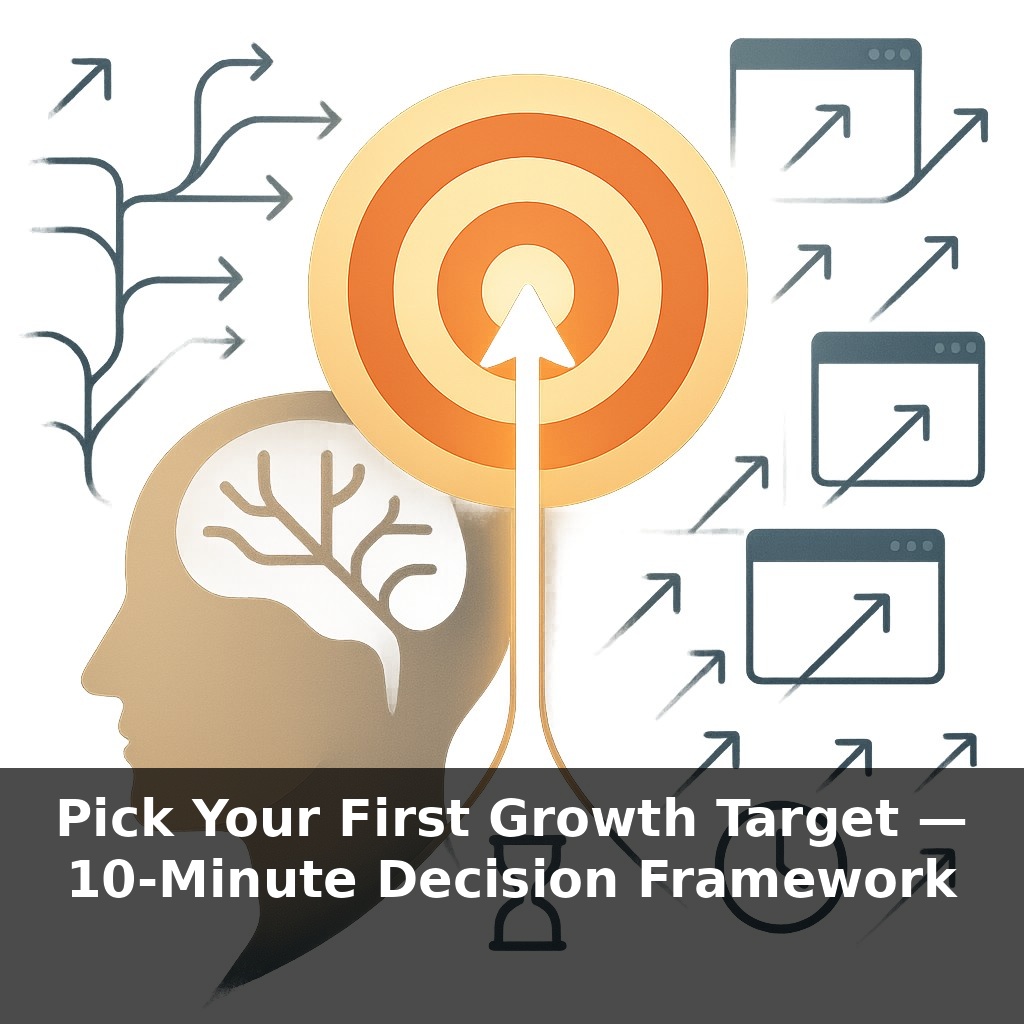
Today we’ll do something different: instead of piling on more aspirations, you’ll run a quick, evidence-based “triage” on your options and deliberately pick just one high-leverage growth target for the next 28–30 days. Think of it as choosing the one adjustment that, if improved, would tilt the rest of your life slightly in your favor. By the end, you’ll have a simple scoring rubric you can reuse any time you feel pulled in ten directions at once.
You might already have a rough list of “I should really…” items floating in your head: sleep more, network better, learn that skill, fix your mornings. Episode 1 helped you notice how much of your day runs on habit; now we’ll harness that awareness by choosing *where* to intervene first. Think of your life like a small clinic on a busy day: you can’t treat every patient at once, so you need a quick triage system. In the next few minutes, you’ll use three simple lenses—Impact, Effort, and Evidence—to rank your options and uncover the one move most likely to pay off in the next month.
Think of this section as a quick diagnostic, not a life redesign. You’re going to line up your possible targets and run them through three lenses: Impact, Effort, and Evidence. This borrows from the ICE and RICE models product teams have used since around 2014 to decide what to ship next—but we’ll keep it lightweight enough to do in ten minutes with a pen and paper.
Start by dumping out your contenders. Not every “someday” idea—only what feels realistically in range for the next 28–30 days. Maybe: “improve sleep by 1 hour,” “ship a portfolio piece,” “have one deep conversation per week,” “exercise 3x/week.” Four to eight options is plenty.
Now you’ll score each one from 1–5 on three factors:
1) Impact: If this *worked*, how much would it positively tilt the rest of your life this month? You’re looking for ripple effects. “Fix my calendar” might quietly boost work, family time, and rest. “Clean out closet” might feel good but change little else. Go with your best honest guess, not a fantasy.
2) Effort: Here, lower is better. How much time, emotional energy, and complexity does this demand? A 1 might be “20 minutes a day, low stress.” A 5 might be “hours, coordination with others, likely setbacks.” You’re not judging worthiness; you’re gauging how heavy the lift will feel on an average Tuesday.
3) Evidence: What tells you this is actually the right thing to tackle now? This is where you lean on data, not vibes. Have you already noticed clear pain signals—recurring conflicts, missed deadlines, lingering guilt? Do you have tracking, feedback from others, or patterns from Episode 1’s awareness work that point straight at this area? Strong evidence earns a higher score.
Once each option has three numbers, combine them. One simple way: (Impact + Evidence) – Effort. High positive scores suggest “small bet, strong upside, and good reasons to believe.” If two are close, ask: “Which one would be easiest to start *this week*?” That extra question often breaks ties.
The point isn’t to predict perfectly; it’s to make a fast, good-enough call that frees you from paralysis. People who commit to one written goal are dramatically more likely to follow through, and constraining yourself to a single target for this short window keeps your mental bandwidth focused where it can actually compound.
Think of how hospitals sort incoming patients. They don’t ask, “Who seems most interesting?” They scan for: who’s most critical, who’s easiest to stabilize quickly, and where the doctor is most certain about what to do. You’re doing a gentler version of that with your options. To make this concrete, take three targets: “cut scrolling at night,” “practice a new language,” and “have a weekly planning session.” Maybe scrolling quietly drains your evenings, the language feels exciting but distant from current pressures, and planning is the one thing your past weeks clearly lacked. As you score, you might notice planning gets medium Impact, very low Effort, and strong Evidence from repeated Sunday chaos. Suddenly it beats the “sexier” goal. Another angle: check whether any option unlocks others. A planning ritual could naturally create time for language practice later, while the reverse isn’t true. That “unlock factor” is often a tie-breaker your future self will quietly thank you for.
As tools mature, this kind of 10‑minute targeting may shift from a quiet notebook exercise into a live dashboard for your life. Imagine your calendar, sleep tracker, and collaboration apps feeding a simple “opportunity index” each morning: nudge your social energy today, protect your deep-work block tomorrow. Instead of reacting to fires, you’d get a short, evidence-backed menu of moves—more like a weather report than a to‑do list—so you can steer, not just cope.
Your challenge this week: test this rubric on real life. Pick three wildly different aims—one career, one health, one relationship. Run the 1–5 Impact/Effort/Evidence scan, do the math once, then *live with* the winner for seven days. Notice how saying “not now” to the rest feels like closing apps on a lagging phone so one video finally streams smoothly.