About nine out of ten self-improvement plans quietly fall apart—not because people are lazy, but because they’re working *too* hard in the wrong way. You start strong, tracking everything, chasing every goal, then one slip makes you feel like it’s all ruined. Why does that keep happening?
Ninety‑two percent of New Year’s resolutions don’t make it to the finish line. That’s not a willpower problem; it’s a design problem. After you’ve noticed your autopilot habits and picked a first growth target, the next trap is subtle: you try to upgrade everything, measure everything, and demand perfection from yourself—instantly. On paper it feels ambitious; in real life it quietly fries your mental circuits. Cognitive science is blunt about this: your attention is a scarce resource, and every extra goal and metric fights for the same tiny pool. Add in a brain that loves black‑and‑white verdicts—“nailed it” or “total disaster”—and progress turns fragile. In this episode, we’ll zoom in on three specific mistakes that make improvement unsustainable, and we’ll rebuild your plan so it’s something your actual, busy, imperfect life can support day after day.
So instead of piling on more effort, we’re going to adjust the *architecture* of how you pursue growth. Think of this as upgrading from a cluttered desk covered in half‑finished projects to a clean workspace with one clear priority in front of you. The research is blunt: people who focus on a single, well‑defined objective massively outperform those juggling several. Add too many targets or metrics and you invite decision fatigue—tiny “Should I do this now?” debates that drain you before real work happens. In this episode, we’ll zoom in on three specific design flaws and show you how to swap them for a lean, resilient system.
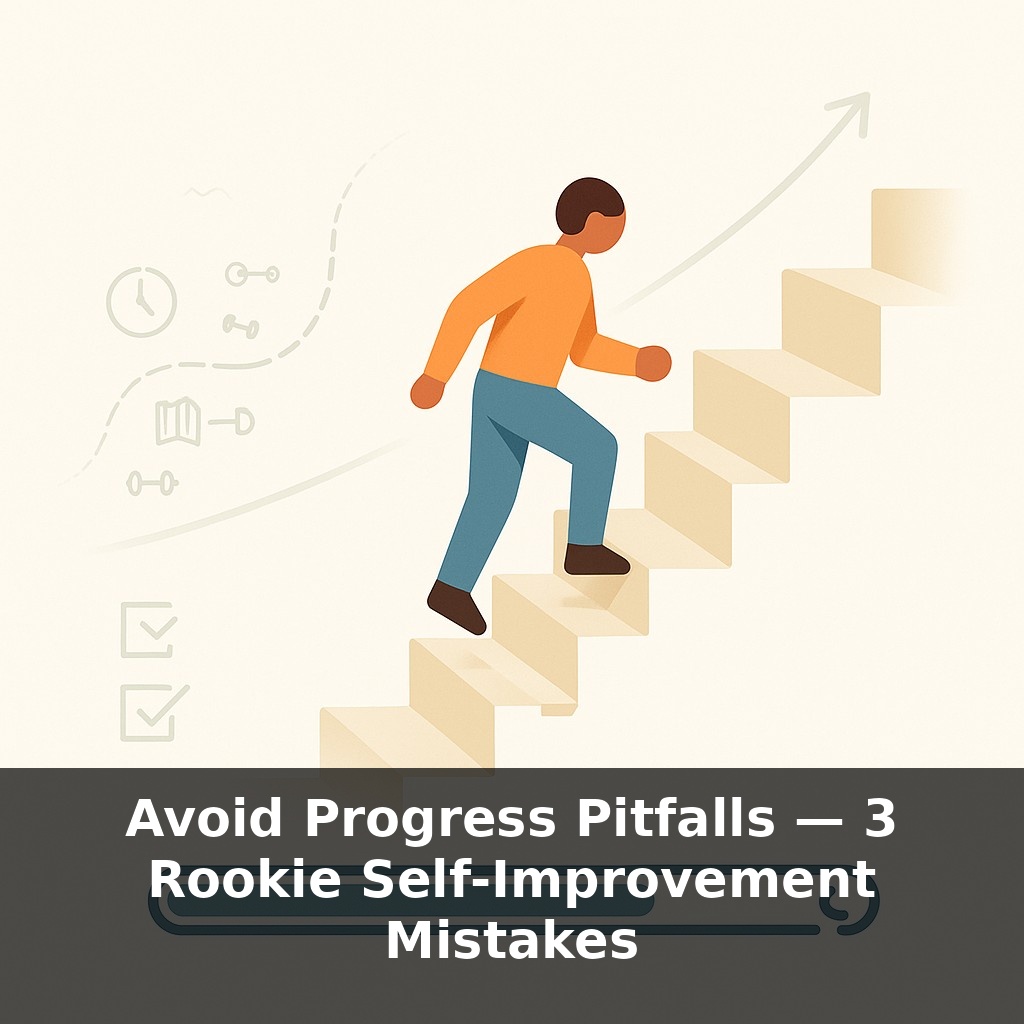
Let’s break down the three rookie mistakes so you can *spot* them in your own plan and swap them out for smarter moves.
**Mistake 1: Shotgun goals**
A Stanford experiment found that people given *one* clear goal finished it more than twice as often as those given three. That’s not because the “one-goal” group was more disciplined; their brains just had fewer internal tabs open.
Shotgun goals show up as: - “I’ll get fit, learn Spanish, read a book a week, and wake up at 5 a.m.” - Every podcast adds a new “must” to your list. - Your to‑do list looks inspiring at 8 a.m. and impossible by lunch.
Under the surface, you’re burning energy *switching* between targets rather than moving any single one forward far enough to feel momentum. Progress stays fuzzy, so your brain stops caring.
**Fix:** For now, connect everything to *one* primary outcome. Other ideas can live on a “parking lot” list you’ll revisit later. You’re not saying “never”; you’re saying “not yet.”
---
**Mistake 2: Metric overload**
The Etkin study showed that tracking can actually *reduce* enjoyment and increase dropout. The problem isn’t measuring—it’s measuring so much that every action feels like a mini performance review.
Metric overload sounds like: - “Steps, calories, macros, heart rate, sleep score, streaks…” - “If I can’t log it perfectly, I don’t want to start.” - Ten different apps for one behavior.
You become the unpaid data analyst of your own life, and the original *why* behind the change (more energy, more confidence, more creativity) gets buried under spreadsheets.
**Fix:** Keep one “output” metric (what you care about changing) and one “input” metric (what you’ll actually do). Anything that doesn’t clearly guide a decision is extra weight.
---
**Mistake 3: All‑or‑nothing thinking**
In therapy research, teaching people to replace “I blew it” with “Where on the scale was I today?” boosts outcomes by up to 50%. The same wiring sabotages growth plans.
All‑or‑nothing thinking sounds like: - “I missed a workout, so this week is shot.” - “I ate one cookie, so the diet is ruined.” - “If I can’t do the full routine, I won’t bother.”
One off‑day becomes a verdict on your identity instead of a single data point. You stop to “restart Monday” instead of adjusting the dial.
**Fix:** Turn every pass/fail rule into a *scale*. Instead of “Did I succeed?” ask, “Where was I on a 0–10 version of this habit today, and what nudged me up even half a point?” That tiny shift protects your streak *psychologically*, even when the day isn’t perfect.
Think about a week where you *almost* did what you planned: you cooked at home four nights, walked on three lunch breaks, read twenty pages twice. It’s easy to dismiss that as “fell off,” yet that’s exactly the kind of messy, partial progress that compounds if you learn how to steer it.
To dodge shotgun goals, try a “lead domino” test: which single change, if it quietly improved, would make two or three other things easier *without* extra effort? For some people, that’s sleep; for others, it’s a 10‑minute planning ritual. Start there and let other ambitions wait their turn.
For metrics, picture a pilot: they don’t watch every dial at once; they focus on the few that actually change the flight. Let one measure tell you whether life is *better*—mood, energy, output—then one behavior you can do today that nudges it.
And when a day goes sideways, borrow a therapist’s trick: ask, “What kept today from being a zero?” That question forces your brain to notice small wins it would normally erase, and those become the footholds for your next adjustment.
We’re early in a shift where tools start acting less like drill sergeants and more like coaches. Instead of shouting more numbers at you, the best apps will quietly highlight one or two levers that matter most *today*, based on context: sleep, stress, schedule, even your calendar. Think of it like a good primary‑care doctor: not ordering every test possible, but picking the few that change the treatment. The upside: less noise, fewer guilt spirals, and progress that fits a real human life.
Progress gets sturdier when you treat it like editing a draft, not carving a statue. You’ll cross things out, rewrite lines, add margins. This week, notice where small tweaks—shorter sessions, looser rules, fewer numbers—actually make it easier to return tomorrow. You’re not lowering the bar; you’re moving it to solid ground so you can keep stepping up.
Try this experiment: For the next 7 days, pick just ONE area you’ve been “over-optimizing” (like fitness, productivity, or morning routines) and deliberately cap your effort at a simple, repeatable minimum—e.g., 10 minutes of walking, 1 focused work block, or a 5-minute nightly review, and nothing extra. Any time you feel the urge to add more hacks, switch goals, or “upgrade” the habit, pause and note what specifically you’re tempted to change and why. At the end of the week, compare how consistent you were with this stripped-down version versus past weeks when you chased multiple improvements at once, and notice which approach actually moved you forward more.