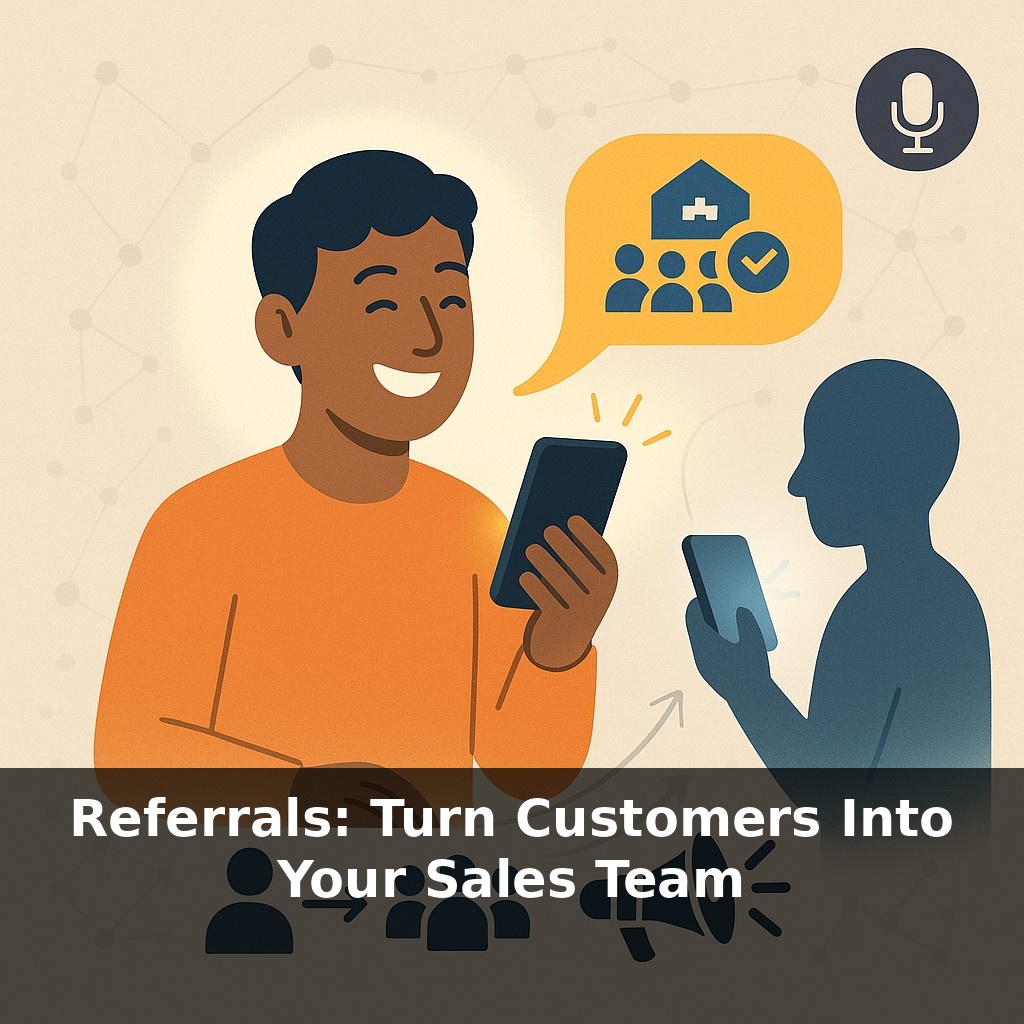
Referrals quietly outsell your best ad campaigns—without spending a dollar more. A buyer texts a friend, “Hey, we used this team, they were great,” and the deal skips half the usual friction. In this episode, we’ll unpack how to make those private moments happen on purpose.
Most teams treat referrals like “nice surprises” instead of a system. That’s the real problem. You probably have happy customers right now who would vouch for you—but there’s no clear trigger, no timing, no path. So their goodwill just… sits there.
When referrals *do* happen, they’re often random: a client forwards your proposal, tags you in a post, or casually mentions you at a meetup. Helpful, yes—but impossible to forecast or scale.
In this episode, we’ll move referrals from luck to leverage. You’ll see how to:
- Spot the exact moments when people are most primed to refer - Make the “ask” feel natural, not needy - Reward referrals without cheapening trust - Turn one good experience into a repeatable chain of introductions
Think of this as designing a quiet, behind-the-scenes campaign where your customers become your most credible reps—without ever feeling like salespeople.
The hidden power of referrals isn’t just “more leads”—it’s the *type* of leads they bring you. People usually refer those who think, buy, and struggle like they do. That means every strong customer can become a clue to an entire cluster of best-fit prospects you haven’t met yet. Instead of shouting your message into a crowded room, you’re quietly getting introduced at a table where the conversation has already started. In this episode, we’ll zoom out from individual introductions and look at how to map, nurture, and intentionally grow these micro-networks around your happiest customers.
Call out what you’re really building: a *network around each great customer*, not just a one-off introduction. Instead of thinking, “How do I get this person to send me someone?” zoom out to, “Who sits in this person’s orbit—and how do I become useful to that whole little ecosystem?”
Start by mapping the roles around your best wins. For a small business client, that might include their bookkeeper, web designer, and mastermind group. For an enterprise account, it could be adjacent team leads, implementation partners, or their favorite vendors. Each of those people is both a potential referrer *and* a potential new customer.
Then, notice that not all introductions are equal. There are at least three useful “flavors”:
- **Direct handoff** – “You should talk to Jordan; I’ll connect you two by email.” - **Public endorsement** – “I’ll comment on your LinkedIn post with a quick story.” - **Quiet signal-boost** – “I’ll forward your resource to two founders in my group.”
Once you see these flavors, you can offer options instead of a single, high-pressure ask. Some people hate making warm intros but are happy to post a quick note. Others avoid social media but will send two thoughtful emails if you draft the copy.
Structure what you’re asking *for*, too. Vague pleas like “keep me in mind” die fast. But targeted prompts such as “Who’s the person in your world who always gets dragged into fixing X?” make it easier for someone to scan their mental Rolodex and land on a name.
This is where your positioning matters more than your pitch. If you’re crystal clear about the specific problem you solve and for whom, your customers can quickly match you to the right people. If you’re foggy—“we do a bit of everything for everyone”—their brain stalls, and the moment passes.
A helpful way to think about it: like a good clinical specialist in medicine, you want to be known for treating a recognizable “condition,” so that when a friend describes those symptoms, your customer immediately knows who to send them to—you.
Think about real people you already serve. Take your most enthusiastic customer and trace one concrete scenario: they’re in a Slack community, someone complains, “Our onboarding is a mess.” Your customer jumps in: “We had that problem; here’s who we used.” That moment isn’t random generosity—it’s a predictable pattern you can quietly encourage.
For example, a solo consultant might keep a simple list: *client, their communities, their go-to peers*. After every strong result, they’ll say, “If this ever comes up in your mastermind, here’s a one-liner you can share.” Now the customer isn’t “doing you a favor”; they’re stocking their own toolkit for helping friends.
A SaaS founder could host a short customer roundtable and ask, “Where do you talk shop with people like you?” Each channel mentioned—Discord, niche forums, local meetups—becomes a place to seed stories, case studies, or exclusive offers customers feel proud to pass along. Your goal isn’t pressure; it’s making it effortless for them to look smart by pointing others your way.
As referral engines mature, the game shifts from “getting more names” to curating the *quality* and *shape* of the network you’re building. Who tends to cluster around you—fast-moving experimenters, slow-but-steady implementers, or high-status “hubs” who quietly influence whole groups? Over time, patterns emerge: certain communities over-index on ideal customers, while others create noise. Treat those patterns like shifting weather fronts, guiding where you plant the next signal and where you let things cool.
As you test, don’t just count new names—watch how your reputation mutates as it passes between people, like a story retold around a campfire. Are they emphasizing your speed, your calm, your creativity? That feedback quietly shapes your next offer, your messaging, even your roadmap. The “sales team” you’re growing is also editing your narrative in real time.
Before next week, ask yourself: 1) “Which 3 current customers are already saying great things about us, and what specific, low-friction way could I invite each of them to refer one person (e.g., a ‘who else on your team would benefit from this?’ email right after a successful result)?” 2) “If I turned my best customer success story into a simple referral script, what exact words would I want happy customers to use when they introduce us to a friend or colleague?” 3) “What’s one delightfully unexpected ‘thank you’ I could offer for referrals (not discounts—think early access, a personal check-in, or a small, thoughtful gift) that would make customers feel proud to recommend us, not like they’re being paid to sell?”