About half the people who give presentations never decide what their talk is actually about. They just… start talking. In a boardroom, on Zoom, at a conference, the pattern repeats: lots of slides, plenty of effort, and an audience quietly thinking, “So what?”
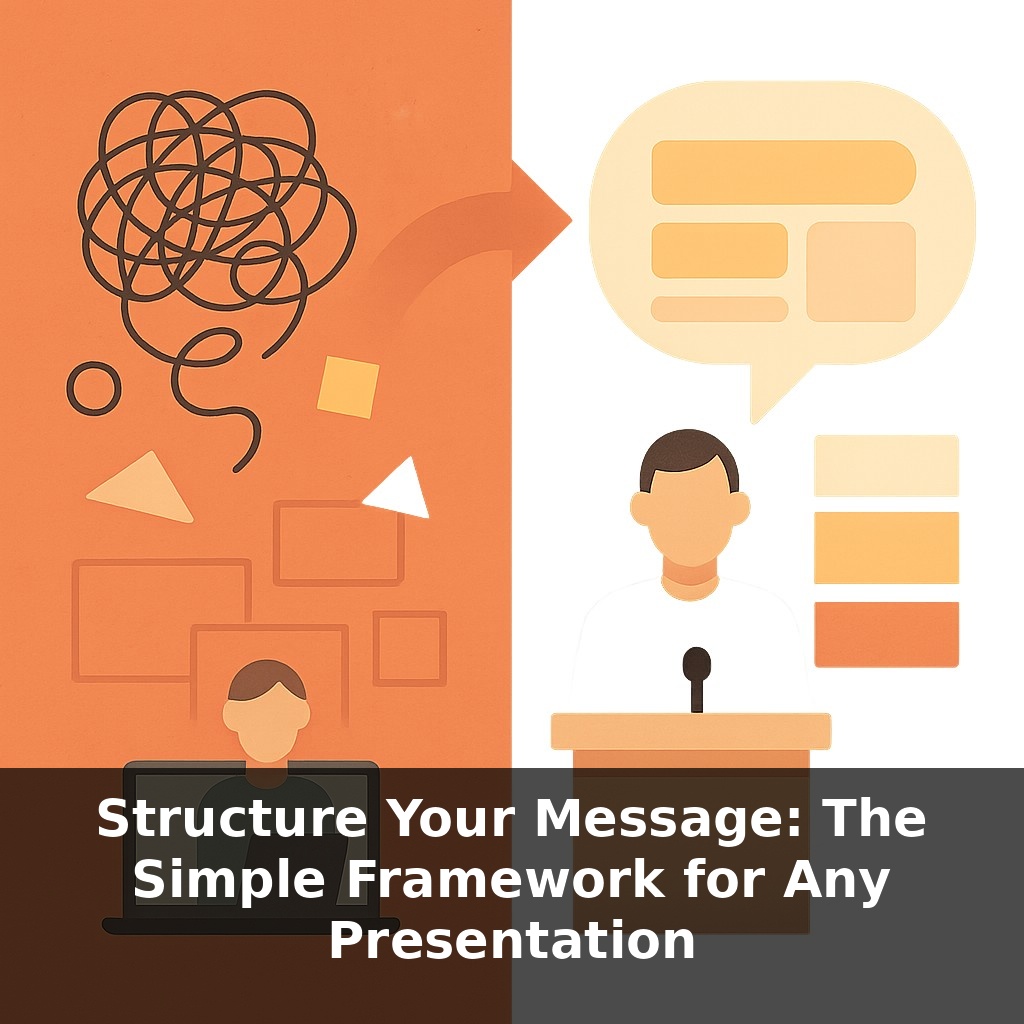
Most people react to that “So what?” problem by adding more: more slides, more data, more enthusiasm. Ironically, that usually makes things worse. When your ideas arrive as one long, unbroken stream, your audience has to build the structure in their own heads—while you’re still talking. That’s like handing someone a box of Lego bricks during a meeting and expecting them to assemble the model before you move to the next point.
There’s a quieter, much more reliable fix: decide on the skeleton of your message *before* you create any content. No slides. No stories. Just the spine. Today we’ll look at a simple way to do that—one you can use whether you’re presenting a quarterly update, a product idea, or a tough recommendation your stakeholders might resist. Once you can see the architecture, everything else gets easier.
Structure isn’t about being rigid; it’s about giving your ideas a clear path to travel. Think of it as setting waypoints in a GPS: you still choose the roads in the moment, but the destinations are locked in. Research backs this up. When listeners know what’s coming, their brains stop wasting energy guessing your direction and start investing energy in evaluating your message. That’s why simple frameworks like Minto’s Pyramid or Monroe’s Motivated Sequence show up in everything from investor pitches to TED talks—they quietly lower cognitive load so your actual content can land where it should: in memory, and then in action.
Here’s the simplest place to start: every presentation you give can ride on three moves—
1) **Start by setting the stakes.** Open with a concrete situation, not a slogan. Instead of: “I’m here to talk about our Q3 numbers,” try: “In Q3 we hit our revenue target—but the way we did it makes Q4 much riskier than it looks on paper.”
One line, but it tells your audience: this matters, and here’s why it’s not just another update. You’re not dumping information; you’re framing a problem or possibility that the rest of your talk will resolve.
2) **Group your ideas into 3–4 “blocks.”** Those blocks could be: - Three reasons a decision is needed - Three options, then your recommendation - Four steps in a rollout
What matters is that each block has a clear label, and you *say* those labels out loud as you go. For example: “We’ll look at this in three parts: customer impact, cost impact, and timing risk.” Now each section has a name, a boundary, and a job to do. Within a block, you can tell stories, show data, or demo a feature—but the label keeps everything tethered to a single idea your audience can remember.
3) **Land the plane on one decisive takeaway.** Most talks fade out with “So… yeah, that’s it,” or a vague “Any questions?” Instead, plan the last 60 seconds as carefully as the first 60. Ask yourself: *If they only remember one sentence tomorrow, what should it be?* That becomes your closing line, followed by the next concrete step you want: a decision, a pilot, a follow‑up meeting, a behavior change.
You can combine this with more advanced frameworks without overcomplicating things. Think of this three‑move pattern as the “default track” under your slides: - Stakes = why this top message exists - Blocks = how you unpack it - Takeaway = what you want them to do with it
Notice what’s missing: you haven’t written a script yet. You’re deciding the order of *decisions* your audience will make as they listen. Only after that do you bother drafting sentences or designing slides.
Think about how this plays out in real rooms. In a product pitch, your “stakes” opener might be: “Three of our top five clients are asking for the same thing—and our current roadmap can’t deliver it.” Your blocks could be: the demand signal, the gap in the product, and the proposed solution. The close: “I’m asking for approval to reallocate two engineers for 90 days to close this gap before renewal season.”
Or take a short team stand‑up. Instead of a status monologue, you frame it as: the key shift since yesterday, today’s top three priorities, and one explicit ask from the group. Same three moves, just compressed.
Notice how Steve Jobs used this in 2007 without calling it a framework: he built to “an iPod, a phone, an internet communicator… are you getting it?”—a single, sticky idea. That’s the power of organizing your material as decisions and chapters, not a stream of updates.
Your challenge this week: before your next meeting where you have more than five minutes to speak, write down *only* three lines: your stakes opener, your 3–4 block labels, and your final takeaway sentence. Do it on paper or in a notes app—no slides, no bullets, no polishing.
When you deliver, resist the urge to add more blocks or change the order on the fly. Just see what happens to how people track you, when they interrupt, and what they repeat back later. Treat it like a live A/B test against how you normally present.
Soon you’ll outline not just words, but experiences. As hybrid work deepens, your “three blocks” might become three zones in a virtual room, each revealing detail as people explore—more like navigating a game level than flipping slides. AI copilots will quietly flag when a point lands flat and suggest a sharper pivot. Think of your outline as version 1.0 of a “presentation API” that future tools will plug into, remixing your message without diluting your intent.
As you keep using this, you’ll start hearing “chapters” in every strong talk—like recognizing the chorus in a song after a few listens. That awareness is your edge: you’ll spot where to cut, where to linger, and how to remix your message for a hallway chat, a Zoom, or a town hall, without ever losing the thread your audience can follow.
To go deeper, here are 3 next steps: 1) Download a slide template tool like Canva or Keynote and build a 3-part deck (hook → problem → solution) using the exact “before/after/bridge” structure discussed, then rehearse it once on Loom and watch your recording to see where your message loses clarity. 2) Grab a copy of “Made to Stick” by Chip & Dan Heath and rework one upcoming presentation using their SUCCESs checklist (Simple, Unexpected, Concrete, Credible, Emotional, Stories) directly alongside the framework from the episode. 3) Install a speech timer app (like “Presenter Timer” or “Toastmasters Timer”) and practice delivering your full structured message in 3 different time slots (1-minute, 5-minute, 15-minute versions) so you can adapt the same core structure to any presentation length.