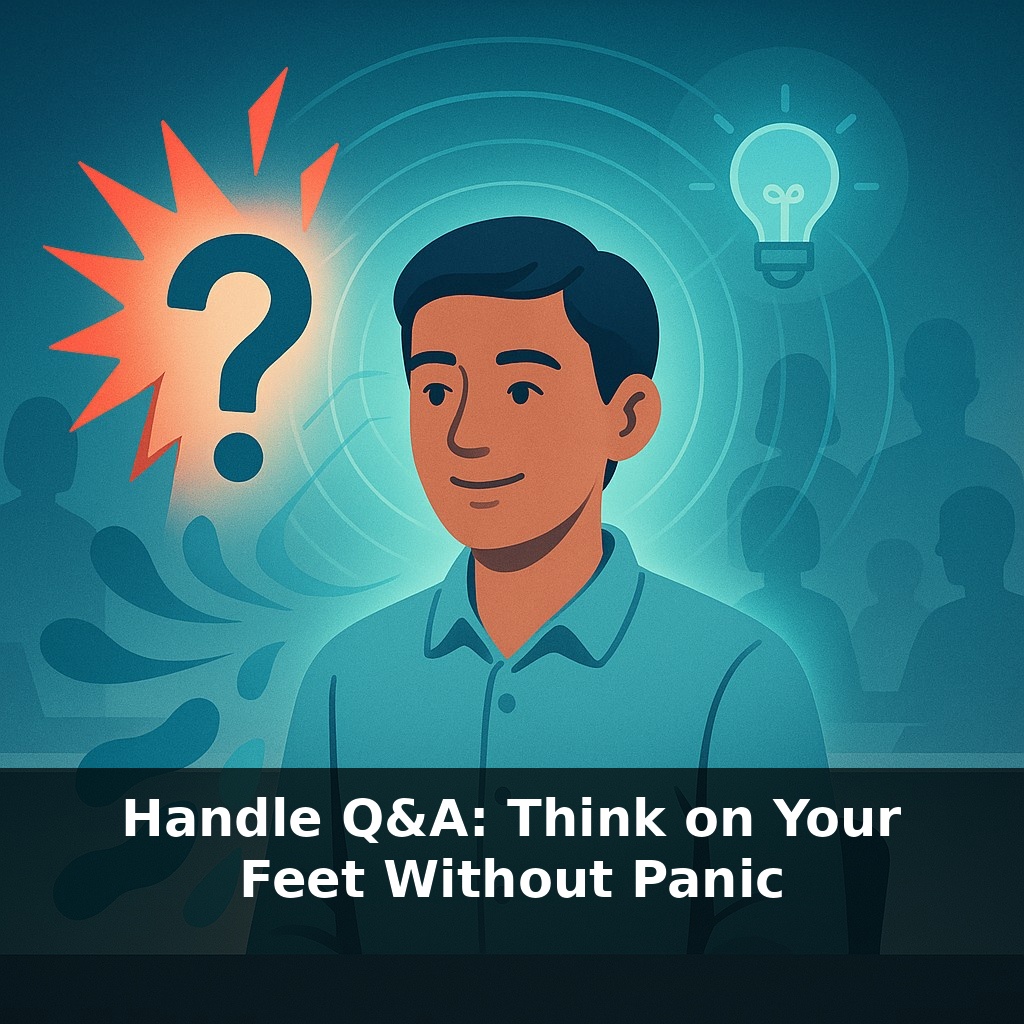
About three out of four people say Q&A time scares them more than their main presentation. Now jump to a tense meeting: a curveball question lands in your lap, eyes lock on you… and instead of freezing, you feel oddly calm, almost curious about what you’ll say next.
That oddly calm feeling isn’t magic; it’s mechanics. Under pressure, your body runs a very old program: heart rate spikes, breathing shallows, vision narrows. If you don’t manage it, your thinking goes from “search” mode to “survive” mode. The good news: you can flip that switch back. Controlled breathing, a two‑second pause, even the way you look at the person asking—these are levers you can train, not talents you’re born with.
In this episode, we’ll treat “thinking on your feet” as a skill you can break into parts: first, keeping your brain online when stakes feel high; second, using a simple structure so your answers don’t ramble; third, rehearsing in a way that actually mirrors live fire, not just reading notes. Instead of trying to be the quickest person in the room, your goal shifts: become the steadiest one, the person others trust when conversations get messy.
Most people assume quick answers come from being smarter or more experienced. Neuroscience gives a different story: in live Q&A, the winners are usually the ones who can buy themselves just a few clear seconds. That tiny gap is where you choose whether to react or respond. In those seconds, you can scan the question for its real intent, decide what *not* to cover, and pick one useful lane instead of five half‑answers. This is also where planning pays off: leaders like Steve Jobs and Jacinda Ardern didn’t improvise from scratch—they relied on practiced mental “shortcuts” they could snap into under pressure.
Here’s the twist: the goal in Q&A isn’t to have the “perfect answer” ready. It’s to have a *reliable way* to turn a messy question into a clear, useful response while your body is still catching up.
Start with what your brain is actually doing in that moment. A question lands, your attention snaps to the asker, then your mind usually sprints in three directions at once: “What do they want? What do I *actually* know? What happens if I mess this up?” Instead of fighting that chaos, you can quietly route it.
Step one: decode intent. Most questions carry a hidden layer beneath the words. - Content questions: “How does this feature work?” → they want information. - Process questions: “How did you reach that decision?” → they want transparency. - Emotion questions: “Are we safe if we do this?” → they want reassurance.
Silently label what you’re hearing—“info,” “process,” or “reassure.” This tiny act keeps you from answering the wrong need, like giving raw data to someone who really wants to know if you’ve thought things through.
Step two: narrow the target. Instead of mentally drafting a full essay, pick *one* main point you want them to leave with. A simple internal prompt helps: “If they forget everything else, what’s the one sentence I want to stick?” That becomes your North Star. You can stack details around it later, but you’ve already decided what “good enough” looks like.
Step three: choose a frame. Think of it like selecting a lens on a camera: - PAR mini-story when they need proof: “Here’s the situation… here’s what we did… here’s what happened.” - Pros/cons when they need a decision path: “Here’s the upside, here’s the risk, here’s how I’m weighing it.” - “What we know / what we don’t / what happens next” when things are uncertain.
Notice none of this requires speed; it requires sequencing. Steve Jobs defending the iPhone antenna didn’t just rely on charisma—he acknowledged the issue, zoomed out to industry data, then returned to concrete fixes. Jacinda Ardern often started with what people were feeling, then layered in facts and next steps.
Over time, you’re not memorizing scripts; you’re building a small library of mental tracks you can hop onto under pressure. The more often you run those tracks, the less “on the spot” you actually feel, even when the questions are genuinely tough.
Notice what skilled interviewees on live TV actually *do* with a tough question. A politician asked about a budget blowout doesn’t try to download their entire brain; they zoom in on one angle, label the tension, and walk the audience through a short, clear path. You can steal that same move in everyday settings.
Say your manager asks, “Why is this project behind?” Instead of defending every detail, you might answer: “There are two main factors—dependencies we don’t control, and one planning mistake I own. Let me start with the external piece, then I’ll talk about what we’ve changed for next time.” You’ve just set an agenda in real time, which makes you sound prepared even if you were surprised.
Or take a product designer who says, “I see three options, and I’m leaning toward B because it gives us 80% of the benefit with half the risk.” That simple contrast tells people how to think, not just what you think.
Seventy-seven percent of people feel their chest tighten when the floor opens for questions—yet the future will demand *more* live thinking, not less.
As AI handles routine queries, your value shifts to nuance: tradeoffs, ethics, “it depends” calls. Expect tools like VR rehearsal rooms and real-time AI feedback whispering, “Slow down; try a clearer hook.” Treat those tools like a producer in your ear—support, not a crutch.
Your challenge this week: join one live session (all-hands, class, stream) and ask *one* thoughtful question. Study how the speaker handles it: where they pause, how they frame, what calms the room.
Over time, you’ll notice a shift: instead of dreading “off‑script” moments, you start treating them like a jam session with a band you know well—unrehearsed, but not unsafe. The next layer is range: practice saying “I don’t know *yet*,” redirecting to the right owner, and inviting others in: “How are you seeing it from your side?”
To go deeper, here are 3 next steps: 1) Practice the “Pause–Paraphrase–Pick 1 Point” method by using a free improv warm-up video on YouTube (search “TJ Jagodowski & David Pasquesi improv Q&A exercises”) and pause after each audience question to paraphrase it out loud, then give a 60-second answer on just one angle. 2) Build your “go-to stories” bank by skimming the “Stories That Stick” book by Kindra Hall (especially the chapter on value stories), then record 3 short voice memos on your phone where you tell one work story, one failure story, and one “lesson learned” story you can reuse in future Q&As. 3) Run a daily 10-minute Q&A drill using otter.ai or a similar voice transcription tool: paste in 5 common questions from your industry (pull them from Reddit or Quora), answer them out loud, and then review the transcript to highlight where you rambled versus where you were clear and concise.