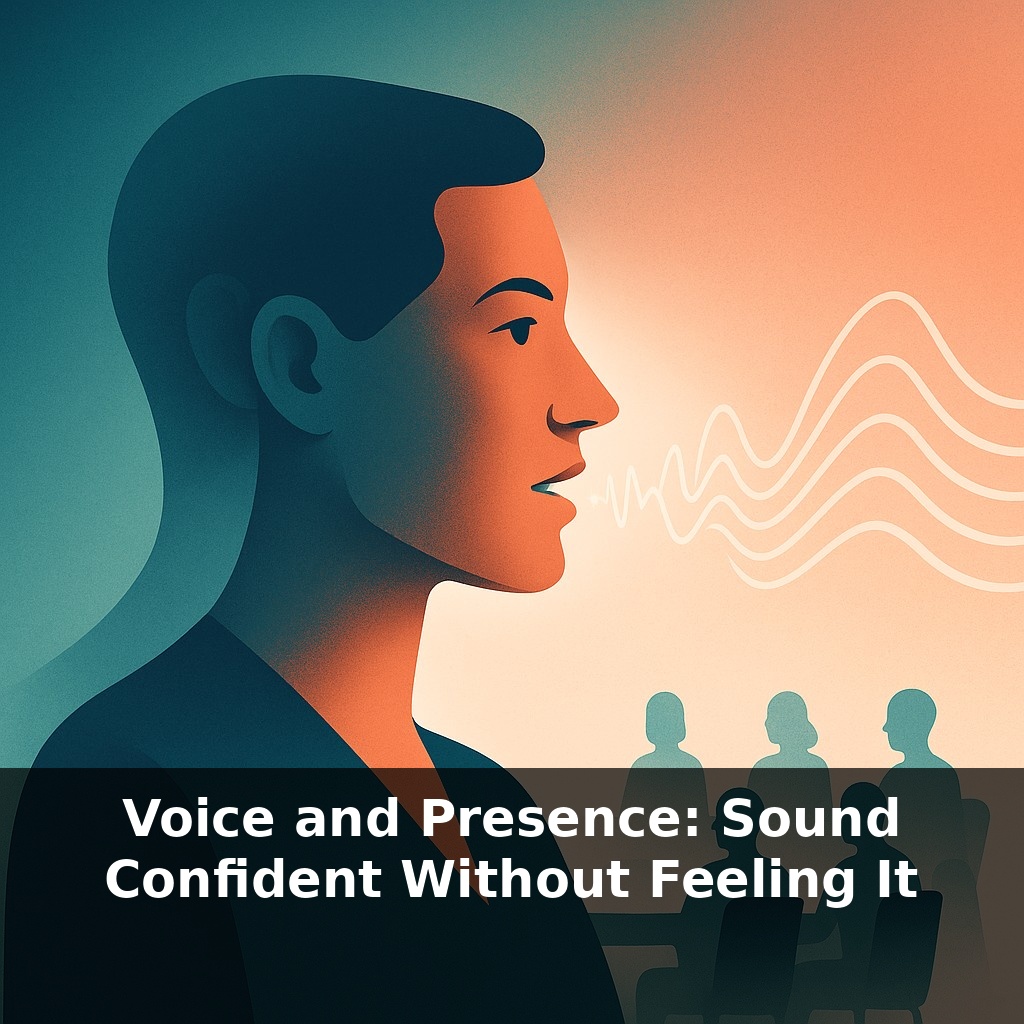
Most people decide if you sound confident in less than a heartbeat—often before you’ve finished your first word. Imagine walking into a meeting where your voice trembles and your idea lands flat, versus one where your tone is steady and people lean in. Same idea. Different voice.
Within that first half-second, listeners aren’t just reacting to *what* you say; they’re unconsciously scanning *how* your system is running: Is your breath shallow or supported? Is your pace rushed or measured? Is your pitch tight and high, or grounded and flexible? They don’t know those terms, of course—they just feel “steady” or “uncertain.”
Here’s the twist: those cues are trainable, and they improve far faster than most people expect. In studies, small, deliberate shifts—slightly slower starts, tiny drops in average pitch, brief pauses before key points—changed leadership and trust ratings without changing the speaker’s core personality at all.
Think of this section as shifting from “I hope my voice behaves” to “I know which knobs to adjust.” We’ll focus on levers you can actually control, even on days when your nerves are loud.
Confidence, then, stops being a mysterious trait and starts looking more like a set of habits wired into your body. This is where physiology and psychology collide: your nervous system, not your “personality,” is usually what hijacks your voice in high‑stakes moments. Heart rate jumps, muscles brace, breathing shrinks—and your sound follows. The good news: that loop runs both ways. When you change how you breathe, shape sound, and pause, you’re not faking it; you’re feeding calmer data back into your brain, giving your words a steadier runway before they ever reach the room.
Most people try to “sound confident” by pushing from the wrong end: forcing more words, more volume, more certainty. The counterintuitive move is to treat your voice less like a performance and more like a system you can configure on demand.
Start with what listeners actually latch onto first: stability. Not brilliance, not charisma—stability. That shows up in three places you can tweak quickly:
1. How your sound *starts* The first half‑second is a snapshot of your current state. If your first word launches mid‑breath, on a tight, squeezed onset (“So, uh…”), people register tension before they register content. A cleaner launch is quiet but decisive: breathe, plant your feet, then let the first consonant be crisp and the first vowel unhurried. You’re not trying to sound big; you’re trying to sound *settled*.
2. Where your voice “sits” Under stress, voices often creep higher and thinner, even if you don’t feel like you’re “talking high.” A quick reset is to speak one short sentence on a gentle hum first—*silently or under your breath* before you unmute. This nudges your sound back into a more resonant, grounded zone without you thinking about “pitch” at all. The listener hears more authority; you just feel less strain.
3. How your ideas are chunked Confidence doesn’t sound like nonstop flow; it sounds like you trust your ideas enough to give them space. Instead of stuffing three points into one breath, treat each key idea as a separate unit with a tiny runway before it and a short landing after it. Those micro‑gaps are where your authority shows up: you’re signaling, “This matters enough to stand alone.”
Here’s where this becomes practical in high‑stakes settings. Before you speak in a meeting, run a 5‑second sequence:
- Exhale fully (quietly) - Inhale once, low and easy - Decide your *first* sentence only - Let the first word start cleanly, not rushed
That’s it. You’re not fixing your whole communication style; you’re configuring the next 10 seconds of sound so it carries more weight than your nerves.
One useful way to think about this: your voice is like a software interface to your nervous system. The backend might be messy—stress, doubt, racing thoughts—but the frontend can still be clear, responsive, and easy for others to navigate. When you adjust starts, placement, and chunking, you’re updating that interface, one interaction at a time.
At work, you already see versions of this. The senior engineer who barely raises his voice but everyone quiets when he starts a sentence. The junior PM whose ideas are solid, but her words blur together and people default to the louder voice in the room. Same meeting length, same slide deck quality—but the sound-track changes whose work travels.
To make this less abstract, borrow from musicians: a jazz trio doesn’t play all notes at the same volume. The bass is steady, the piano adds color, the drummer creates space with rests. You can treat your speaking the same way: choose one phrase per point to be your “bass line.” Say it 5–10% slower, with slightly more resonance, and a cleaner ending. Let the explanation around it be lighter.
Concrete example: Instead of, “Yeah, so the numbers are up and we think it’s due to the campaign shift,” try: “The key result is this: *our signups are up 18% this quarter.*” Brief pause. Then add context. Over time, people start quoting your “bass lines” in rooms you’re not in. That’s vocal presence doing quiet, compounding work.
Algorithms are already “listening” to how we sound, not just what we say. As voice tech matures, it may feel less like public speaking and more like live A/B testing: software nudging your pitch here, softening your pace there. That can democratize presence for quieter people, but it also risks codifying narrow norms of what “authority” sounds like. The opportunity—and responsibility—is to use these tools to expand which voices count, not funnel everyone into the same template.
Your voice doesn’t have to wait for your feelings to “catch up.” Over time, a curious mindset helps more than chasing a perfect sound. Treat each high‑stakes moment like a mini beta test: try one tweak, watch the response, iterate. Like compounding interest on a small deposit, those experiments quietly build a vocal presence that feels more like you.
Your challenge this week: choose ONE recurring situation—your Monday standup, client check‑in, or daily status update. For that single context, run the same 5‑second pre‑sentence routine every time you speak. At week’s end, don’t judge your “confidence.” Instead, note three concrete reactions that felt different.