The Man Who Knew Too Much: Kim Philby
📝 Transcript
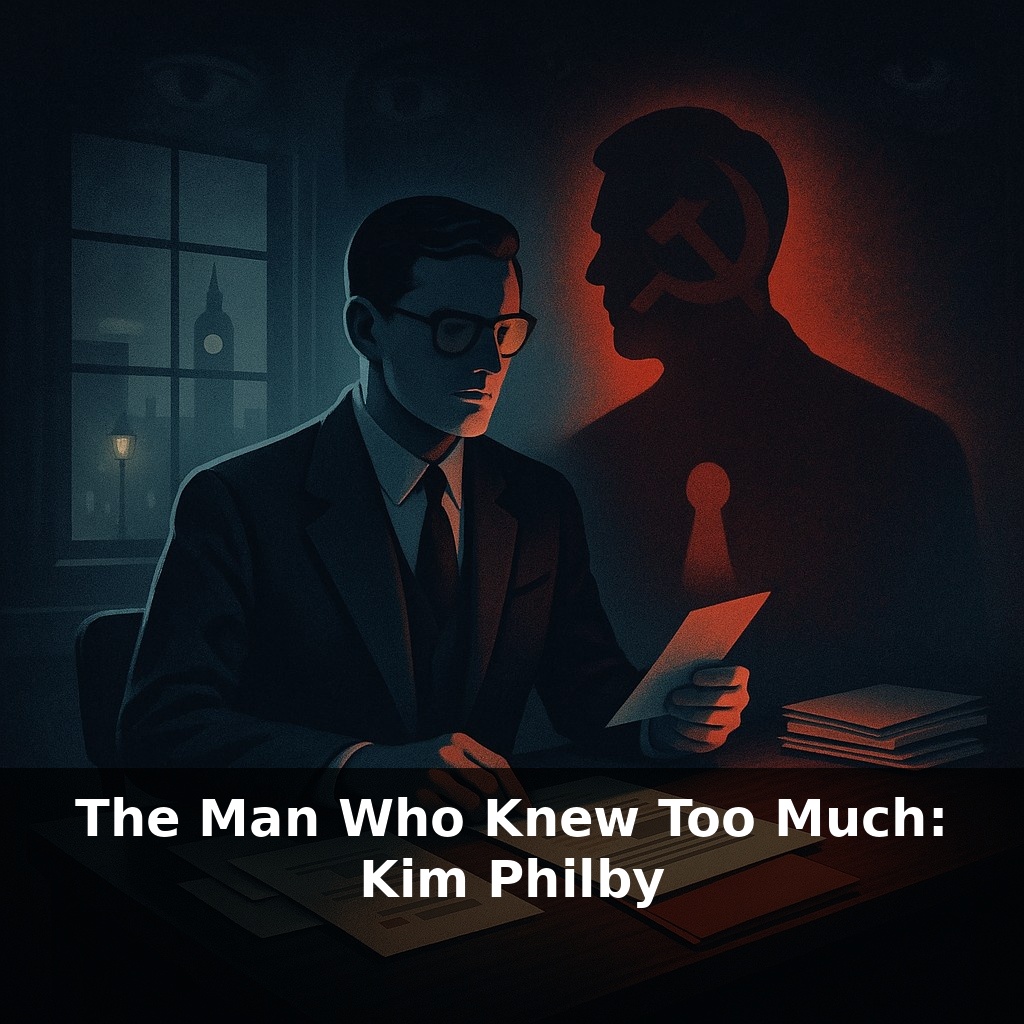
A British spy once led the very department hunting Soviet moles—while secretly working for Moscow. Tonight, we drop into a quiet London office, where one charming, well-connected man reads top‑secret files… and silently decides which ones will live—or die.
Kim Philby did not look like a revolutionary. He looked like the system: well‑tailored suits, club ties, the easy manners of someone who belonged anywhere important decisions were made. That was his real weapon. While others broke codes or planted bugs, Philby learned how to blend so perfectly into Britain’s ruling class that he became almost invisible—like a shadow cast by the establishment itself.
Colleagues saw a war hero, a loyal patriot, the man who knew everyone worth knowing from Washington to Beirut. The Soviets saw something else: a long‑term investment with an extraordinary return. For decades, Philby sat at the crossroads of Western secrets and quietly redirected the flow. To understand how he pulled this off, we have to step back into the rarefied world that trained him, trusted him, and ultimately protected him—long after the first doubts appeared.
Philby’s story begins long before he ever handled a secret file. He grew up in a household where power politics was dinner conversation: his father advised Middle Eastern rulers, moved comfortably among princes and oil men, and treated borders as lines to be navigated, not obeyed. Elite schools followed, then Cambridge in the 1930s, where bright young men debated fascism, democracy, and Marx over port and cigarettes. In that charged atmosphere, communism could feel less like treason and more like a daring moral upgrade to a failing world order. Philby absorbed that mood deeply.
Philby’s path into Soviet service didn’t begin in some smoky back room with suitcases of cash. It started with quiet introductions at Cambridge. There, Soviet recruiters weren’t hunting for petty criminals; they wanted future ambassadors, editors, civil servants—the people who would one day run the system they hoped to subvert. Philby, clever and ambitious, fit perfectly. He was recruited in the mid‑1930s and given a simple brief: stop looking like a left‑wing activist and start looking like the kind of man the British state would trust.
He followed that script with unnerving discipline. He publicly broke with his earlier radical circles, cultivated conservative friends, even did freelance journalism that leaned respectably right. When civil war erupted in Spain, he went as a correspondent on the Nationalist side—the very camp backed by Hitler and Mussolini. It was a ruthless bit of theatre: while appearing to sympathize with fascists, he quietly reported to Moscow on German and Italian operations. A shell blast in Spain left him with shrapnel scars—and a reputation as a courageous anti‑communist reporter. The cover was working.
The Second World War opened doors that peacetime never would. Britain suddenly needed men who spoke languages, knew Europe, and could move easily in diplomatic circles. Philby, with his background and his apparent ideological “conversion,” seemed ideal. By the early 1940s he had slipped into MI6, not through a dramatic heist, but via recommendations from the right schools and the right clubs.
Inside, he progressed steadily. He started with tasks that looked mundane—organizing files, coordinating with other departments—but each step brought him closer to the heart of British strategy. He learned how reports were graded, which ones senior officials actually read, how intelligence flowed from raw intercepts to polished assessments on ministers’ desks. The bureaucracy became his map.
Think of a seasoned conductor learning every section of an orchestra: who comes in when, who follows whose lead, where a single missed cue can distort the whole piece. Philby did that with the machinery of secrecy. By the time the war was ending, he wasn’t just another officer. He was positioned to shape what was seen as credible, what was dismissed as noise—and which carefully chosen fragments would, without a trace, drift east to Moscow.
Philby’s real talent surfaced once he could quietly steer not just documents, but decisions. In Washington, he charmed his way into informal lunches where CIA officers vented about stalled operations and turf wars—details that never made it into cables but were priceless for Moscow’s planners. In London, he chaired meetings where a raised eyebrow or a well‑timed “that source seems unreliable” could bury a report hinting at Soviet penetration.
He also learned to exploit the human desire to be understood. Junior officers confided in him because he listened without judgment; seniors liked that he anticipated their preferences and trimmed briefings accordingly. Over time, colleagues stopped double‑checking his summaries. Why would they? The polished, slightly world‑weary Philby felt as natural in their world as rain in an English winter: always there, rarely questioned. When he later moved to posts in Washington and Beirut, that same ease travelled with him, turning new environments into familiar stages where the script was already his.
Philby’s story lingers because it blurs the line between loyalty and performance. He showed that the most dangerous breach may look like a model employee whose access slowly widens, like a river quietly eroding its banks. In an age of AI, that erosion might appear as subtle data patterns: tiny timing shifts in log‑ins, oddly selective searches, unusual clusters of contacts. The frontier isn’t just stronger walls; it’s learning to read these ripples without drowning in false alarms.
Philby died in Moscow, toasting visitors while the regime he’d backed began to thin like mist. His life leaves a harder puzzle than “traitor or hero.” The sharper question: who, today, sits so naturally inside your own systems that scrutiny feels impolite? Your challenge this week: trace one “trusted” process to see who could quietly reroute it.
From this course
Spies, Lies, and Espionage: Secrets of the Cold War
8 episodesUnlock all episodes
Full access to 8 episodes and everything on OwlUp.
Subscribe — $1.99/monthLess than a coffee ☕ · Cancel anytime