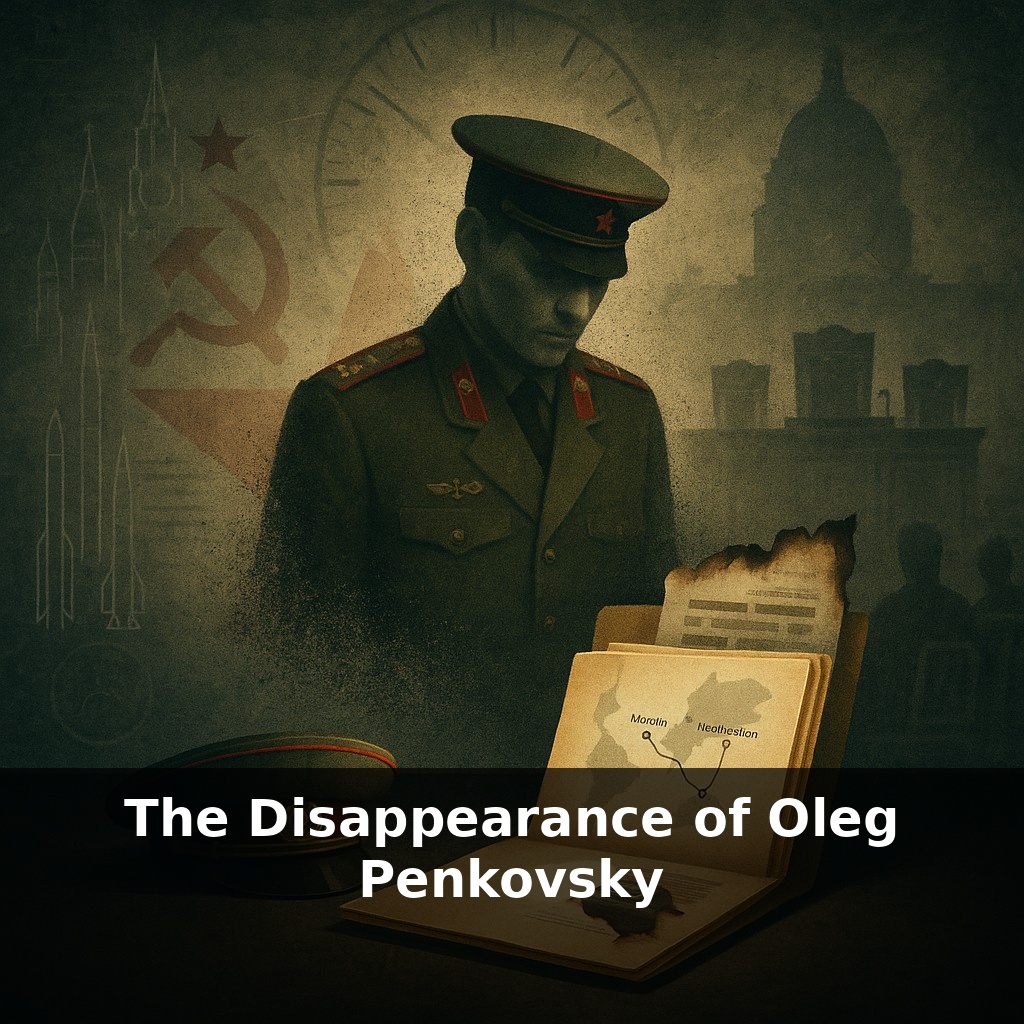
A Soviet colonel once handed the West so many secrets that, for a brief moment, Washington knew more about Moscow’s missiles than many Soviet generals did. Yet after his secret trial, he simply…vanished. No grave. No photos. Just a name: Oleg Penkovsky.
The mystery around Penkovsky doesn’t start with his last day; it starts with how far he was willing to go before that. Colleagues recalled a man who seemed almost too eager to impress foreigners, a career officer who understood exactly how lethal his betrayal would be—and did it anyway. He cultivated Western contacts in Moscow’s diplomatic circles, slipping between receptions and backstreet meetings like a commuter changing trains, each stop taking him farther from the world that trained him.
His reports didn’t just list missile specs; they mapped the fears and weaknesses of the Soviet command itself: which generals were blustering, which factories were behind schedule, where launch crews were cutting corners. To Western analysts, it felt like suddenly tuning into a private frequency of the Kremlin’s anxieties. And once that signal went silent, the question was never just how he died—but who decided what story the world would hear.
By 1962, Penkovsky’s world ran on two clocks. On one, he was a decorated insider, still attending Party functions and smiling in official photos. On the other, he moved to the rhythm of dead drops, brush passes, and coded phone calls, each second weighted with risk. Western handlers studied his reports like meteorologists staring at storm charts, watching pressure lines tighten over Cuba and Berlin. Inside Moscow, counterintelligence officers were plotting, too—combing guest lists, tailing diplomats, tracing the faint footprints of a leak they knew existed long before they knew his name.
main_explanation: When Western services first read Penkovsky’s material, they didn’t quite believe it. Moscow had spent years projecting an image of endless rockets and invincible arsenals; his documents sketched something messier: gaps in deployment, delays in production, units that looked fearsome on parade but were thinly supplied in the field. Analysts cross‑checked everything—satellite images, signals intercepts, embassy gossip—waiting for the moment his story would break. It didn’t. Piece by piece, his reporting aligned with other fragments, until planners in London and Washington quietly rebuilt their war scenarios around his numbers.
That mattered most in October 1962. While U.S. reconnaissance planes snapped photos over Cuba, Penkovsky was in Moscow, answering dense, technical questions: how long it really took to fuel certain missiles; what a genuine launch site should look like when fully operational; which features in a photograph were camouflage and which meant “ready to fire.” His guidance helped distinguish bluster from imminent danger at the exact moment hawks were urging airstrikes. Declassified files later show phrases like “confirmed by IRONBARK” scribbled in the margins of crisis memos—IRONBARK being the project label attached to his stream of intelligence.
Inside the Soviet system, the search for that stream’s source was accelerating. Security organs tightened surveillance around foreign missions, rotated watch teams, and quietly reopened old personnel files. A minor procedural slip—an irregular phone call here, an unreported contact there—suddenly looked less like sloppiness and more like a thread to pull. Western case officers sensed pressure too: meetings were cancelled, routes changed, contingency plans dusted off. Penkovsky himself began signaling anxiety, yet kept volunteering for more: more questions to answer, more manuals to photograph, more assessments of who in the Soviet hierarchy might panic, and who might push the button.
His arrest in late 1962 closed the channel abruptly, but the story only grew larger in its absence. Internally, Soviet propaganda cast him as a textbook traitor, paraded in posters and security lectures as a warning. Abroad, he became something different: a case study in how one well‑placed insider can tilt the balance of a global confrontation, the way a sudden drop in barometric pressure can warn that a storm is about to break. The true scope of his contribution, and the precise script of his final days, would be argued over for decades—each new memoir or declassified page adding detail, but never quite settling what happened after the courtroom doors shut.
Penkovsky’s value wasn’t just in what he knew, but in when and how it could be used. Think of crisis decision‑making as a conductor facing an orchestra that might, at any second, burst into chaotic noise. He wasn’t writing the score; he was slipping the conductor the real tempo markings, so the brass in Washington and the strings in London didn’t come in with the wrong, lethal intensity. That timing shaped specific calls: how long leaders could safely wait before responding to new Soviet deployments, how seriously to treat sudden alerts from radar stations, how to rank competing threats when resources were finite.
His disappearance, too, became operational data. Western services studied every tiny scrap—the pace of official announcements, the silence around a burial site, even the style of Soviet press condemnations—as clues to Moscow’s internal procedures for handling high‑level defection. Later mole hunters and analysts built checklists from his case: which personality traits to flag, which workplace frictions might hint at a future Penkovsky, how quickly damage spreads when such a figure finally breaks cover.
Intelligence services study Penkovsky less as a martyr and more as a prototype. His case reshaped how agencies weigh risk: is one insider worth the political firestorm if exposed? As surveillance tightens and data floods in, a single trusted human can still act like a tuning fork, revealing where an adversary’s story goes off‑key. Future “disappearances” may unfold faster, with digital trails and leaks exposing what Cold War regimes could bury for decades.
Penkovsky’s fate sits where archive and rumor overlap, a gap intelligence services quietly mine for lessons. Was he broken, bargained over, or staged as a warning? Each theory reveals more about the regimes proposing it than about the man himself. Like a river disappearing underground, his story resurfaces downstream in how modern states script the ends of their own traitors.
To go deeper, here are 3 next steps: (1) Read “The Spy Who Saved the World” by Jerrold L. Schecter & Peter S. Deriabin and, as you go, compare their account of Penkovsky’s GRU role and CIA/MI6 contacts with how the episode framed his motivations and downfall. (2) Open the CIA’s FOIA Reading Room and search “Penkovsky” to skim at least three declassified documents, focusing on how his intelligence was used during the run‑up to the Cuban Missile Crisis. (3) Watch the 2021 film “The Courier” and then pull up a short academic review or critique (e.g., from JSTOR or a history blog) to note at least three concrete differences between the movie’s portrayal of Penkovsky and the historical record discussed in the episode.