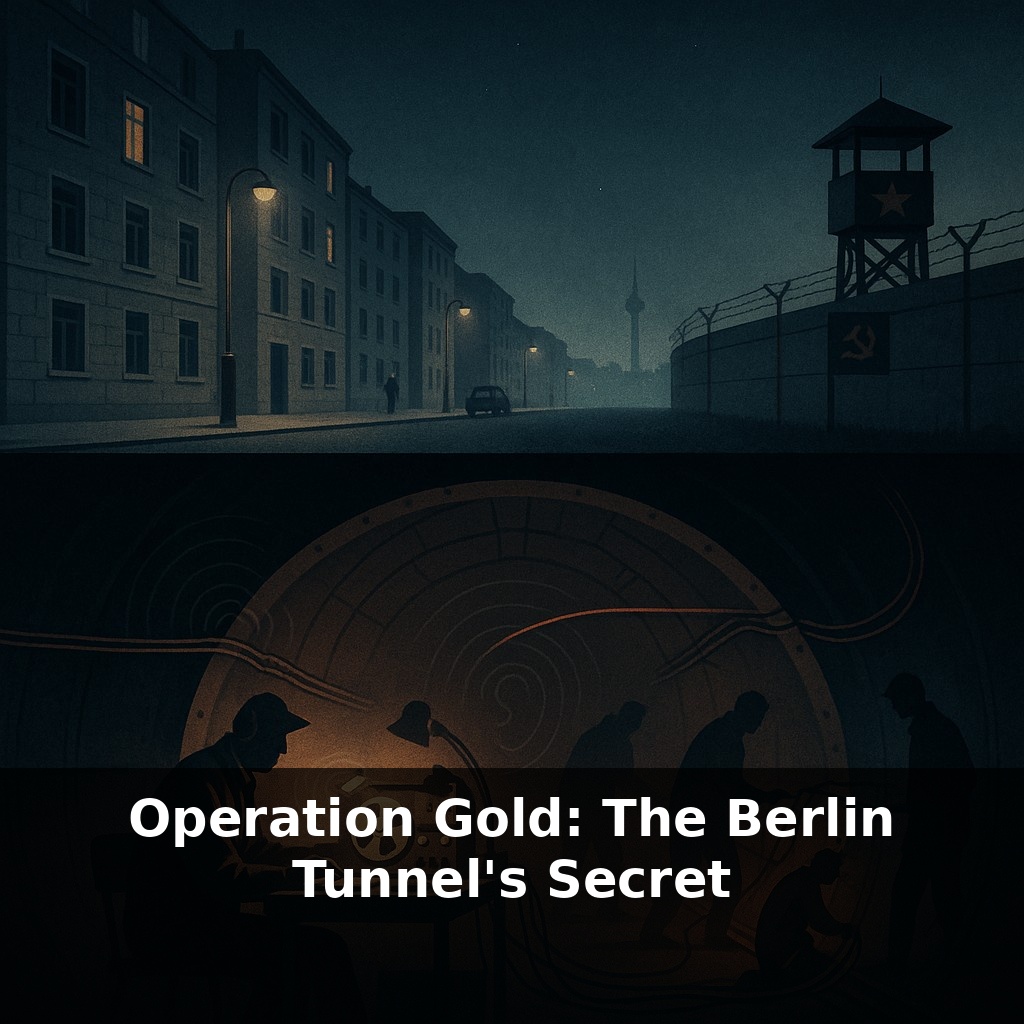
A tunnel longer than four football fields, dug in secret under Berlin, just to listen to phone calls. American and British spies worked night after night, knowing a single slip could start a war—while, on the other side, the Soviets quietly watched them do it.
They called it “the finest listening post ever constructed,” but from street level almost nothing betrayed that history was being siphoned away underground. Engineers had to solve problems that felt less like cloak‑and‑dagger games and more like brutal construction puzzles: how do you move hundreds of tons of soil without changing the shape of the landscape, or keep heavy machinery quiet enough that a bored night sentry doesn’t raise an eyebrow? Every decision—where to dump mud, when to schedule truck runs, which cover story to give a curious local—became part of a delicate choreography, like trying to play a full orchestra at whisper‑volume. And all of it unfolded in a city where the front lines of the Cold War weren’t trenches or barbed wire, but curbs, sidewalks, and basement walls shared by rival superpowers.
Above ground, the cover story had to be as solid as the concrete below. Officially, this was just a routine expansion of U.S. facilities near the sector border, the kind of dull infrastructure work that makes eyes glaze over. That boredom was part of the design: nondescript trucks, predictable schedules, workers who looked more like municipal crews than secret operatives. At the same time, planners mapped not only streets and basements, but habits—when locals walked dogs, when trams rattled past, when rain or wind could mask suspicious sounds, like using bursts of weather as brief, natural curtains.
To make all that surface‑level dullness pay off, the planners needed something precise hiding at the center: Soviet and East German cable junctions that carried high‑level military and diplomatic traffic. Locating them wasn’t guesswork. Technicians in safe rooms poured over captured maps, maintenance records, even tiny variations in pole markings and manhole covers. The goal was to predict exactly where the most valuable circuits ran—within inches—so that when the dig finally curved under the border, the crews would break into the right patch of earth, not just any patch.
Once they reached position, the job shifted from brute effort to delicate craft. Specialists opened a sealed chamber around the target cables and stripped back insulation like surgeons exposing arteries. They couldn’t cut anything; every phone and teleprinter on those lines had to seem untouched. Instead, they designed custom inductive taps—metallic “saddles” that nestled against the live conductors and siphoned off tiny electromagnetic echoes. Those traces were amplified, cleaned, and sent back along hidden lines to recording rooms in the Western sector.
Inside those windowless rooms, the operation looked less like a heist and more like a factory. Banks of reel‑to‑reel recorders spun day and night, tended by technicians who logged start times, circuit IDs, and glitchy moments when weather or line noise fuzzed the signal. Linguists and cryptanalysts sat one level removed, sorting the torrent: German, Russian, Czech; routine logistics versus rare glimpses of genuine strategic intent. A movement report for fuel trucks might seem mundane on its own, but cross‑checked with radio intercepts and satellite photography, it could reveal which armored units were being readied and where.
The strangest twist was that, on paper, almost nothing appeared dramatic. There were no car chases, no cinematic confrontations—just an accumulation of small, verified details: unit numbers, names of colonels, patterns in leave schedules, recurring code words. Over time, those fragments coalesced into something closer to a full score, letting analysts “hear” shifts in Soviet readiness and doctrine long before any public moves were made.
Analysts later described the material from the tunnel as “unromantic but relentlessly useful.” Instead of dramatic secrets about nuclear launch codes, much of it looked like scheduling clutter: fuel deliveries, rail timetables, staffing rosters, repair requests. Yet buried in that noise were the rhythms of an entire military machine. A sudden spike in messages about bridge inspections, for instance, could hint at planned troop movements. Repeated references to specific depots might flag which regions the Soviets quietly considered vulnerable.
The real artistry lay in pattern‑spotting. One historian compared it to listening to an orchestra through a wall and working out which piece is being played just from tempo changes and stray notes. A cluster of calls about leave cancellations here, a flurry of signals about ammunition stocks there—none dramatic on their own, but together suggesting an exercise, a border alert, or a doctrinal shift. Operation Gold’s haul became a training ground: future generations of analysts learned to treat the driest logistics chit‑chat as potential early‑warning radar.
Today’s cables are fiber strands under oceans, cell towers on rooftops, sensor grids in “smart” traffic lights. Instead of shovels, intruders bring firmware tweaks, rogue updates, a contractor with the wrong USB stick. The real frontier may be who quietly shapes these systems as they’re built—whose chips, whose standards, whose maintenance crews. Like wind bending tall grass, their influence can be invisible until you notice everything leaning the same way.
In the end, Operation Gold feels less like a one‑off stunt and more like a prototype for how power now hides in plain sight. Where concrete once mattered, code and standards do: routing tables, firmware defaults, “optional” diagnostics. They’re like faint ripples on a still pond—easy to ignore, until you realize they sketch who quietly owns the water.
Here’s your challenge this week: Recreate your own “Operation Gold” by running a 48-hour information-security drill on yourself. Today, map every digital “tunnel” into your life by listing every app, device, and service that could quietly collect or leak your data (think phones, smart speakers, messaging apps, cloud backups—your modern Berlin tunnel). Then, in the next two days, shut down or tighten at least five of those channels: turn off one always-on microphone, revoke location access for three apps, enable end-to-end encryption in your main messenger, and set strong, unique passwords for two critical accounts. At the end of the 48 hours, do a quick debrief: what “intelligence” about you would still be easy to tap, and what did you successfully “bury” like the tunnel cables under Berlin?