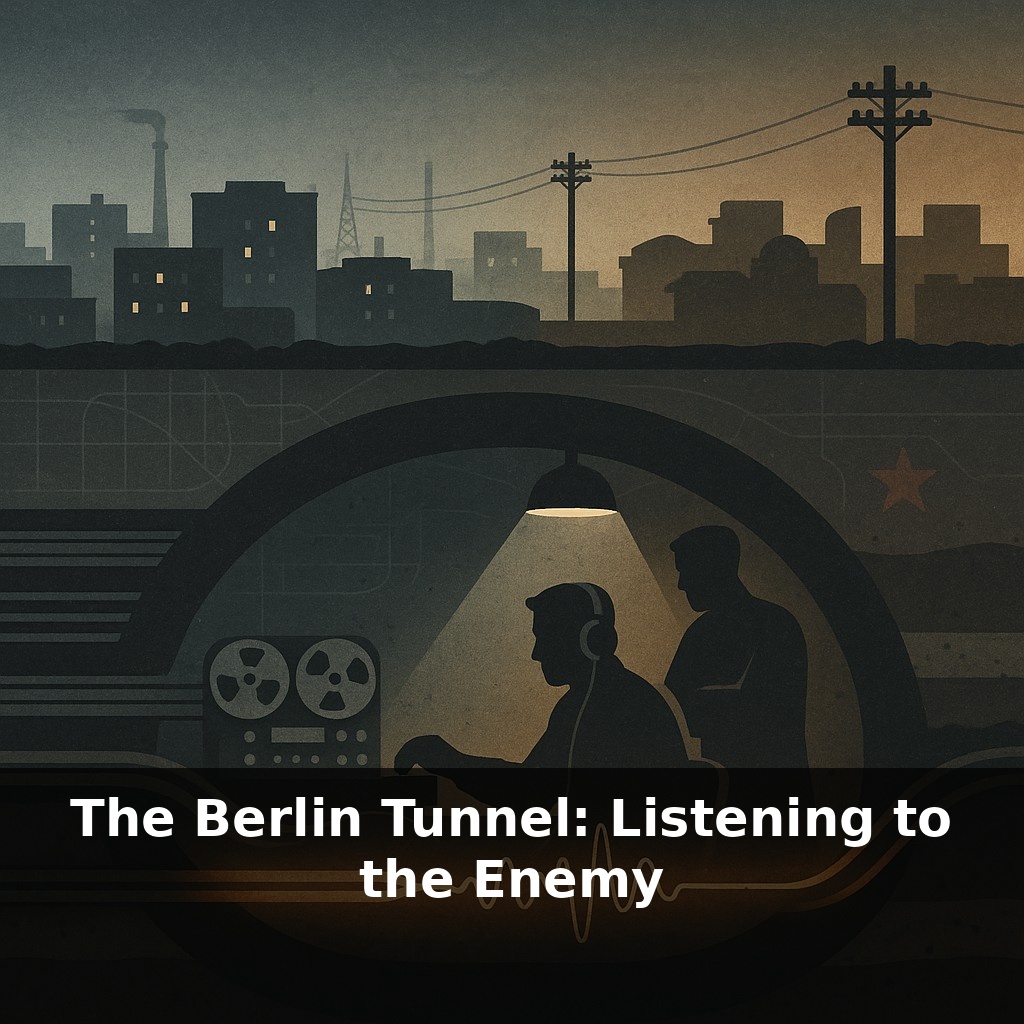
Somewhere under Berlin in the mid‑1950s, American and British spies listened to the Soviet Army breathe. Not just generals, but clerks, drivers, switchboard operators. For almost a year, every routine complaint and urgent command flowed through a secret tunnel they weren’t supposed to know existed.
It started with a problem no gadget could solve: radio waves could be jammed, codes could be broken or changed, but copper wire buried under Soviet streets was stubbornly loyal to Moscow. The most sensitive orders, troop movements, and logistics didn’t fly through the air; they crawled along those quiet landlines like ants along a hidden branch. So in 1954, planners in Washington and London stopped thinking like radio engineers and started thinking like miners. If you couldn’t beat Soviet security from the outside, you’d go underneath it—literally. The plan that emerged was less like a spy movie heist and more like digging a subway line in hostile territory, only your “passengers” would be conversations that were never meant to leave the ground.
Going underground in Berlin meant more than shovels and courage; it demanded accountants, architects, and physicists in equal measure. Before a single clod of soil moved, planners had to map where Soviet cables actually ran, estimate soil pressure, and calculate how far vibrations from a jackhammer might travel to a suspicious ear on the surface. Even the cover building above the dig site had to look dull enough to be ignored but busy enough to justify late‑night truck traffic, like a small factory that never quite shut its doors yet never made anything memorable.
The warehouse cover went up first: a “Berlin Operation Base” with a vehicle shed, an office or two, and a schedule that conveniently justified odd-hour deliveries. Under its concrete floor, engineers cut a hatch that opened onto something that officially did not exist: a sloping shaft dropping toward the East. The project needed to stay invisible not just to Soviet patrols, but to curious West Berlin neighbours and even most Americans stationed a few metres away. Only a tiny inner circle knew that each new crate of “equipment” actually held tunnel sections, pumps, or the specialized tools needed to work in a cramped, air‑starved tube.
The tunnel itself crept forward in prefabricated steel rings, bolted together like the spine of a metal worm. Workers dug in three shifts, often lying on their sides, passing muck back in small trolleys so the spoil could be hidden inside the warehouse and quietly trucked away. Groundwater seeped, timbers groaned, and every sound had to be tamed. Even a dropped wrench could, in theory, echo up through foundations and invite awkward questions. To outsiders, the site was tedious. To the small CIA–MI6 team below, it was a race between physics, fatigue, and the risk that somebody on the other side of the city might connect too many dots.
Reaching the Soviet cable routes was only half the job. Technicians had to open the clay‑packed ducts, strip insulation, and clamp on taps that would capture conversations without changing resistance enough to trigger alarms. The slightest miscalculation might distort a signal at a Soviet switchboard miles away, prompting an inspection. To make matters trickier, they couldn’t simply cherry‑pick a few “important” lines; no one in the West could predict which trunk would carry a sudden redeployment order or an offhand remark about new doctrine. So they took as many as they could reach, then faced a different problem: how to sift a flood.
That flood arrived as hissing, crackling audio and teletype pulses pouring into racks of recorders and demultiplexers in the supposedly dull warehouse. It was like trying to follow dozens of orchestras playing at once in adjoining rooms. Banks of tape machines ran almost constantly, tended by specialists who knew that a skipped reel or mislabelled spool might mean losing the one discussion analysts had been waiting months to hear.
To make sense of what they were hearing, analysts treated the raw take less like a stack of spy reports and more like shifting weather over Eastern Europe. Most days were informational “drizzle”: duty rosters, supply shortages, minor disciplinary issues. But patterns in that drizzle—repeated mentions of fuel stockpiles in one district, sudden silence from another—hinted at approaching “storms” long before any public thunderclap like a troop exercise or border incident.
They built routine out of this noise. A certain colonel’s gruff voice at 08:10, a logistics net that always sounded slightly overloaded on Mondays, a regional HQ that went oddly quiet whenever Moscow called. Every deviation became a clue. When a familiar “cloud pattern” broke—extra late-night circuits lighting up, unusual phrases creeping into otherwise dull traffic—analysts learned to lean forward.
The real art wasn’t catching a single dramatic phrase; it was recognizing when the entire atmospheric pressure of Soviet military life seemed to shift by a degree.
Today, the ghost of the Berlin Tunnel runs under cities and oceans. States quietly map where fibre trunks, data centres and 5G hubs really sit, the way artillery once marked bridges. Expect more “listening posts” fused into maintenance gear: a diagnostic box that also samples traffic, or a smart manhole sensor tuned for vibration patterns that scream tampering. As tunnelling tech shrinks and quiets, the real defence becomes noticing the tiniest, out‑of‑place scrape in the digital bedrock.
In the end, the tunnel feels less like a Cold War relic and more like an early rehearsal for tapping today’s fibre veins. The real legacy isn’t the cables they pierced, but the mindset: map the hidden routes, slip inside the routine, listen for tiny shifts. Like watching a river’s ripples to guess what swims beneath, the next “tunnel” may be pure software, but the questions stay the same.
Start with this tiny habit: When you plug in your phone to charge at night, spend 60 seconds imagining you’re an SIS officer planning the Berlin Tunnel and ask yourself one question: “What’s one ‘hidden wire’ in my day that quietly feeds me good intel (a person, a book, a newsletter)?” Then, before you walk away, tap one contact or open one source and star, pin, or bookmark it as “Priority Intel” for tomorrow. Each night, you’re not overhauling your life—you’re just reinforcing one trustworthy “line” of information, the way the tunnel tapped a single cable at a time.