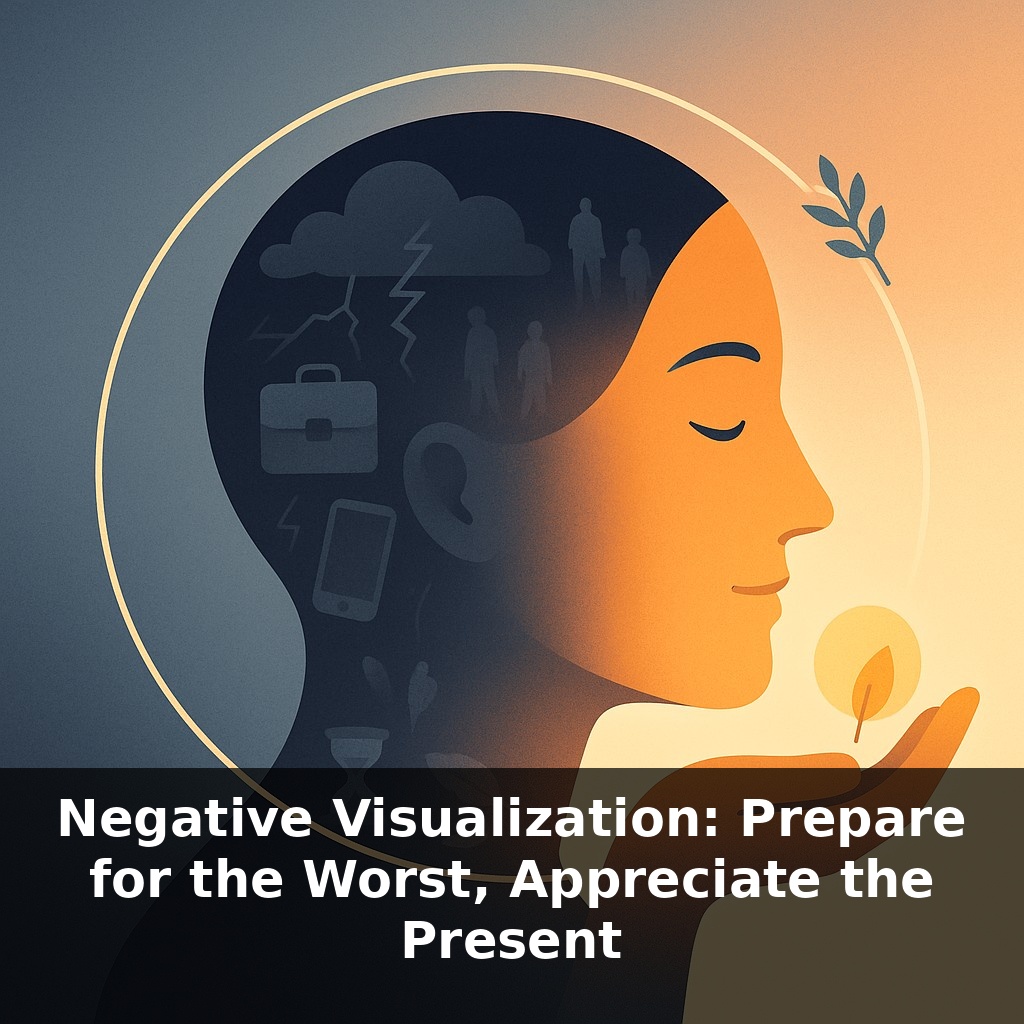
Your brain is calmer when you briefly think about bad outcomes than when you avoid them. Strange, right? A short, focused “worst case” tends to lower anxiety. So picture this: you lose your job, your phone, or someone you love. Stay with that thought—then notice what suddenly matters most.
Seneca took this further than a quick “what if it all went wrong” moment. He suggested regularly scanning the parts of life you quietly assume are permanent: health, relationships, work, status, even the ability to get out of bed unassisted. Not to brood, but to see how much of your mood rests on things you can’t fully control. Modern research quietly backs him up: when people briefly contemplate losing specific comforts, they report sharper focus, more deliberate choices, and a surprising drop in entitlement.
Think of ordinary routines: scrolling through your phone at night, snapping at a partner, half‑listening in meetings. Negative visualization slices through that autopilot. By contrast with an imagined loss, the “ordinary” evening or tedious Monday becomes more vivid. Over time, this shifts the question from “How do I keep everything?” to “How do I show up well for what I actually have today?”
Seneca’s twist is to keep this practice short and specific, like taking a quick inventory of what could vanish: the friend you assume will text back, the apartment you assume you’ll renew, the hands you assume will always be steady enough to make coffee. Modern studies echo this: brief, intentional contact with uncomfortable possibilities can boost resilience, creativity, and even performance under pressure. Used well, it’s less about scaring yourself and more about adjusting the lighting—dim the background comforts for a moment so the foreground of your life comes into sharper, truer focus.
Most people try to “stay positive” by pushing away unpleasant possibilities. The problem is that your nervous system doesn’t buy it. Suppressed fears leak out sideways as procrastination, irritability, or that vague dread you feel at 3 a.m. Negative visualization takes the opposite route: it gives fear a small, supervised window—so it doesn’t have to run the whole house.
The Stoics treated this like a mental drill. Seneca would deliberately call to mind specific areas of potential loss, then return to his day. Modern research suggests why that works. When you briefly simulate a setback, your brain starts quietly running “if‑then” scripts: If I lose this client, then here’s my backup plan; if this relationship ends, then here’s who I’d lean on. That planning response seems to reduce the sense of being ambushed by life, which is where much of raw panic comes from.
Crucially, this isn’t open‑ended catastrophe fantasizing. Studies on defensive pessimism show that people who picture things going wrong—but then move into preparation—perform better under pressure than sunny optimists who never mentally rehearse obstacles. The visualization is a trigger for problem‑solving, not a cue to spiral.
You can aim it at very different layers of your life:
- Micro level: today’s presentation, a difficult conversation, a tight commute. - Meso level: this quarter at work, a key project, the next six months of a relationship. - Macro level: career collapse, serious illness, financial shocks, aging and death.
Each tier calls forth a different kind of wisdom. On the micro level, you notice concrete fixes: “If the slides fail, I can speak from a one‑page outline.” On the macro level, you meet values questions: “If my status dropped tomorrow, who would I still be trying to be?”
The University of Toronto trial (which needs replication) hints at something else: gains compound. Participants didn’t just feel less anxious; they reported more gratitude and clarity about priorities. It’s as if regularly touching the edge of loss resets your internal scoreboard away from petty comparison and toward, “What do I actually want to protect and nurture?”
Like a medical vaccination that introduces a weakened pathogen to train your immune system, this practice introduces a safely contained dose of fear. Done consistently, you don’t become morbid; you become hard to rattle, easier to please, and quicker to act where it truly counts.
A useful way to test this is to tie it to very specific situations you already care about. Before a big meeting, you might quietly picture arriving late, fumbling your notes, or forgetting your main point. Rather than freezing, most people find this nudges them to leave ten minutes earlier, print a backup outline, or open with one clear sentence they can’t lose. Before opening social media, briefly consider losing access to your account and all its validation; see whether that shifts how urgently you feel the need to check it. With someone you love, you could, for a moment, imagine this as the last conversation you’ll have in this mood, on this ordinary day. Notice what you choose to say—or not say—next. Athletes sometimes do a version of this by rehearsing false starts and slips on the track, then calmly resettling into their form. In daily life, you’re doing something similar with your character: rehearsing small stumbles so your response, not the setback, becomes the most memorable part.
Instead of staying a private habit, this could quietly reshape institutions. Therapists might prescribe short, app‑guided drills before known stressors, like a social “warm‑up set.” HR teams could weave scenario rehearsals into onboarding, so setbacks feel like variations on a practiced script, not personal failures. Over time, leaders who train this way may make bolder, cleaner decisions—less driven by ego defense, more by “If this all vanished tomorrow, what would still be worth doing today?”
Let this be a quiet counter‑habit to autopilot living. When your mind starts replaying worries, test steering it instead: short, chosen “loss drills” beside the usual unchosen fears. Over weeks, you may notice priorities rearranging themselves, like books sliding into a neater order on a shelf you never realized was crooked. Curiosity, not control, becomes the point.
Try this experiment: Tonight, set a 5‑minute timer and vividly imagine that tomorrow you wake up having permanently lost one thing you totally take for granted right now—your ability to see, your smartphone and all its data, or your job. Walk through an ordinary day in detail with that loss: getting dressed, commuting, eating, talking to people—really notice the specific inconveniences, emotions, and ripple effects. When the timer ends, immediately use that thing (look around your room, scroll your phone, or review your calendar) while silently saying “I still have this” three times and notice how your mood and behavior shift for the rest of the evening. Repeat with a different “loss” for three days and compare which one most strongly boosted your appreciation and changed your choices.