A Harvard study found that simply naming a feeling can cut its intensity almost in half. Now, hear this: one rude email, and your heart races; one kind text, and your whole body softens. Same nervous system—totally different stories. So what, exactly, are your emotions trying to tell you?
You fire off a sharp reply, slam a door, say yes when you mean no—and only afterward think, “Why did I do that?” Neuroscience has a blunt answer: your emotions acted faster than your story about them. But here’s the part most people miss: “faster” doesn’t mean “in charge.” That first wave is automatic; the second and third waves are where your power sits.
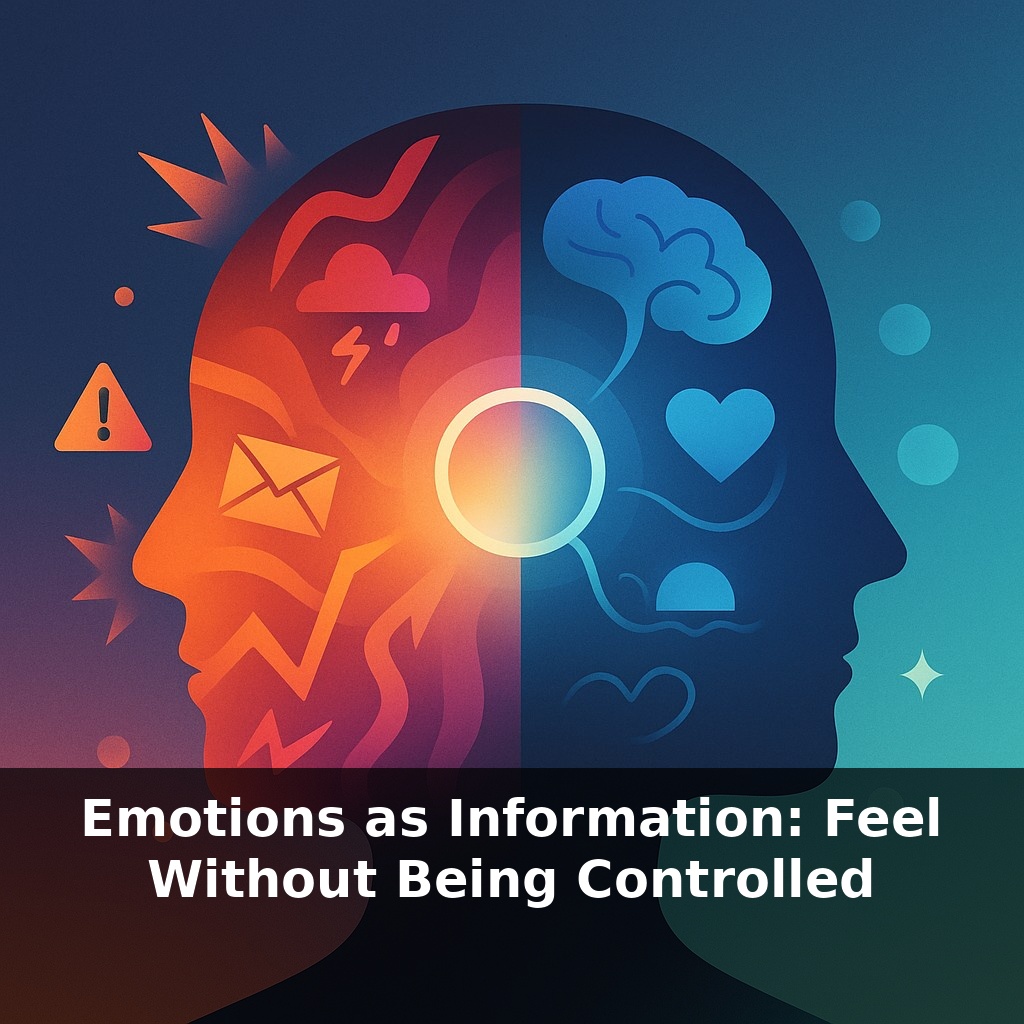
Stoics treated feelings as signals, not commands—closer to notifications than orders. Modern research backs this up: attention and interpretation decide whether anger becomes a boundary, or a grudge; whether anxiety becomes preparation, or paralysis.
In this episode, we’ll treat emotions as data: how to read them, how not to obey them blindly, and how to turn that split-second gap between feeling and action into your most valuable skill.
To use emotions as information, we need to know what kind of information they carry. Anger often flags a perceived boundary violation; anxiety points to uncertainty or something you care about; envy can reveal a value or goal you haven’t owned yet; guilt may signal misalignment with your standards—or just people-pleasing. Instead of asking, “How do I stop feeling this?” a more Stoic, and scientifically savvy, question is, “What is this feeling pointing at right now?” That tiny shift moves you from wrestling the emotion to interrogating the message underneath it.
Here’s the catch: information is only useful if you can read it before it runs you. That’s where the split-second relay race inside your brain matters. The amygdala bolts off the starting line, but the prefrontal cortex can still overtake it—if you train it to show up fast and often.
The Stoics called this training “prohairesis”: your faculty of choice. Today we’d call it a set of skills you can practice on Tuesday afternoon at work, not just on a mountaintop.
Three skills matter most:
1. **Spot the flare, not just the fire.** Most people only notice emotions once they’re at “slam the door” level. But the brain gives earlier clues: tightening jaw in a meeting, scrolling faster when anxious, talking louder when threatened. These are your “pre-actions”—tiny, semi-automatic moves that tell you you’re about to do something you’ll have to apologize for. Catching these is like noticing the “low fuel” light instead of waiting to stall on the highway.
2. **Name the *pattern*, not just the feeling.** You already know labeling a feeling helps. Go further: label the *trigger + story* pair. “Tension + authority figure + ‘I’m about to be judged.’” “Drop in mood + social media + ‘Everyone’s ahead of me.’” Now your emotion isn’t a fog; it’s a map. You can’t control the appearance of sadness or irritation, but you can absolutely audit the recurring story it drags in with it.
3. **Ask the Stoic-CBT question: ‘Useful, accurate, or just loud?’** When a strong feeling shows up, run it through three filters: - **Useful?** Does this help me protect a value, relationship, or goal? - **Accurate?** Does the intensity match the actual stakes? - **Just loud?** Is this mostly old wiring replaying itself? An email from your boss may trigger the same inner siren as real danger. You don’t argue with the siren; you check whether there’s actually smoke.
Here’s where emotional intelligence becomes strategic, not sentimental. People who can do this consistently don’t *feel* less; they convert raw reactions into better moves. That’s one reason those high in EI tend to earn more: they stay in the meeting, negotiation, or conflict long enough for the prefrontal cortex to steer, while others are still busy defending, withdrawing, or exploding.
Your goal is not to mute emotion, but to become a sharp, skeptical reader of it—keeping the data, dropping the drama.
You’re in a meeting. Someone interrupts you, and your chest tightens. Instead of snapping, you quietly note: “Heat in face, urge to cut them off, thought: ‘They don’t respect me.’” That simple inventory turns a knee‑jerk reaction into a data point.
Use the same approach in small, low‑stakes moments first. A delayed train, a slow cashier, a partner on their phone. In each case, zoom in on two things: 1) **What I did in the next 10 seconds** 2) **What I seemed to be protecting** (status, time, image, belonging).
Over a week, you’ll start seeing recurring “protective moves”: sarcasm to guard pride, over‑explaining to guard approval, going quiet to guard safety.
One analogy, then we move on: like a weather app, your brain keeps updating its forecast based on past storms. If you always “predict” rejection, you’ll carry an umbrella into clear skies—and miss opportunities. The practice isn’t to ignore the forecast, but to keep asking, “Given today’s conditions, is this still the right gear?”
Future implications
As emotion-reading wearables, workplace dashboards, and AI “mood mirrors” spread, your inner stance will matter more than the gadgets. Data may warn: “frustration spike with this teammate,” but only you can decide whether to renegotiate roles, upgrade skills, or exit. Schools already rehearse these choices through SEL drills. In an automated economy, promotions may favor those who can sit with a hard feeling like a coach during a timeout—steady, curious, still running the play.
Your challenge this week: when a strong feeling hits, respond like a scientist, not a judge. For seven days, jot a one‑line “hypothesis”: what this emotion might be pointing to (a need, crossed line, or value). Later, test it against reality. Over time, you’re not chasing moods—you’re refining a compass for what actually matters to you.