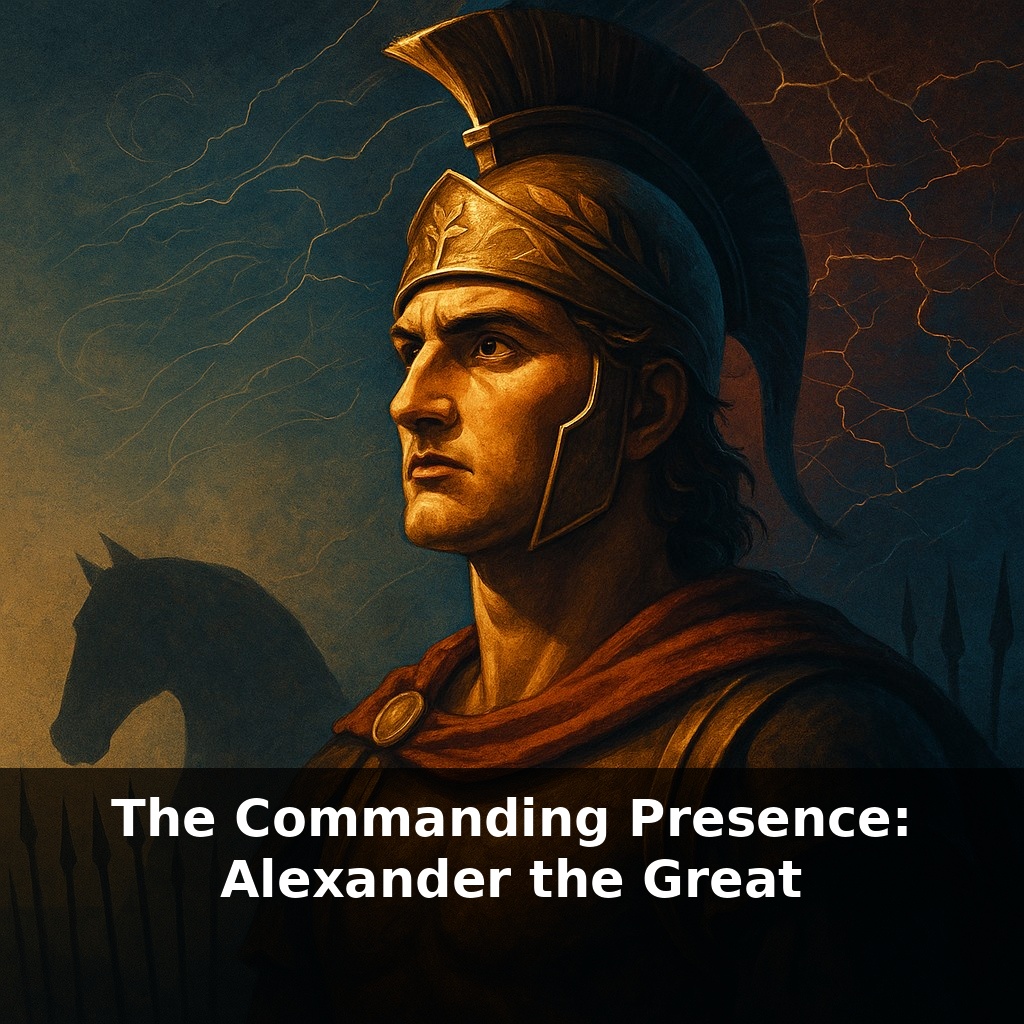
The Commanding Presence: Alexander the Great
📝 Transcript
A king in his early twenties rides straight into a wall of enemy spears—and instead of dying, he breaks the world’s largest empire. Why did tens of thousands follow him, again and again, into almost certain death? And what, beneath the legend, made his presence so commanding?
Alexander didn’t start with presence; he engineered it. Before campaigns, he studied enemy customs so precisely that his arrivals felt less like invasions and more like storms locals had long expected. He learned names of minor officers, rewarded small acts of courage publicly, and turned campfires into rumor factories about his stamina, injuries, and near-mythic endurance. Think of how a sudden cold front reshapes an entire coastline: one shift alters tides, shipping routes, even daily routines. In the same way, every choice—from the cut of his armor to how quickly he appeared after a setback—was calibrated to shift how people felt when he entered a space. Not by accident, but by design. In modern terms, what looks like “natural aura” was often a careful stack of habits, signals, and stories that compounded over time into something that felt unstoppable.
Alexander also understood that presence without performance collapses fast. His troops watched what happened after the speeches: rations arrived on time, scouts returned with accurate reports, bridges were already half-built before they reached the river. Behind the scenes, he obsessed over routes, supply depots, even how tired horses would be after a steep pass versus a gentle one. It’s like running a restaurant where the lighting and music draw people in, but what keeps them talking about you is the meal arriving hot, correct, and fast—night after night, no excuses, no surprises.
Alexander’s real edge was how he fused bold vision with microscopic detail. The vision wasn’t just “go farther than anyone else.” He sold his troops on a narrative: they weren’t merely plundering; they were rewriting the map of the known world. That story did two things at once: it made hardships feel like investment, and it made personal risk feel meaningful rather than random.
But vision alone doesn’t explain why veterans kept trusting his judgment after brutal marches and near-mutinies. The glue was how he used **sequence and timing**. He’d alternate audacious moves with periods of consolidation. After a dangerous river crossing or forced march, he didn’t immediately demand another sacrifice; he’d grant rest, distribute rewards, or stage rituals that signaled, “What you just did mattered.” The pattern taught his army that extreme effort would be followed by tangible recognition, not endless grind.
He was also ruthless about **who saw what, and when**. After a setback, he didn’t disappear into a tent; he became more visible in very specific ways—riding the lines, visiting the wounded, convening councils. But arguments with senior officers, doubts, and messy deliberations stayed in smaller circles. To the rank and file, the sequence was: shock, visible stability, then clear next steps.
Notice how often he linked **symbolic gestures** with operational decisions. Adopting elements of Persian dress came bundled with promotions for local elites and mixed units of Macedonian and Asian troops. The signal and the system changed together. When leaders change symbols without touching systems, people feel manipulated. When they change systems without symbols, people miss that anything changed at all.
Underneath the campaigns was a kind of **rhythm management**: push, pause, honor, adapt, then push again—like a tide that withdraws just enough to gather force for the next wave. Modern teams feel this too: they don’t only track what targets you set, but how you pace demands, acknowledgments, and course corrections. Over time, that rhythm becomes a prediction engine in your people’s heads: “When things get tough, this is how we move.”
Alexander’s campaigns offer some unexpectedly modern parallels. Think of a product launch at a fast-growing startup: the CEO doesn’t just unveil features; they choreograph early access for power users, sync PR with engineering readiness, and line up customer success to handle the surge. That’s close to how Alexander treated a risky offensive—scouts, engineers, and reserves each “entering” at a precise moment, so bold moves felt strangely safe to his troops.
You can see a similar rhythm in how Netflix rolls out experimental features to limited regions before going global, or how SpaceX iterates rocket designs through visible failures followed quickly by upgraded tests. The pattern teaches observers: “When we stretch, we stabilize right after.” Leaders who ignore that sequence—demanding continuous stretch without visible consolidation—burn out their best people first. The presence you project in a crisis is really just the surface ripples of the deeper pattern your team has learned to expect from you over time.
A curious twist: as tools mimic more of a leader’s “presence,” followers may grow more sensitive to tiny cues that can’t be faked—who shares risk, who changes course after bad news, who credits others. Think of culture as a field of snow: every decision leaves tracks, and people learn to follow specific paths. In hybrid teams, that trail is scattered across chat logs, video calls, and dashboards. The next edge won’t be louder signals, but cleaner, more consistent tracks.
Building on Alexander's approach to presence, his edge wasn’t mystique; it was repeatable design. He treated every campaign like a prototype, stress‑testing what earned trust and discarding moves that rang false. Your equivalent might be how you handle a setback on a Tuesday afternoon: the brief Slack note, the follow‑up call, the small, specific promise you keep. Those tiny, boring beats are where legends quietly start.
To go deeper, here are 3 next steps: (1) Watch historian James Romm’s lecture “Alexander the Great: Lessons in Strategy and Leadership” (search it on YouTube) and pause after each major campaign (Granicus, Issus, Gaugamela) to list the concrete leadership moves he made in that battle, then compare them to how you currently lead under pressure. (2) Read the first 3 chapters of *Alexander the Great* by Philip Freeman and, with a highlighter, mark every instance where Alexander uses presence (body language, ritual, symbolism, silence) instead of words, then experiment with one of those techniques in your next meeting or conversation today. (3) Open Google Earth and trace Alexander’s route from Pella to Gaugamela using pins; at each stop, quickly Google the city’s name and note what political or cultural challenge he faced there—this will give you a visual, strategic map of how he expanded his influence step by step, rather than seeing his career as one big myth.
From this course
Strategic Leadership Lessons from Military History
5 episodesUnlock all episodes
Full access to 5 episodes and everything on OwlUp.
Subscribe — $1.99/monthLess than a coffee ☕ · Cancel anytime