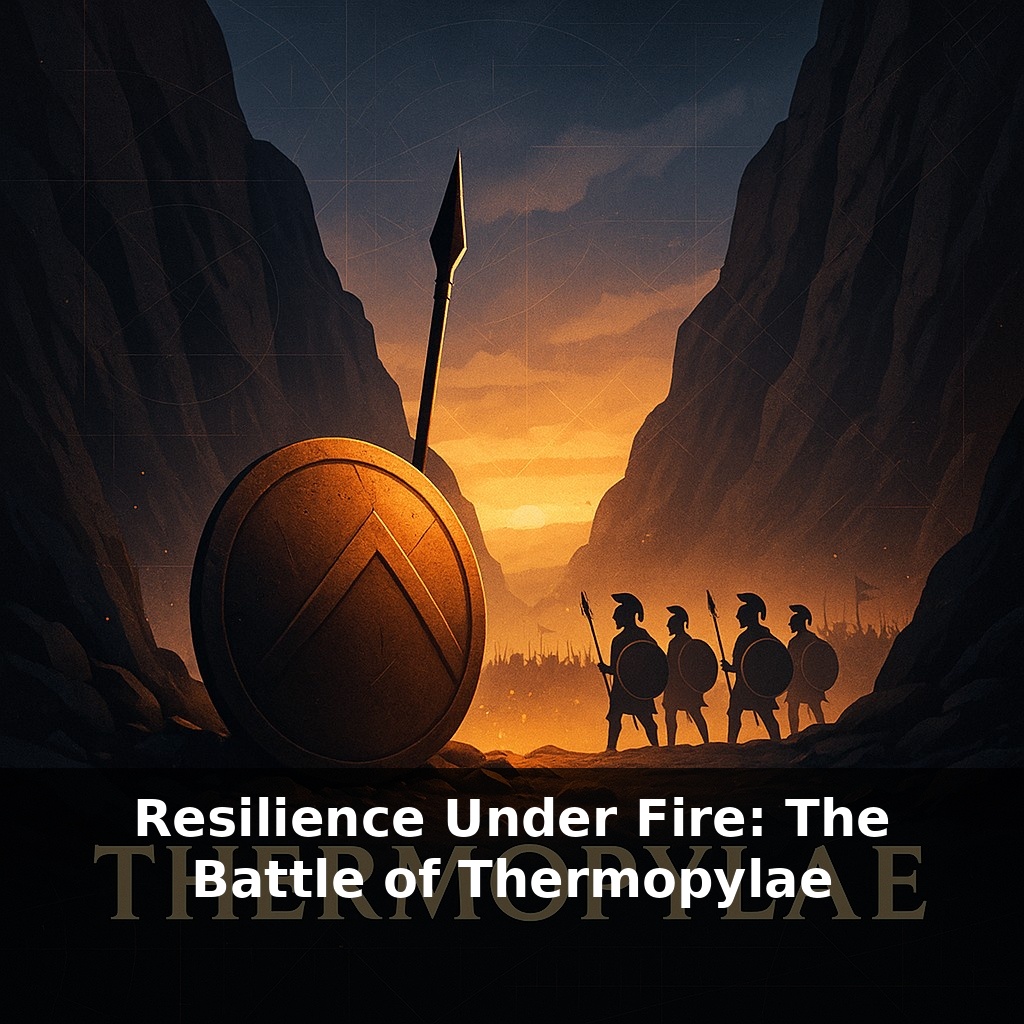
Thermopylae was a narrow pass where a few thousand Greeks blocked an empire. In this episode, we’re not chasing hero worship. We’re asking a harder question: how do small, outmatched teams keep showing up when logic says they should already be crushed?
Modern psychologists might call what happened there “collective resilience under extreme uncertainty.” The Greeks didn’t know the exact Persian numbers, the timing of their naval allies, or whether their stand would spark wider resistance. What they did know was this: retreating would hand Xerxes a clear road into central Greece.
So leaders improvised. They rotated units like marathon relays, using fresh contingents to absorb shock while others recovered. Leonidas used simple, repeatable messages—who they were, why they were there—to keep fear from fracturing cohesion. And when a local revealed a flanking path, they didn’t dissolve into blame; they re-planned under fire, deciding who would stay, who would withdraw, and how to buy a few more crucial hours for everyone else.
What often gets missed is how deliberately the Greeks structured their resistance. City-states that normally bickered over trade and pride agreed to a joint command, shared supply lines, and a rough division of roles between land and sea forces. That coalition work was messy; some allies argued for falling back, others for more aggressive strikes. Yet they maintained a minimum of unity long enough to matter. Think of it like an orchestra under pressure: not every musician loves the conductor, but they still have to hit the same notes at the right time or the whole performance collapses.
Numbers alone don’t explain why that coalition didn’t unravel on day one. The deeper story is how leaders turned a looming disaster into a *shared frame* that made hardship feel meaningful instead of pointless.
Start with clarity of purpose. The Greek commanders didn’t promise victory; they promised time—time for cities to evacuate, for fleets to coordinate, for wavering allies to decide. That narrower, realistic aim turned an impossible task into a hard but graspable one. In modern terms, they shrank the goal from “win the war at the pass” to “buy every extra hour we can.” Teams under pressure cope better when the target is specific, bounded, and honest.
Next comes constraint design. The pass forced the Persians into a smaller frontage, but the Greeks also imposed *behavioral* constraints on themselves: no one city-state could simply cut a side deal and walk away without consequence; commands ran through an agreed structure; units had understood turn-taking in the line. Under stress, people regress to self-preservation. Structure channels that impulse so it serves the group instead of shattering it.
Then, adaptive problem-solving moved from individual heroics to coordinated experiments. Scouts probed enemy habits. Engineers quietly reinforced weak spots. When Persian tactics shifted, the defenders didn’t rely on a single genius plan; they ran a series of small, fast adjustments, learning with each clash. Resilient groups treat each setback less like a verdict and more like fresh data.
Crucially, leaders modelled how to carry fear without letting it hijack judgment. Leonidas and others spent their last morning not on grand speeches, but on mundane tasks—orders, logistics, positioning. That normalcy amid chaos signalled: “We still have choices. We still have work.” People don’t need guaranteed safety to stay functional; they need to feel their actions still matter.
Like a coastline breaking up a huge incoming wave into smaller, manageable surges, this combination of clear purpose, smart constraints, iterative learning, and calm example didn’t stop the storm—but it kept the defenders from being swept away all at once.
Resilience like this shows up in quieter places too. In 2008, when Airbnb was close to running out of cash, its founders didn’t promise investors instant dominance. They narrowed the mission: survive the next few months, city by city. They personally photographed hosts’ apartments in New York, learning what made listings work, then turned those scrappy lessons into a repeatable playbook. Each weekend wasn’t do-or-die for the whole company; it was one more chance to “buy time” and refine the model.
You can see a similar pattern in hospital emergency departments facing seasonal surges. They don’t fantasize about eliminating all bottlenecks. Instead, leaders define a modest, high-impact aim—say, getting triage times under a specific threshold—then redesign shifts, hallway layouts, and communication norms to support that. Staff test micro-changes across a few days, keep what works, discard the rest. The result isn’t glamour; it’s a culture where difficulty is expected, mapped, and steadily reworked into something survivable.
Resilience research suggests the real opportunity is *before* the next crisis hits. High‑reliability teams run “pre-mortems,” stress-testing plans the way engineers stress-test bridges against rare storms. Leaders can borrow this by treating small disruptions—a supplier delay, a systems outage—as live-fire drills. Instead of hiding strain, surface it: ask what held, what cracked, and who improvised. Over time, those debriefs become sedimentary layers of know-how, turning today’s scramble into tomorrow’s quiet advantage.
Your challenge this week: run one “Thermopylae drill” with your team. Pick a likely future crunch point—a product launch, funding dip, or audit—and, for 30 minutes, war‑game *only* how you’d use limited time: what gets protected, what is deliberately sacrificed, and how you’d signal that choice. Notice where answers are vague; that’s where to fortify next.